
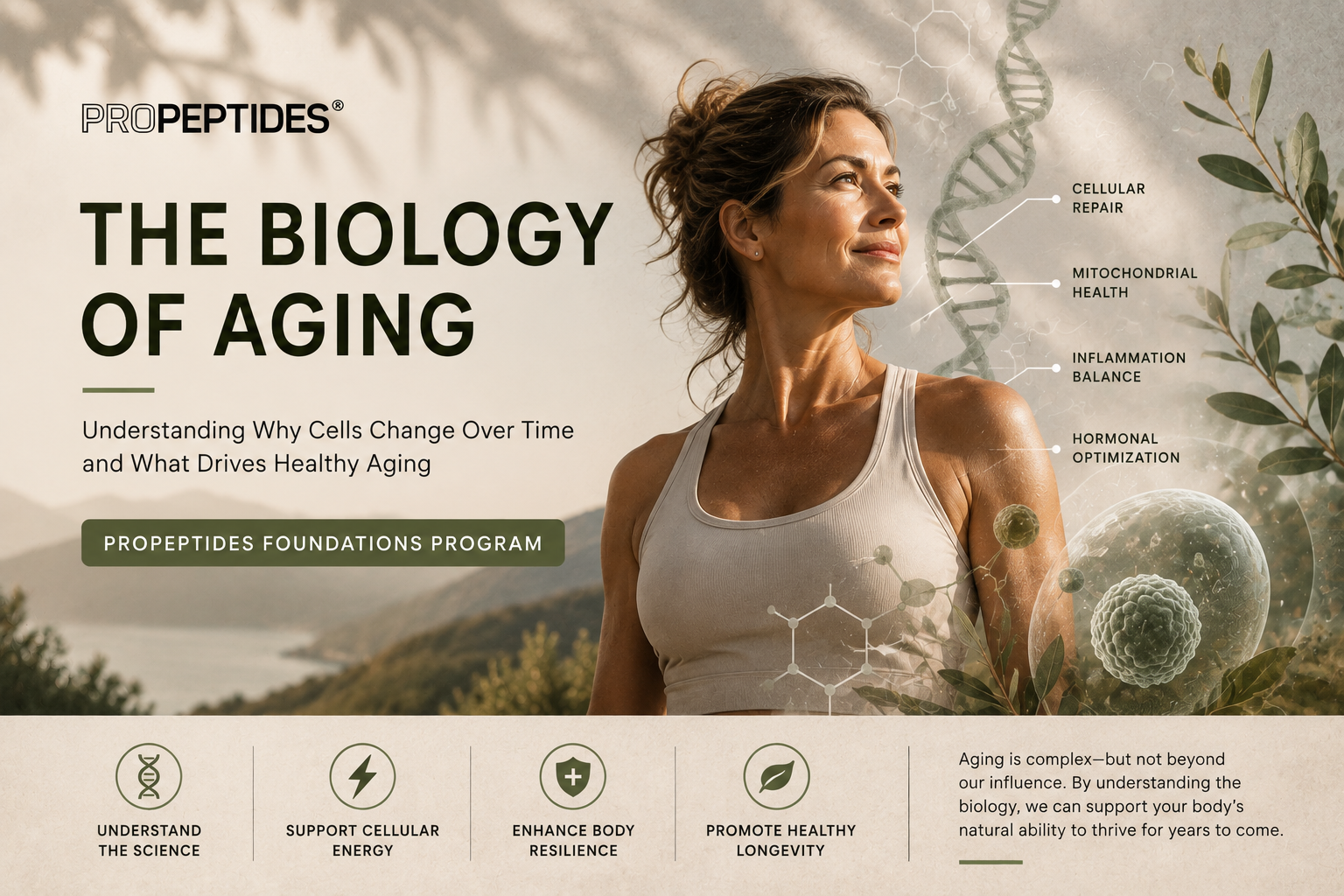
The Biology of Aging
Understanding Why Cells Change Over Time and What Drives Healthy Aging
PROPeptides Foundations Program
Introduction
Aging is often thought of as something that simply happens with the passage of time.
In reality, aging is the result of countless biological processes occurring continuously within every cell of the body. From the moment we are born, our cells are constantly repairing DNA, producing energy, replacing damaged proteins, communicating with neighboring tissues, and adapting to environmental stress. These maintenance systems allow us to grow, heal, learn, and remain resilient throughout much of life.
Over time, however, the efficiency of these systems gradually declines.
Damage begins to accumulate faster than it can be repaired. Cells communicate less effectively, tissues lose regenerative capacity, immune function changes, and the body's ability to recover from physiological stress becomes progressively diminished. The result is not a single disease, but a gradual loss of biological resilience that increases susceptibility to many chronic conditions associated with aging.
Modern aging research has transformed our understanding of this process. Rather than viewing aging as an inevitable consequence of time alone, scientists now recognize that aging results from multiple interconnected biological mechanisms, many of which are influenced by genetics, environment, lifestyle, and cellular signaling.
Understanding these mechanisms provides the foundation for nearly every area of longevity medicine, including peptide research.
Aging Is Not a Disease
One of the most important concepts in longevity science is that aging itself is not considered a disease.
Instead, aging represents a universal biological process characterized by progressive declines in physiological function over time.
Nearly every organ system experiences age-related changes, including:
Skeletal muscle
Bone
Cardiovascular system
Brain
Immune system
Endocrine system
Skin
Connective tissue
Mitochondria
These changes occur gradually and vary considerably among individuals.
Some people maintain excellent physical and cognitive function well into advanced age, while others develop chronic disease decades earlier. This variability illustrates that biological aging and chronological aging are not always the same.
Chronological Age Versus Biological Age
Chronological age simply measures the number of years a person has lived.
Biological age attempts to estimate how well the body's physiological systems are functioning relative to those years.
Two individuals may both be 65 years old chronologically while having very different biological ages.
Factors that influence biological aging include:
Physical activity
Nutrition
Sleep
Smoking
Alcohol use
Chronic disease
Environmental exposures
Genetics
Psychosocial stress
Because these factors differ widely between individuals, biological aging progresses at different rates throughout the population.
This concept has become central to modern preventive and longevity medicine.
The Hallmarks of Aging
Researchers have identified several recurring biological processes that appear to contribute to aging across many different tissues.
Collectively, these processes are known as the Hallmarks of Aging.
Rather than representing isolated mechanisms, the hallmarks interact continuously with one another.
Current hallmarks include:
Genomic instability
Telomere attrition
Epigenetic alterations
Loss of proteostasis
Dysregulated nutrient sensing
Mitochondrial dysfunction
Cellular senescence
Stem cell exhaustion
Altered intercellular communication
Chronic inflammation
Impaired autophagy
These hallmarks provide a useful framework for understanding why aging affects virtually every organ system.
Much of modern longevity research—including peptide research—focuses on understanding these interconnected biological processes.
Homeostasis Becomes More Difficult to Maintain
Throughout life, the body works continuously to maintain homeostasis, the stable internal environment required for normal cellular function.
Homeostasis regulates:
Body temperature
Blood glucose
Blood pressure
Fluid balance
Hormone concentrations
Immune activity
Cellular energy production
In younger individuals, these systems typically respond rapidly to physiological stress.
With aging, the ability to restore equilibrium gradually declines.
Recovery following illness, injury, surgery, or intense exercise often becomes slower because the body's adaptive reserve has diminished.
This loss of resilience represents one of the defining characteristics of biological aging.
Repair Becomes Less Efficient
Healthy tissues depend upon continuous maintenance.
Every day, the body repairs:
DNA damage
Oxidized proteins
Cell membranes
Mitochondria
Connective tissue
Bone
Blood vessels
These repair systems operate remarkably well throughout much of life.
However, repair efficiency gradually decreases with age.
Small amounts of damage that would once have been corrected begin to accumulate.
Over decades, these cumulative changes contribute to declining tissue function.
Importantly, aging results less from catastrophic injury than from the gradual imbalance between ongoing damage and the body's ability to repair itself.
Cells Communicate Constantly
Cells do not function independently.
Instead, they exist within an intricate communication network involving hormones, cytokines, neurotransmitters, growth factors, peptides, and direct cell-to-cell signaling.
These communication systems allow tissues to coordinate:
Growth
Repair
Immune responses
Energy metabolism
Inflammation
Stress adaptation
As aging progresses, this communication becomes less coordinated.
Signals that were once tightly regulated may become exaggerated, diminished, or persist longer than necessary.
This altered communication contributes to many age-related physiological changes and helps explain why aging affects multiple organ systems simultaneously.
Aging Is Influenced by Lifestyle
Although genetics contribute to aging, they do not determine the entire process.
Research consistently demonstrates that lifestyle influences many biological mechanisms associated with healthy aging.
Regular physical activity supports:
Mitochondrial function
Muscle mass
Bone density
Insulin sensitivity
Cardiovascular health
Nutritious dietary patterns provide the substrates needed for cellular repair.
Adequate sleep supports endocrine regulation, immune function, and protein synthesis.
Stress management influences inflammatory signaling and neuroendocrine balance.
These interventions affect many of the same pathways currently being investigated in longevity research.
For this reason, lifestyle remains the foundation of healthy aging regardless of future therapeutic advances.
Where Peptides Enter the Conversation
Peptides have attracted growing interest because many naturally occurring signaling molecules participate in the biological systems involved in aging.
Researchers are investigating peptides that influence:
Mitochondrial function
Immune regulation
Tissue repair
Cellular communication
Circadian biology
Metabolic regulation
Importantly, most peptides currently discussed within longevity medicine remain investigational.
While early research has generated considerable interest, relatively few have demonstrated sufficient evidence to support routine use specifically for promoting healthy aging.
Throughout this section, we will distinguish between established physiology, emerging human evidence, and promising experimental research.
Aging Is a Systems Process
Perhaps the most important lesson from modern geroscience is that aging cannot be explained by any single molecule or biological pathway.
Instead, aging emerges from interactions among numerous physiological systems.
For example:
Mitochondrial dysfunction may increase oxidative stress.
Oxidative stress can contribute to DNA damage.
DNA damage may promote cellular senescence.
Senescent cells release inflammatory molecules.
Chronic inflammation further impairs tissue repair.
Each process influences the others.
This systems perspective explains why healthy aging depends on preserving multiple biological functions simultaneously rather than targeting only one mechanism.
It also explains why peptide medicine should be viewed within the broader context of exercise, nutrition, sleep, metabolic health, and preventive medicine.
Bringing It All Together
The biology of aging is far more complex than the passage of time alone. Aging reflects the gradual decline of the body's ability to maintain cellular function, repair damage, regulate inflammation, produce energy, and coordinate communication between tissues. These changes occur across multiple interconnected biological systems, ultimately reducing resilience and increasing vulnerability to disease.
Modern longevity research seeks to understand these mechanisms rather than simply treating the diseases that develop later in life. By identifying the biological processes that contribute to aging, researchers hope to develop strategies that preserve healthspan, maintain function, and support healthy aging. Peptide medicine has emerged as one area of investigation because peptides naturally participate in many of the signaling pathways that regulate repair, metabolism, immune function, and cellular communication. Understanding these systems provides the scientific foundation for evaluating both current therapies and future discoveries.
Looking Ahead
Among the many biological processes that contribute to aging, one has attracted particular attention because it represents a fundamental shift in how cells respond to damage. Rather than dying or continuing to divide, some cells enter a state known as cellular senescence, remaining alive while altering the behavior of surrounding tissues through persistent inflammatory signaling. These senescent cells are increasingly recognized as important contributors to aging and age-related disease.
In the next article, we'll explore Cellular Senescence, examining why cells stop dividing, how senescent cells influence tissue health, and why they have become a major focus of modern longevity research.
Clinical Perspective
The biology of aging has become one of the fastest-growing areas of biomedical research because it shifts the focus from treating individual diseases to understanding the cellular processes that underlie many chronic conditions simultaneously. Rather than viewing aging as an unavoidable consequence of time, modern geroscience recognizes aging as the cumulative result of interconnected changes in DNA maintenance, mitochondrial function, immune regulation, cellular communication, and tissue repair. Peptide medicine has generated considerable interest because endogenous peptides naturally regulate many of these same biological systems. While relatively few peptide therapies have established clinical roles in promoting healthy aging, understanding these signaling pathways provides a valuable framework for interpreting emerging research. As with all topics throughout this Foundations Program, a physiology-first approach remains essential for distinguishing established evidence from promising but still investigational therapies.