
REGENERATIVE MEDICINE IN TEMPE ARIZONA
Regenerative Medicine and Orthobiologics can offer a more natural & biologically fitting solution for fixing injuries in muscles and bones.
Regenerative Medicine is a rapidly evolving field that involves the use of biological materials and techniques to enhance the healing and repair of musculoskeletal injuries. This can include the use of growth factors, stem cells, and other biologic agents to promote the regeneration of bone, cartilage, tendons, and ligaments.
Regenerative Medicine and Orthobiologics
Advanced, Minimally Invasive Treatments for Sports Injuries, Joint Pain, and Orthopedic Conditions
Traditional orthopedic treatment often focuses on controlling pain, reducing inflammation, or surgically repairing damaged tissue. These approaches remain important and may be necessary for certain injuries. However, they do not always address the biological environment responsible for tissue healing.
Regenerative medicine offers another approach.
In sports medicine and orthopedics, regenerative medicine uses biologically active treatments—often called orthobiologics—to support the body’s natural repair processes. These treatments are designed to improve the environment surrounding an injured joint, tendon, ligament, muscle, or other musculoskeletal structure.
Rather than simply masking symptoms, regenerative medicine treatments may help:
Stimulate tissue-repair signaling
Improve the local healing response
Support collagen production and remodeling
Regulate excessive or prolonged inflammation
Improve joint function
Reduce pain
Support recovery from chronic or acute injuries
Delay or potentially avoid more invasive procedures in appropriately selected patients
Platelet-rich plasma, or PRP, is one of the most established and commonly used regenerative medicine treatments in orthopedic and sports medicine practice.
What Is Regenerative Medicine?
Regenerative medicine is a broad area of healthcare focused on repairing, restoring, or supporting damaged cells and tissues.
Within orthopedic and sports medicine, regenerative medicine generally refers to treatments that use biological substances to influence healing. Many of these substances are collected from the patient’s own blood or bone marrow, processed to concentrate specific biological components, and then delivered directly to the injured area.
These treatments are frequently described as orthobiologics.
The term orthobiologic refers to a biological product used to support the treatment of an orthopedic or musculoskeletal condition. Orthobiologics may contain platelets, growth factors, signaling proteins, anti-inflammatory proteins, cells, or other biologically active components.
Common orthopedic regenerative medicine treatments include:
Platelet-rich plasma
Platelet concentrates
Plasma-based prolotherapy
Bone marrow aspirate concentrate
Autologous conditioned serum
Growth factor concentrates
Certain cellular or tissue-derived products
Emerging extracellular vesicle and exosome technologies
The composition, regulatory status, supporting evidence, and appropriate use differ significantly between these treatment categories. Regenerative medicine is not a single treatment, and not every product marketed as regenerative medicine has the same level of evidence or regulatory status.
How Regenerative Medicine Works
When a tissue is injured, the body initiates a coordinated repair response.
Platelets, immune cells, growth factors, blood vessels, connective-tissue cells, and extracellular signaling molecules work together to stabilize the injury and begin rebuilding the damaged area.
However, the healing response may become limited or incomplete when:
The tissue has poor blood flow
The injury is repeatedly overloaded
The damage has been present for an extended period
The joint environment remains chronically inflamed
The tissue has undergone degenerative changes
Normal collagen organization has been disrupted
The patient has metabolic or nutritional factors that impair recovery
Rehabilitation does not provide the correct mechanical stimulus
Regenerative medicine treatments attempt to improve this biological environment.
Depending on the treatment, this may involve concentrating the patient’s own platelets, increasing the delivery of growth factors, modifying inflammatory signaling, recruiting repair-related cells, or providing a scaffold that supports tissue remodeling.
These treatments do not create an entirely new joint, tendon, or ligament. They are intended to support the body’s existing capacity for repair and improve the conditions under which healing occurs.
What Conditions Can Regenerative Medicine Treat?
Orthopedic regenerative medicine may be considered for a range of acute injuries, chronic overuse conditions, and degenerative joint problems.
Potential treatment areas include:
Tendon Injuries
Rotator cuff tendinopathy
Partial rotator cuff tears
Tennis elbow
Golfer’s elbow
Patellar tendinopathy
Achilles tendinopathy
Gluteal tendinopathy
Proximal hamstring tendinopathy
Biceps or triceps tendon injuries
Plantar fascia injuries
Ligament Injuries
Partial ligament tears
Chronic ligament sprains
Ankle instability
Medial collateral ligament injuries
Selected partial knee ligament injuries
Joint instability related to ligament laxity
Joint and Cartilage Conditions
Knee osteoarthritis
Hip osteoarthritis
Shoulder arthritis
Ankle arthritis
Cartilage defects
Meniscal injuries
Labral injuries
Joint inflammation
Early degenerative joint disease
Muscle and Fascial Injuries
Muscle strains
Chronic muscular injuries
Myotendinous injuries
Scar tissue
Fascial pain
Persistent sports-related soft-tissue injuries
Recovery After Surgery
Regenerative medicine may also be incorporated into selected surgical recovery plans to support healing, tissue integration, and rehabilitation.
The appropriate treatment depends on the diagnosis, tissue involved, severity of the damage, patient health, functional goals, and available evidence.
Platelet-Rich Plasma: A Leading Regenerative Medicine Treatment
What Is PRP?
Platelet-rich plasma, commonly called PRP, is an autologous regenerative medicine treatment prepared from the patient’s own blood.
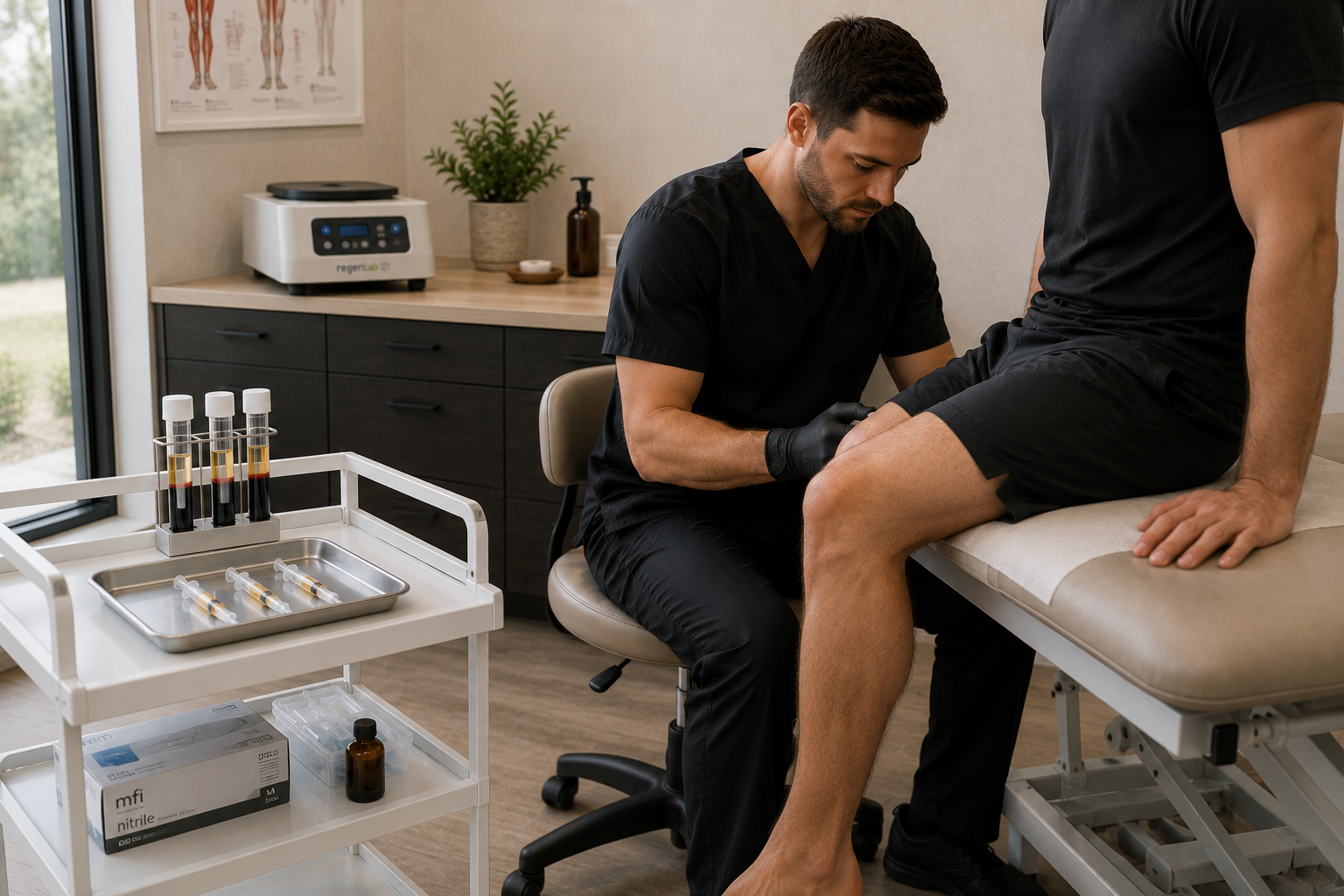
A blood sample is collected and processed in a centrifuge to separate and concentrate the platelets and plasma. The resulting platelet concentrate is then injected into the injured tissue or joint, typically using musculoskeletal ultrasound guidance.
Platelets are widely known for their role in blood clotting, but they also contain biologically active proteins involved in tissue repair.
When platelets become activated, they release growth factors and signaling molecules that influence:
Collagen production
Cellular recruitment
Blood-vessel formation
Inflammatory regulation
Tissue remodeling
Extracellular matrix production
Tendon and ligament healing
Joint homeostasis
PRP does not contain a medication or corticosteroid. It uses concentrated components of the patient’s own blood to stimulate a localized healing response.
Why Platelet Concentration Matters
Not every PRP treatment is the same.
PRP quality can vary significantly depending on:
The amount of blood collected
The centrifuge system
The processing method
Platelet recovery
Final injection volume
Platelet concentration
Total platelet dose
White blood cell concentration
Red blood cell contamination
Whether the product is activated
The tissue being treated
The accuracy of injection placement
The term “PRP” alone does not describe the final biological dose.
A small-volume blood draw processed through a basic system may produce a substantially different treatment than a high-volume, laboratory-style preparation designed to deliver a larger number of concentrated platelets.
Research increasingly suggests that the total platelet dose may influence clinical outcomes in conditions such as knee osteoarthritis. However, the optimal preparation is not identical for every injury, and treatment should be selected according to the diagnosis and tissue biology.
How PRP May Help Injured Tissue
PRP is intended to stimulate and organize a new healing response in tissue that may have become chronically irritated, degenerative, or biologically inactive.
Potential effects include:
Growth Factor Release
Activated platelets release signaling proteins that participate in tissue repair and cellular communication.
Collagen Production
PRP may stimulate fibroblast and tenocyte activity, helping support collagen synthesis and remodeling in tendons and ligaments.
Inflammatory Regulation
PRP does not simply eliminate inflammation. Instead, it may help shift the tissue away from prolonged, dysfunctional inflammation and toward a more organized repair process.
Vascular Signaling
Certain platelet-derived factors may support the formation of new microvascular networks within healing tissue.
Joint Environment Support
When injected into a joint, PRP may help regulate inflammatory signaling and improve symptoms related to osteoarthritis.
Tissue Remodeling
PRP may support the gradual replacement and reorganization of damaged extracellular tissue.
These biological effects take time. PRP is not an immediate numbing injection, and improvement often develops over several weeks to months.
Conditions Commonly Treated With PRP
PRP is used across sports medicine and orthopedic practice, but the amount and quality of evidence vary by condition.
Knee Osteoarthritis
PRP may reduce pain and improve function in patients with symptomatic knee osteoarthritis. The American Academy of Orthopaedic Surgeons states that PRP may provide improvement, although the strength of the recommendation remains limited because treatment preparation and study protocols vary.
Recent comparative research has also found that PRP can improve pain and function compared with placebo and may perform favorably compared with several other injectable treatments.
PRP does not reverse advanced arthritis or guarantee that joint replacement will be avoided. It may help improve symptoms, joint function, and activity tolerance in appropriately selected patients.
Lateral Epicondylitis
Lateral epicondylitis, commonly known as tennis elbow, is one of the more established orthopedic indications for PRP.
The condition is generally related to chronic degeneration of the common extensor tendon rather than simple short-term inflammation. PRP may help stimulate tendon remodeling and improve long-term pain and function.
Clinical reviews have found supportive evidence for leukocyte-rich PRP in chronic lateral epicondylitis.
Patellar Tendinopathy
PRP may be considered for chronic patellar tendon pain that has not responded adequately to progressive loading, physical therapy, and activity modification.
Treatment should still be combined with a structured tendon-loading program.
Plantar Fasciitis
PRP may be used for chronic plantar fasciitis or plantar fasciopathy when symptoms persist despite conservative treatment.
The goal is to stimulate remodeling at the damaged plantar fascia rather than temporarily suppressing symptoms.
Rotator Cuff and Shoulder Conditions
PRP may be considered for selected rotator cuff tendon injuries, partial tears, and chronic tendinopathy.
Evidence is mixed and depends on the specific diagnosis, tear severity, PRP preparation, and whether treatment is performed as a stand-alone injection or during surgery. PRP should not be presented as a universal replacement for surgical repair when a significant or complete tendon tear is present.
Achilles Tendinopathy
PRP is sometimes used for chronic Achilles tendon disease, particularly after an appropriate eccentric or progressive loading program has failed.
Clinical results are variable, and an accurate diagnosis is essential because insertional tendinopathy, midportion tendinopathy, partial tearing, and paratenon disorders may require different treatment strategies.
Ligament, Meniscus, and Labral Injuries
PRP may be considered for selected partial ligament injuries, meniscal pathology, and labral injuries.
The AAOS notes that PRP can be considered as an adjunct during surgical repair of certain acute isolated meniscal tears.
For nonsurgical cases, results depend greatly on the location, blood supply, stability, mechanical demands, and severity of the injury.
Bone Marrow Aspirate Concentrate
Bone marrow aspirate concentrate, or BMAC, is prepared by collecting bone marrow—commonly from the pelvis—and concentrating its cellular and signaling components.
BMAC may contain:
Platelets
White blood cells
Growth factors
Cytokines
Hematopoietic cells
A relatively small number of mesenchymal stromal cells
Other marrow-derived signaling components
BMAC is sometimes casually described as a “stem cell injection.” However, this wording can be misleading.
Bone marrow aspirate concentrate is a mixed biological product. It contains many components, and the number of mesenchymal stromal cells present is relatively limited. Its potential effects are thought to involve signaling, inflammatory regulation, cellular communication, and support of the local tissue environment—not simply the growth of entirely new cartilage.
Systematic reviews suggest that BMAC may improve pain and function in patients with knee osteoarthritis. However, current evidence has not consistently demonstrated that BMAC is clinically superior to PRP or other injection treatments, and additional research is needed.
BMAC may be considered for selected patients based on the degree of degeneration, previous treatments, biological goals, and provider assessment.
Autologous Conditioned Serum and Growth Factor Concentrates
Autologous conditioned serum, sometimes referred to as ACS, is another blood-derived regenerative medicine treatment.
Unlike PRP, which focuses primarily on concentrating platelets, ACS preparation is intended to increase specific anti-inflammatory proteins and signaling molecules.
One of the most discussed components is interleukin-1 receptor antagonist, or IL-1Ra. This protein may help block some of the inflammatory signaling associated with osteoarthritis and chronic joint irritation.
Growth factor and conditioned-serum treatments may be considered for:
Osteoarthritis
Chronic joint inflammation
Selected tendon disorders
Patients who have not responded to conventional injection treatments
Situations where inflammatory regulation is a major treatment goal
Preparation methods vary, and these treatments should not be assumed to be biologically identical.
A2M and Other Anti-Inflammatory Orthobiologics
Alpha-2-macroglobulin, commonly called A2M, is a naturally occurring protein found in blood plasma.
A2M acts as a broad protease inhibitor. Proteases are enzymes that can contribute to cartilage and tissue breakdown when excessively active within an inflamed or degenerative joint.
Concentrated A2M-based treatments are intended to:
Bind selected cartilage-degrading enzymes
Support a healthier joint environment
Reduce destructive inflammatory activity
Complement platelet-derived repair signaling
Protect remaining cartilage and connective tissue
A2M is sometimes combined with PRP to provide both anabolic signaling from platelets and additional regulation of catabolic enzymes within a degenerative joint.
Evidence and protocols continue to evolve. Treatment should be explained as a biologically based option rather than a guaranteed method of regrowing cartilage.
Extracellular Vesicles and Exosomes
Extracellular vesicles are microscopic particles released by cells. They carry proteins, lipids, messenger RNA, microRNA, and other biological signals between cells.
Exosomes are one type of extracellular vesicle.
These products are being studied for their potential ability to:
Influence immune signaling
Regulate inflammation
Support cell-to-cell communication
Promote cartilage and connective-tissue research pathways
Support recovery within damaged tissue environments
However, exosome therapy remains an emerging and investigational area.
There are currently no FDA-approved exosome products for orthopedic conditions. Products marketed as exosomes can differ substantially in their source, processing, purity, concentration, sterility, and biological contents.
Patients considering extracellular vesicle or exosome products should receive clear information about their regulatory status, supporting evidence, sourcing, and potential risks.
Why Regenerative Medicine Is Growing in Sports Medicine
Regenerative medicine has become increasingly incorporated into sports medicine because it offers a treatment approach that can be coordinated with the biology and mechanics of healing.
Minimally Invasive Treatment
Many orthobiologic procedures are performed through an injection rather than an incision.
This may reduce the recovery burden associated with surgery and allow the treatment to be performed in an outpatient setting.
Uses the Patient’s Own Biology
PRP, plasma concentrates, conditioned serum, and BMAC are collected from the patient’s own body.
This reduces the risk of allergic reaction to the injected biological material, although procedural risks such as infection, bleeding, pain, and treatment failure remain possible.
Reduced Dependence on Symptom-Suppressing Medication
Corticosteroids, NSAIDs, and pain medications may be appropriate in certain circumstances. However, repeated or prolonged use can have limitations.
Regenerative medicine provides a different strategy—one focused on improving the tissue environment rather than repeatedly suppressing symptoms.
Can Be Combined With Rehabilitation
Regenerative medicine does not replace physical therapy or progressive strengthening.
The best outcomes often occur when biological treatment is paired with:
Progressive mechanical loading
Physical therapy
Mobility restoration
Biomechanical correction
Nutrition
Adequate protein intake
Sleep and recovery
Gradual return to activity
May Delay More Invasive Treatment
In appropriately selected patients, regenerative medicine may help improve pain and function enough to delay surgery or joint replacement.
It cannot guarantee that surgery will never be required. Complete tendon ruptures, unstable ligament injuries, advanced mechanical joint damage, severe fractures, and other structural conditions may still require surgical evaluation.
Regenerative Medicine Is Not a Shortcut
Regenerative medicine should not be viewed as a single injection that instantly heals an injury.
Tissue recovery depends on:
The correct diagnosis
The severity and duration of the injury
The patient’s age and overall health
Blood flow to the injured structure
Metabolic health
Nutrition
Sleep
Tobacco use
Hormonal status
Medication use
Rehabilitation compliance
Activity modification
The accuracy and quality of the procedure
A biologic treatment can provide a powerful signal, but the tissue still requires adequate time, nutrition, and mechanical loading to remodel.
The Importance of Diagnostic Imaging
A successful regenerative medicine procedure begins with identifying the correct pain generator.
Pain in the shoulder, hip, knee, or back may come from several different structures. Treating the location of pain without identifying the damaged tissue can lead to poor outcomes.
Musculoskeletal ultrasound and MRI may be used to evaluate:
Tendon tears
Tendon degeneration
Ligament injuries
Cartilage damage
Joint inflammation
Bursitis
Meniscal or labral pathology
Calcification
Scar tissue
Muscle injuries
Joint instability
Diagnostic ultrasound can also be used during the procedure to visualize the needle and confirm that the orthobiologic product is delivered directly to the intended structure.
Why Ultrasound Guidance Matters
Regenerative medicine injections should be performed with precision.
Musculoskeletal ultrasound allows the provider to observe the needle in real time and avoid nearby nerves, vessels, and other sensitive structures.
Ultrasound guidance may improve:
Treatment accuracy
Anatomical targeting
Patient safety
Distribution of the injected product
Identification of previously unrecognized pathology
A biologically advanced product will have limited value if it is not delivered to the correct tissue.
What to Expect After a Regenerative Medicine Procedure
Recovery depends on the procedure and tissue treated.
Patients may experience:
Temporary soreness
Mild swelling
Stiffness
Aching
Increased sensitivity
A short-term inflammatory response
Temporary reduction in exercise tolerance
These effects may be part of the intended healing response.
Most regenerative procedures do not create immediate pain relief. Some patients notice improvement within several weeks, while tendon, ligament, cartilage, and joint remodeling may continue for several months.
A structured recovery plan may include:
Initial protection of the treated area
Gentle mobility
Progressive loading
Strength development
Sport- or activity-specific rehabilitation
Gradual return to unrestricted activity
The timeline should be based on the tissue treated rather than symptoms alone.
Who May Benefit From Regenerative Medicine?
Regenerative medicine may be appropriate for:
Athletes recovering from sports injuries
Active adults with chronic tendon or joint pain
Patients with mild to moderate osteoarthritis
Individuals attempting to delay joint replacement
Patients who have not improved with conventional conservative care
Patients who want to avoid repeated corticosteroid injections
Patients with partial tendon or ligament injuries
Individuals seeking a coordinated nonsurgical treatment plan
Selected patients recovering from orthopedic surgery
Not every patient is a candidate.
Advanced arthritis, severe structural deformity, complete tendon rupture, active infection, uncontrolled medical conditions, certain blood disorders, and other factors may affect treatment eligibility.
Selecting the Right Regenerative Medicine Treatment
The most expensive or aggressive treatment is not automatically the best treatment.
The correct regenerative medicine plan should be based on:
The specific diagnosis
Injury severity
Tissue quality
Imaging findings
Duration of symptoms
Previous treatment
Patient health
Functional goals
Supporting clinical evidence
Expected recovery demands
For many tendon and joint conditions, a well-prepared PRP treatment may be more appropriate than a cellular product. Other cases may benefit from PRP combined with A2M, plasma-based treatment, BMAC, shockwave therapy, or another procedure.
The treatment should match the biology of the injury.
Regenerative Medicine at Arizona Sports Medicine
At Arizona Sports Medicine, regenerative medicine is not approached as an isolated injection.
Each treatment plan may incorporate:
Detailed orthopedic examination
Musculoskeletal ultrasound
MRI or X-ray review
Ultrasound-guided procedures
Platelet-rich plasma
PRP combined with A2M
Plasma prolotherapy
Shockwave therapy
Tenex treatment
Physical therapy
Progressive strengthening
Peptide and recovery-support protocols
Nutrition and metabolic optimization
Long-term injury-prevention planning
The goal is to identify the damaged tissue, select the most appropriate biological treatment, and guide the patient through the complete recovery process.
The Future of Orthopedic Care Is Regenerative
Regenerative medicine is changing how sports injuries, tendon disorders, and degenerative joint conditions are managed.
Rather than relying only on medication, repeated corticosteroid injections, or surgery, physicians and sports medicine providers can now consider treatments that interact directly with the biological healing environment.
PRP already has meaningful clinical support for selected conditions, particularly knee osteoarthritis and lateral epicondylitis. Other orthobiologic treatments, including BMAC, conditioned serum, A2M, and extracellular vesicle technologies, continue to be studied and refined.
These treatments are not universal cures, and they do not eliminate the need for surgery in every patient. Their greatest value comes from appropriate patient selection, accurate diagnosis, precise image-guided treatment, and a carefully structured rehabilitation plan.
The future of orthopedic medicine is not simply replacing damaged tissue.
It is learning how to better support, protect, and restore the tissue the patient already has.
Schedule a Regenerative Medicine Evaluation
Persistent pain does not automatically mean that surgery is the next step.
A comprehensive evaluation can help determine:
Which structure is causing the pain
Whether regenerative medicine is appropriate
Which orthobiologic treatment may provide the greatest benefit
Whether additional imaging is needed
Whether PRP, PRP with A2M, plasma prolotherapy, BMAC, or another treatment should be considered
What rehabilitation plan should accompany the procedure
What recovery timeline is realistic
Schedule a regenerative medicine consultation with Arizona Sports Medicine to develop a personalized treatment plan based on the diagnosis, goals, and biology of the injury.
There are a wide variety of orthobiologic therapies that are currently being studied and used in clinical practice.
Platelet Plasma (P.R.P.)
PRP is a concentrated solution of platelets that are obtained from the patient's own blood. These platelets contain growth factors that can promote the healing of soft tissue injuries, such as tendinitis and ligament sprains.
Exosome Therapy
Stem cells are immature cells that have the ability to differentiate into various types of cells, including bone and cartilage. Stem cell therapy involves the injection of stem cells into the site of an injury to promote the regeneration of damaged tissue.
Peptide Therapy
Peptides are short chains of amino acids that act as signaling molecules throughout the body. Peptide therapy uses targeted peptide compounds to influence specific biological pathways involved in tissue repair, inflammation, metabolism, cellular function, recovery, and healthy aging.
⭐️⭐️⭐️⭐️⭐️
“Great conversation with the PA that went over both medical and everyday treatment possibilities for an injury.
Couldn’t have been more helpful and
would recommend this practice to anyone.”
Andrew H.
Verified Zocdoc Review
Orthobiologics F.A.Q.
In recent years, orthobiologics have garnered widespread attention in the realm of sports medicine and orthopedics due to their remarkable potential in facilitating the body's innate healing mechanisms. Consequently, numerous patients find themselves inquisitive about this pioneering therapeutic avenue. To cater to this curiosity, we have meticulously assembled a catalog of commonly asked questions pertaining to orthobiologics, with the aim of furnishing all-encompassing insights and resolution of prevalent apprehensions that individuals might harbor when contemplating this course of treatment.
-
Orthobiologics are substances derived from the body that are used to help injuries and conditions heal more quickly. They can be derived from substances such as platelet-rich plasma (PRP), bone marrow, or other tissue sources. These substances help promote the body's natural healing processes.
-
Orthobiologics are commonly used to treat injuries and conditions affecting the muscles, tendons, ligaments, and joints. This can include conditions such as tendonitis, ligament injuries, osteoarthritis, and other musculoskeletal injuries.
-
Orthobiologics can be administered through injections directly into the affected area. The specific method and frequency of administration will depend on the individual's condition and the type of orthobiologic being used.
-
Orthobiologics are derived from the patient's own body or from donor sources and are generally considered safe. As with any medical treatment, there are potential risks and side effects, which will be thoroughly discussed with the patient prior to treatment.
-
The success of orthobiologics can vary depending on the individual's condition, overall health, and other factors. Many patients experience positive outcomes and improvements in their symptoms after undergoing orthobiologic treatment.
-
Coverage for orthobiologic treatment can vary depending on the specific type of treatment, the patient's insurance plan, and the reason for treatment. Our team can work with patients to determine insurance coverage and explore alternative payment options if necessary.
-
Patients interested in orthobiologic treatment should schedule a consultation with our qualified orthopedic sports medicine physician. During the consultation, the physician will evaluate the patient's condition, discuss treatment options, and answer any questions to help the patient make an informed decision.