
Shockwave Therapy In Tempe Arizona
Shockwave Therapy
Targeted Acoustic Energy for Pain Relief, Tissue Recovery, and Improved Function
Chronic tendon pain and soft-tissue injuries can persist even after rest, medication, physical therapy, or activity modification. In many cases, the injured tissue is no longer experiencing a normal healing response and requires a new mechanical stimulus to restart the recovery process.
Shockwave therapy is a noninvasive treatment that delivers controlled acoustic pressure waves into targeted muscles, tendons, ligaments, fascia, and other musculoskeletal tissues. These mechanical waves may help reduce pain, improve local circulation, stimulate cellular signaling, and support the body’s natural tissue-repair processes.
At PRO Sports Medicine, shockwave therapy is incorporated into a comprehensive treatment plan based on the diagnosis, tissue involved, severity of the condition, and the patient’s functional goals.
What Is Shockwave Therapy?
Shockwave therapy—also known as extracorporeal shockwave therapy, acoustic wave therapy, or EPAT—is a nonsurgical treatment used for a variety of musculoskeletal conditions.
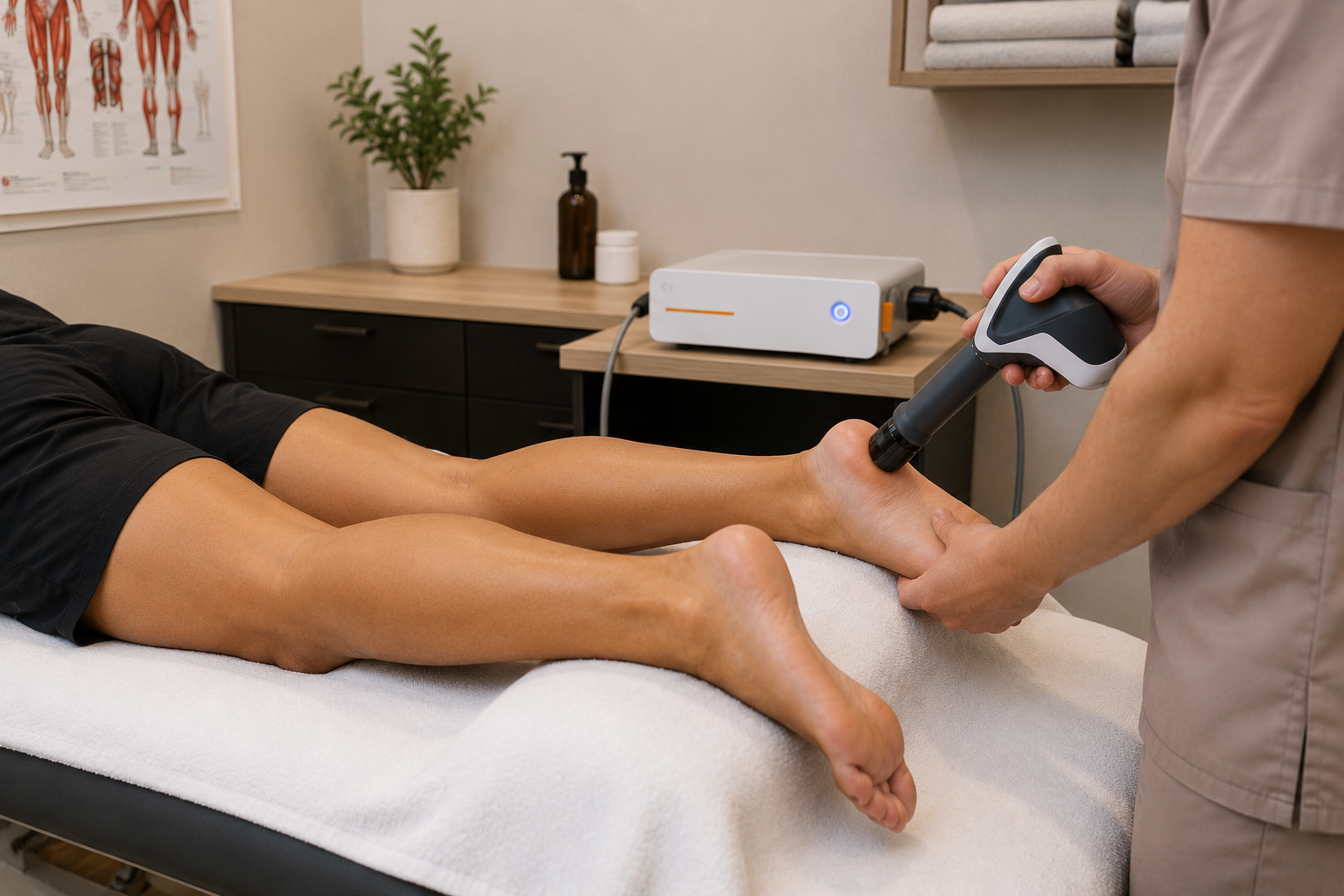
During treatment, a handheld applicator delivers a series of controlled mechanical pressure waves through the skin and into the targeted tissue. These are acoustic waves, not electrical shocks.
The energy transmitted into the tissue creates a mechanical stimulus that may influence local circulation, pain signaling, cellular activity, collagen remodeling, and tissue repair. This process is commonly described as mechanotransduction: the conversion of a physical stimulus into a biological response.
Shockwave therapy does not simply cover up pain. Its purpose is to change the biological and mechanical environment of the injured tissue so that recovery can progress more effectively.
More Than Temporary Pain Relief
Pain relief is an important treatment goal, but reducing symptoms without addressing the underlying tissue dysfunction may produce only temporary improvement.
Shockwave therapy is designed to influence both pain and tissue behavior. Depending on the condition being treated, it may help:
Reduce localized musculoskeletal pain
Improve circulation within poorly vascularized tissue
Stimulate cellular repair signaling
Support collagen remodeling
Improve tendon and fascial mobility
Decrease muscular tension and trigger-point sensitivity
Improve range of motion and functional tolerance
Support progressive rehabilitation and mechanical loading
The treatment is most effective when it is directed toward a clearly identified pain generator rather than applied generally to an entire body region.
How Shockwave Therapy Supports Tissue Recovery
Tendons, ligaments, fascia, and other connective tissues may heal slowly because they receive less blood flow than muscle. Chronic injuries can also become biologically stagnant, with disorganized collagen, altered tissue stiffness, reduced circulation, and persistent pain sensitivity.
The mechanical energy produced during shockwave therapy may help reactivate portions of the healing response.
Proposed biological effects include:
Mechanotransduction
Mechanical pressure is converted into biochemical signaling within the tissue. This may influence cellular activity, collagen production, vascular signaling, and tissue remodeling.
Improved Local Circulation
Shockwave therapy may stimulate vascular responses within and around the treated area, potentially improving the delivery of oxygen, nutrients, and repair-related cells.
Collagen Remodeling
Controlled mechanical stimulation may encourage more organized collagen turnover in chronically injured tendons, ligaments, and fascia.
Pain Modulation
Shockwave therapy may temporarily alter local pain signaling and reduce sensitivity within chronically painful tissue.
Tissue Mobilization
The treatment can mechanically stimulate restricted or thickened tissue, helping improve mobility between fascial planes, muscles, and tendons.
These effects develop over time. Shockwave therapy should not be viewed as an instant repair, and improvement may continue for several weeks after the treatment series has been completed.
Conditions Commonly Treated With Shockwave Therapy
Shockwave therapy is most frequently used for chronic tendon, fascial, muscular, and attachment-site pain.
Conditions that may be considered for treatment include:
Foot and Ankle
Plantar fasciitis
Chronic heel pain
Achilles tendinopathy
Insertional Achilles pain
Peroneal tendinopathy
Posterior tibial tendon pain
Knee and Lower Leg
Patellar tendinopathy
Quadriceps tendon pain
Chronic calf tightness
Myofascial trigger points
Selected cases of medial tibial stress syndrome
Hip and Pelvis
Gluteus medius or minimus tendinopathy
Greater trochanteric pain syndrome
Proximal hamstring tendinopathy
Adductor-related groin pain
Piriformis and deep gluteal pain
Chronic muscular trigger points
Shoulder and Upper Arm
Rotator cuff tendinopathy
Calcific rotator cuff tendinopathy
Biceps tendon pain
Chronic muscular restriction
Myofascial shoulder pain
Elbow, Forearm, and Hand
Lateral epicondylitis, or tennis elbow
Medial epicondylitis, or golfer’s elbow
Distal biceps or triceps tendinopathy
Chronic forearm muscle pain
Selected hand and wrist tendinopathies
The appropriateness of shockwave therapy depends on the diagnosis. Not every painful area is a shockwave candidate, and some symptoms require additional imaging or evaluation before treatment begins.
Radial and Focused Shockwave Therapy
Shockwave systems can deliver energy in different ways. The two primary categories are radial pressure wave therapy and focused shockwave therapy.
Radial Pressure Wave Therapy
Radial treatment disperses mechanical energy across a broader and generally more superficial area. It can be useful for muscular tightness, trigger points, fascia, and more diffuse tendon or soft-tissue conditions.
Focused Shockwave Therapy
Focused shockwave concentrates energy into a smaller, more precisely defined treatment area and can reach deeper tissue. It may be selected for specific tendon attachments, calcific deposits, deeper structures, or focal areas of chronic tissue dysfunction.
The optimal treatment type, intensity, depth, and number of impulses depend on the tissue being treated and the patient’s tolerance. A higher setting is not automatically better. Treatment parameters should be selected deliberately for the individual condition.
Using MSK Ultrasound to Improve Treatment Precision
Musculoskeletal ultrasound can be used alongside shockwave therapy to identify the injured structure and determine where treatment should be concentrated.
Ultrasound may help evaluate:
Tendon thickening or degeneration
Partial tendon tearing
Calcific deposits
Fascial thickening
Bursal fluid
Scar tissue
Ligament injury
Areas of abnormal tissue movement
Localized swelling or inflammation
The treatment itself is generally performed externally without needles. However, ultrasound findings can provide a more accurate anatomical target and help prevent treatment from being directed solely by the location where pain is felt.
Pain may be referred from another structure, and the most tender area is not always the primary source of the condition.
Shockwave Therapy and Rehabilitation
Shockwave therapy works best as part of a larger rehabilitation strategy.
The mechanical stimulus created by shockwave therapy does not replace the need for progressive strengthening, mobility work, movement correction, or appropriate loading of the injured tissue. Instead, treatment may help create a more favorable environment in which rehabilitation can be performed.
A coordinated plan may include:
Progressive tendon loading
Strength and mobility exercises
Physical therapy
Activity modification
Movement-pattern correction
Bracing or temporary support
Nutritional optimization
Recovery and sleep support
Gradual return to sport or exercise
Completely resting a tendon for an extended period can reduce its capacity to tolerate future activity. Conversely, returning to full activity too quickly can repeatedly overload the tissue. The goal is to establish the appropriate amount of mechanical loading throughout the recovery process.
Combining Shockwave With Regenerative Medicine
Shockwave therapy may be used as a stand-alone treatment or incorporated into a broader regenerative medicine plan.
Depending on the condition, it may be combined with:
Platelet-rich plasma therapy
A2M treatment
Plasma prolotherapy
Ultrasound-guided procedures
Tenex treatment
Physical therapy
Corrective exercise
Peptide-based recovery protocols
Nutrition and health optimization
Shockwave may sometimes be used before a regenerative procedure to improve tissue mobility and stimulate the local treatment environment. In other cases, it may be used later in recovery to address persistent stiffness, muscular compensation, or areas of incomplete functional improvement.
The timing of treatment should be determined by the tissue involved and the overall recovery plan.
What to Expect During Treatment
Shockwave therapy is performed in the office and does not normally require anesthesia, injections, or surgical preparation.
Before treatment, the provider identifies the targeted structure through physical examination and, when appropriate, musculoskeletal ultrasound. Gel is applied to the skin to help transmit the acoustic energy.
The handheld applicator is then moved across the treatment area while delivering a predetermined number of pressure-wave impulses.
Patients typically experience repetitive tapping or pulsing. Sensitive or injured areas may feel temporarily uncomfortable during treatment, but the intensity can usually be adjusted based on tolerance.
A typical session may take approximately 10 to 20 minutes, depending on the number and size of the areas being treated.
How Many Treatments Are Needed?
Shockwave therapy is generally performed as a series rather than as a single isolated treatment.
Many treatment plans involve approximately three to six sessions separated by several days to one week. More persistent or complex conditions may require additional sessions.
The appropriate number of treatments depends on:
The diagnosis
How long the condition has been present
The tissue involved
The severity of degeneration or injury
Previous treatments
The patient’s response
Rehabilitation compliance
Activity demands and recovery goals
Some patients notice early pain reduction, while others improve more gradually over several weeks. Tissue remodeling can continue after the final session.
No specific number of treatments can guarantee a particular outcome.
Recovery After Shockwave Therapy
Most patients can walk out of the office and return to routine daily activities after treatment.
Temporary responses may include:
Localized soreness
Mild redness
Tenderness
Bruising
Temporary swelling
Increased sensitivity in the treated area
Short-term fatigue or aching within the tissue
These symptoms are generally mild and resolve without significant intervention.
Patients are usually encouraged to continue normal movement while avoiding unusually intense or provocative activity immediately after treatment. Exercise recommendations will depend on the structure being treated and the current phase of rehabilitation.
Anti-inflammatory medication may not be recommended around treatment in some cases because inflammation is part of the body’s repair response. Medication decisions should always be reviewed with the treating provider, particularly when a medication has been prescribed for another medical condition.
When Shockwave Therapy May Not Be Appropriate
Shockwave therapy is not appropriate for every patient or every condition.
Treatment may need to be avoided or modified when there is:
An active infection in the treatment area
An open wound
A known tumor in or near the treatment area
A significant bleeding disorder
Certain anticoagulant-related concerns
An acute fracture
Severe loss of sensation
Pregnancy when treatment would be performed near the abdomen or pelvis
A major blood vessel, lung field, brain, spinal cord, or other sensitive structure within the treatment path
A condition requiring urgent surgical or neurological evaluation
A clinical examination is necessary before treatment to confirm that shockwave therapy is appropriate and that a more serious diagnosis is not being overlooked.
When Additional Imaging Is Needed
Shockwave therapy should not be used as a substitute for establishing an accurate diagnosis.
MRI, X-ray, diagnostic ultrasound, or other imaging may be recommended when there is concern for:
A complete tendon rupture
A significant partial tear
A fracture or stress injury
Advanced joint degeneration
A labral injury
Significant nerve involvement
A mass or bone lesion
Infection
Symptoms that do not match the examination
Failure to improve with appropriate treatment
Imaging allows the treatment plan to be based on the actual tissue pathology rather than symptoms alone.
Benefits of In-Office Shockwave Therapy
Shockwave therapy offers several potential advantages for appropriately selected musculoskeletal conditions:
Noninvasive treatment
No incision or surgical recovery
No medication is injected
Minimal interruption to daily activities
Adjustable treatment intensity
Treatment can be localized to the injured structure
Can be combined with physical therapy and regenerative procedures
May help treat chronic conditions that have not responded to rest alone
Can support pain reduction and improved function over time
Results vary by diagnosis, tissue quality, severity, chronicity, and patient adherence to the accompanying rehabilitation program.
A More Complete Approach to Musculoskeletal Recovery
Chronic pain is rarely resolved by addressing only one component of the problem.
An injured tendon may also be affected by weakness, reduced joint mobility, poor movement mechanics, muscular compensation, nutritional limitations, inadequate recovery, or repetitive overload. Treating the painful tissue without correcting these contributing factors may limit long-term improvement.
At PRO Sports Medicine, shockwave therapy is used within a systems-based treatment model that may include diagnostic imaging, physical therapy, regenerative medicine, progressive strengthening, recovery planning, and health optimization.
The goal is not simply to make the area feel better temporarily. The goal is to improve tissue capacity, restore function, and help the patient return to normal activity with a lower risk of recurring symptoms.
Schedule a Shockwave Therapy Evaluation
Persistent tendon or soft-tissue pain does not always mean surgery is the next step.
A clinical evaluation can help determine:
Which structure is generating the pain
Whether shockwave therapy is appropriate
Whether imaging is needed
How many sessions may be recommended
What rehabilitation should accompany treatment
Whether another procedure would provide greater benefit
Schedule an evaluation with PRO Sports Medicine to determine whether shockwave therapy should be included in your recovery plan.
⭐️⭐️⭐️⭐️⭐️
“Friendly staff, on time, knowledgeable and professional!
I was impressed by the care and the quick diagnosis...
ultrasound was available at my appointment
and I left with answers and relief of my pain,
with a plan for treatment moving forward.
Great care and great service. Thank you!”
Verified Zocdoc Review
Shockwave F.A.Q.
At Arizona Sports Med, we understand that seeking medical care for a sports injury can raise many questions. To help you feel informed and prepared, we have compiled answers to some of the most common inquiries related to Tenotomy treatment for sports injuries.
-
The procedure is usually done under local anesthesia, and the surgeon makes a small incision to access the affected tendon. Then the tendon is precisely cut to release tension and allow for improved movement.
-
Tenotomy is commonly used to address conditions like tendonitis, plantar fasciitis, and tight or contracted tendons in the hand, elbow, or knee.
-
Recovery time can vary depending on the specific procedure and the individual patient. Typically, patients are advised to rest and elevate the affected area, engage in physical therapy, and follow post-operative care instructions provided by their doctor.
-
The results of tenotomy are generally long-lasting, providing relief from pain and improved function. However, individual experiences may vary, and follow-up care is essential for optimal outcomes.
-
It is crucial to have a thorough discussion with your healthcare provider to understand the potential benefits, risks, and expected outcomes of the procedure. Additionally, exploring non-surgical options and seeking a second opinion can be beneficial.