
Tesamorelin
Understanding FDA-Approved Growth Hormone-Releasing Hormone Therapy and the Biology of Visceral Fat
PROPeptides Foundations Program
Not all body fat serves the same biological function.
Some fat exists just beneath the skin, providing insulation, cushioning, and energy storage. Other fat accumulates much deeper within the abdominal cavity, surrounding organs such as the liver, pancreas, and intestines. Although these two forms of fat may appear similar externally, they behave very differently from a metabolic perspective.
Deep abdominal fat—known as visceral adipose tissue (VAT)—is considerably more biologically active than subcutaneous fat. Excess visceral fat has been associated with insulin resistance, chronic low-grade inflammation, dyslipidemia, fatty liver disease, and increased cardiovascular risk. As a result, reducing visceral fat has become an important goal in metabolic medicine.
One therapy developed specifically for this purpose is Tesamorelin.
Tesamorelin is a synthetic analog of growth hormone-releasing hormone (GHRH) designed to stimulate endogenous growth hormone secretion. Unlike many peptides discussed in performance medicine, Tesamorelin has undergone extensive clinical evaluation and is FDA approved for the reduction of excess abdominal visceral adipose tissue in adults with HIV-associated lipodystrophy.
Understanding why Tesamorelin works requires understanding the unique biology of visceral fat, growth hormone physiology, and body composition.
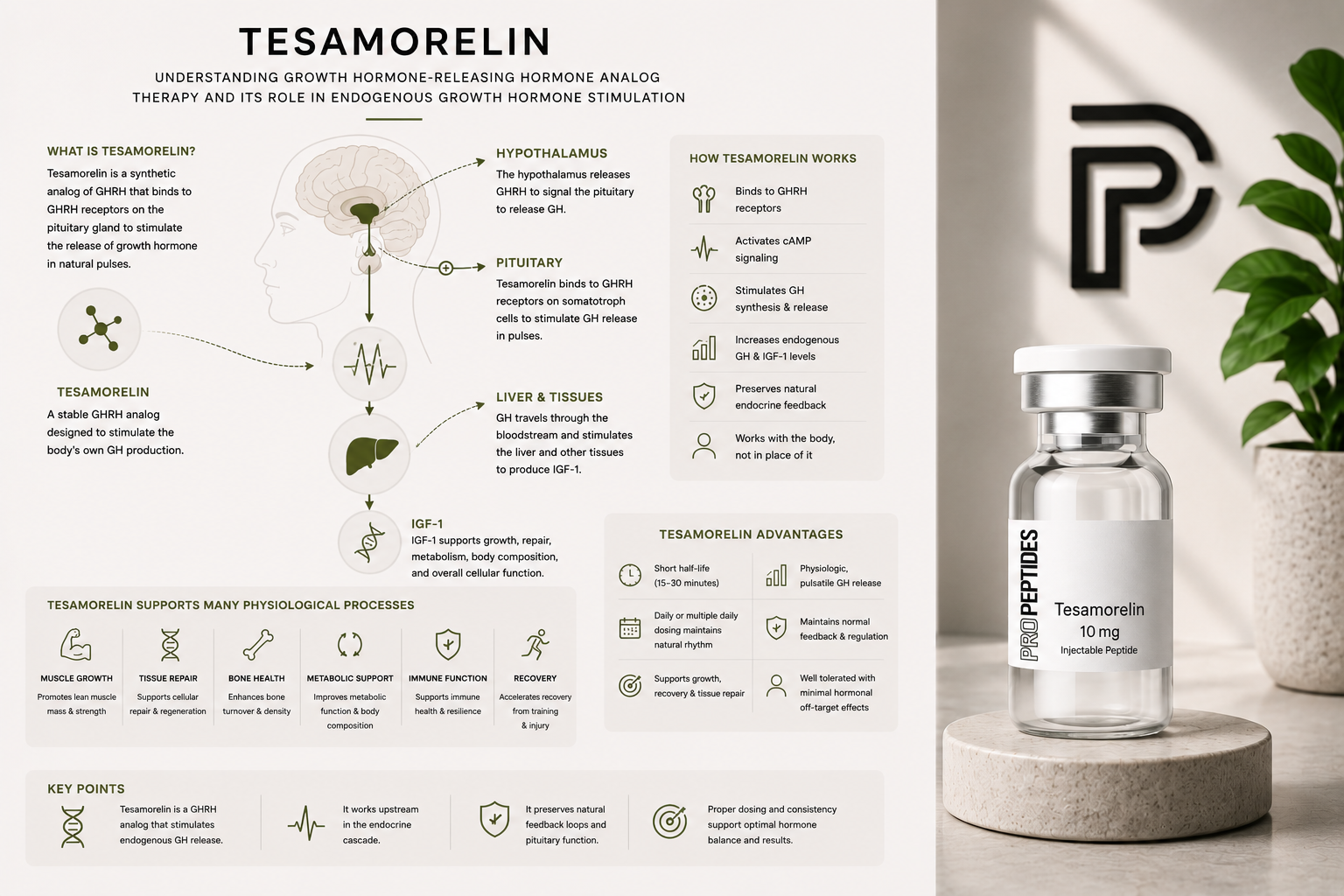
What Is Tesamorelin?
Tesamorelin is a synthetic peptide derived from naturally occurring growth hormone-releasing hormone (GHRH).
Like endogenous GHRH, Tesamorelin binds to GHRH receptors located on somatotroph cells within the anterior pituitary.
Activation of these receptors stimulates the release of endogenous growth hormone.
The resulting increase in growth hormone then promotes production of insulin-like growth factor-1 (IGF-1), creating physiological effects throughout multiple organ systems.
Importantly, Tesamorelin does not contain growth hormone.
Instead, it stimulates the body's own endocrine pathway.
Why Was Tesamorelin Developed?
The development of Tesamorelin was driven by a very specific clinical problem.
Many individuals living with HIV who received antiretroviral therapy developed a condition known as HIV-associated lipodystrophy.
This syndrome often included:
Increased visceral abdominal fat
Loss of peripheral fat
Dyslipidemia
Insulin resistance
Changes in body shape
Increased cardiovascular risk
Traditional weight-loss strategies frequently produced only modest improvements in visceral fat accumulation.
Researchers therefore investigated whether restoring aspects of growth hormone physiology might preferentially influence visceral adipose tissue.
This work ultimately led to the development and FDA approval of Tesamorelin for this specific indication.
Visceral Fat vs Subcutaneous Fat
One of the most important concepts in metabolic physiology is that not all fat behaves the same way.
Subcutaneous Fat
Subcutaneous fat lies directly beneath the skin.
It serves several important physiological functions:
Energy storage
Thermal insulation
Mechanical cushioning
Endocrine signaling
Although excessive subcutaneous fat can contribute to obesity, it is generally less metabolically active than visceral fat.
Visceral Fat
Visceral adipose tissue accumulates within the abdominal cavity around internal organs.
Compared with subcutaneous fat, visceral fat demonstrates:
Greater inflammatory activity
Higher rates of lipolysis
Increased portal fatty acid delivery to the liver
Greater association with insulin resistance
Stronger relationships with metabolic disease
Because visceral fat drains directly into the portal circulation, substances released from these fat cells reach the liver rapidly, influencing glucose metabolism, lipid production, and systemic inflammation.
This biological distinction helps explain why clinicians increasingly evaluate body composition rather than body weight alone.
Why Growth Hormone Influences Visceral Fat
Growth hormone has numerous physiological effects on metabolism.
Among its most important actions is the stimulation of lipolysis, the breakdown of stored triglycerides into free fatty acids that can be used as energy.
Visceral adipose tissue appears particularly responsive to growth hormone signaling.
Although the exact mechanisms continue to be investigated, several factors likely contribute:
Higher metabolic activity within visceral fat
Differences in hormone receptor expression
Regional variation in blood flow
Distinct endocrine behavior of visceral adipocytes
Rather than functioning as a generalized weight-loss therapy, Tesamorelin appears to influence one specific component of body composition.
This distinction is central to understanding its approved clinical use.
How Tesamorelin Works
Tesamorelin binds to the growth hormone-releasing hormone receptor on anterior pituitary somatotroph cells.
Following receptor activation:
Growth hormone secretion increases.
Growth hormone stimulates hepatic and local production of IGF-1.
Lipid metabolism shifts toward greater lipolysis.
Visceral adipose tissue gradually decreases in many treated patients.
Because Tesamorelin stimulates endogenous growth hormone production rather than supplying exogenous growth hormone, normal physiological feedback mechanisms continue to influence hormone secretion.
Negative feedback through IGF-1 remains active.
Somatostatin continues regulating pituitary activity.
The endocrine system remains engaged rather than bypassed.
Clinical Evidence
Tesamorelin has been evaluated in multiple randomized clinical trials involving adults with HIV-associated lipodystrophy.
Across these studies, researchers consistently demonstrated:
Significant reductions in visceral adipose tissue
Increased circulating IGF-1 concentrations
Preservation of subcutaneous fat in many participants
Improvements in several metabolic parameters
Importantly, these findings formed the basis for FDA approval.
Outside of HIV-associated lipodystrophy, however, evidence is considerably more limited.
Investigators continue studying potential roles in:
Metabolic dysfunction-associated steatotic liver disease (MASLD)
Metabolic syndrome
General obesity
Healthy aging
At present, these applications remain investigational and should not be considered established indications.
Tesamorelin Is Not a General Weight-Loss Medication
One of the most common misconceptions surrounding Tesamorelin is that it functions like a traditional obesity medication.
Current evidence suggests otherwise.
Unlike GLP-1 receptor agonists, which primarily reduce caloric intake through appetite regulation, Tesamorelin works by influencing growth hormone physiology.
Clinical trials have generally demonstrated greater reductions in visceral fat than in total body weight.
For many patients, changes in body composition may exceed changes observed on a standard bathroom scale.
This reinforces the importance of evaluating:
Waist circumference
Body composition analysis
Imaging-based assessment of visceral fat
rather than relying solely on body weight.
Safety Considerations
Because Tesamorelin stimulates the growth hormone–IGF-1 axis, appropriate patient selection and clinical monitoring remain important.
Potential considerations include:
Increased IGF-1 concentrations
Fluid retention
Arthralgia
Injection-site reactions
Alterations in glucose metabolism
Clinical trials generally demonstrated acceptable tolerability within the approved patient population, but long-term safety outside the approved indication continues to be investigated.
Tesamorelin Compared with CJC-1295
Although both peptides act through the GHRH receptor, they differ substantially in their clinical development.
Feature
Tesamorelin / CJC-1295
Mechanism
GHRH analog / GHRH analog
FDA approval
Yes, for HIV-associated lipodystrophy / No
Clinical evidence
Multiple Phase III trials and long-term follow-up / Primarily early-phase endocrine studies
Primary research focus
Visceral adipose tissue reduction / GH and IGF-1 physiology
Regulatory status
Approved for a specific indication / Investigational
These differences highlight why compounds with similar mechanisms may have very different levels of clinical evidence and regulatory approval.
Bringing It All Together
Tesamorelin demonstrates how a detailed understanding of endocrine physiology can lead to targeted therapies for specific clinical conditions. By acting as a synthetic analog of growth hormone-releasing hormone, Tesamorelin stimulates endogenous growth hormone secretion while preserving many of the body's normal regulatory mechanisms.
Its greatest clinical contribution has been improving our understanding of visceral adipose tissue. Rather than functioning as a nonspecific weight-loss therapy, Tesamorelin illustrates that different fat depots possess distinct biological characteristics and may respond differently to hormonal regulation.
This distinction emphasizes a broader principle in metabolic medicine: body composition often provides more meaningful physiological information than body weight alone.
Looking Ahead
Growth hormone influences many aspects of metabolism and tissue remodeling, but much of its downstream activity is mediated through insulin-like growth factor-1 (IGF-1). While Tesamorelin stimulates endogenous production of both growth hormone and IGF-1, researchers have also developed synthetic IGF-1 analogs that interact more directly with the body's anabolic signaling pathways.
In the next article, we'll explore IGF-1 LR3, examining how it differs from endogenous IGF-1, its unique pharmacology, and why its physiological effects differ substantially from peptides that stimulate the growth hormone axis.
Key References
Falutz J, Allas S, Blot K, et al. Metabolic Effects of a Growth Hormone-Releasing Factor in Patients With HIV.New England Journal of Medicine.
Stanley TL, Grinspoon SK. Body Composition and Metabolic Effects of Tesamorelin. Journal of Clinical Endocrinology & Metabolism.
Grinspoon SK, et al. Tesamorelin for Reduction of Visceral Adipose Tissue in HIV-Associated Lipodystrophy.Lancet.
Melmed S, Auchus RJ, Goldfine AB, Koenig RJ, Rosen CJ. Williams Textbook of Endocrinology.
Neeland IJ, Ross R, Després JP, et al. Visceral and Ectopic Fat, Atherosclerosis, and Cardiometabolic Disease.Nature Reviews Cardiology.
Clinical Perspective
Tesamorelin occupies a unique position among peptides that influence the growth hormone axis because it has progressed from physiological research to an FDA-approved therapy for a defined medical condition. Its development underscores the importance of distinguishing body composition from body weight and visceral adipose tissue from subcutaneous fat. While current evidence supports its use for reducing excess visceral abdominal fat in adults with HIV-associated lipodystrophy, investigation into broader metabolic applications is ongoing. As with all therapies that modify endocrine physiology, clinicians should interpret emerging evidence within the context of the approved indication, individual patient characteristics, and the current strength of clinical data.