
Sleep & Recovery
Understanding the Biology That Transforms Training into Adaptation
PROPeptides Foundations Program
Exercise creates the opportunity for adaptation.
Recovery allows adaptation to occur.
This distinction is one of the most important principles in exercise physiology. During training, muscles experience mechanical stress, energy stores become depleted, connective tissues undergo microscopic strain, and the nervous system is challenged. These temporary disruptions are necessary because they provide the biological signals that stimulate improvement.
The improvements themselves, however, occur largely after the workout has ended.
During recovery, muscle proteins are synthesized, glycogen stores are replenished, connective tissues remodel, mitochondria adapt, hormones return toward baseline, and the nervous system reorganizes movement patterns developed during training.
Sleep represents the most important recovery period within this process.
Far from being a passive state of rest, sleep is a highly organized biological process during which the brain and body coordinate many of the physiological events responsible for tissue repair, metabolic regulation, immune function, learning, and performance adaptation.
Understanding sleep physiology helps explain why even the most sophisticated training program cannot overcome chronically inadequate recovery.
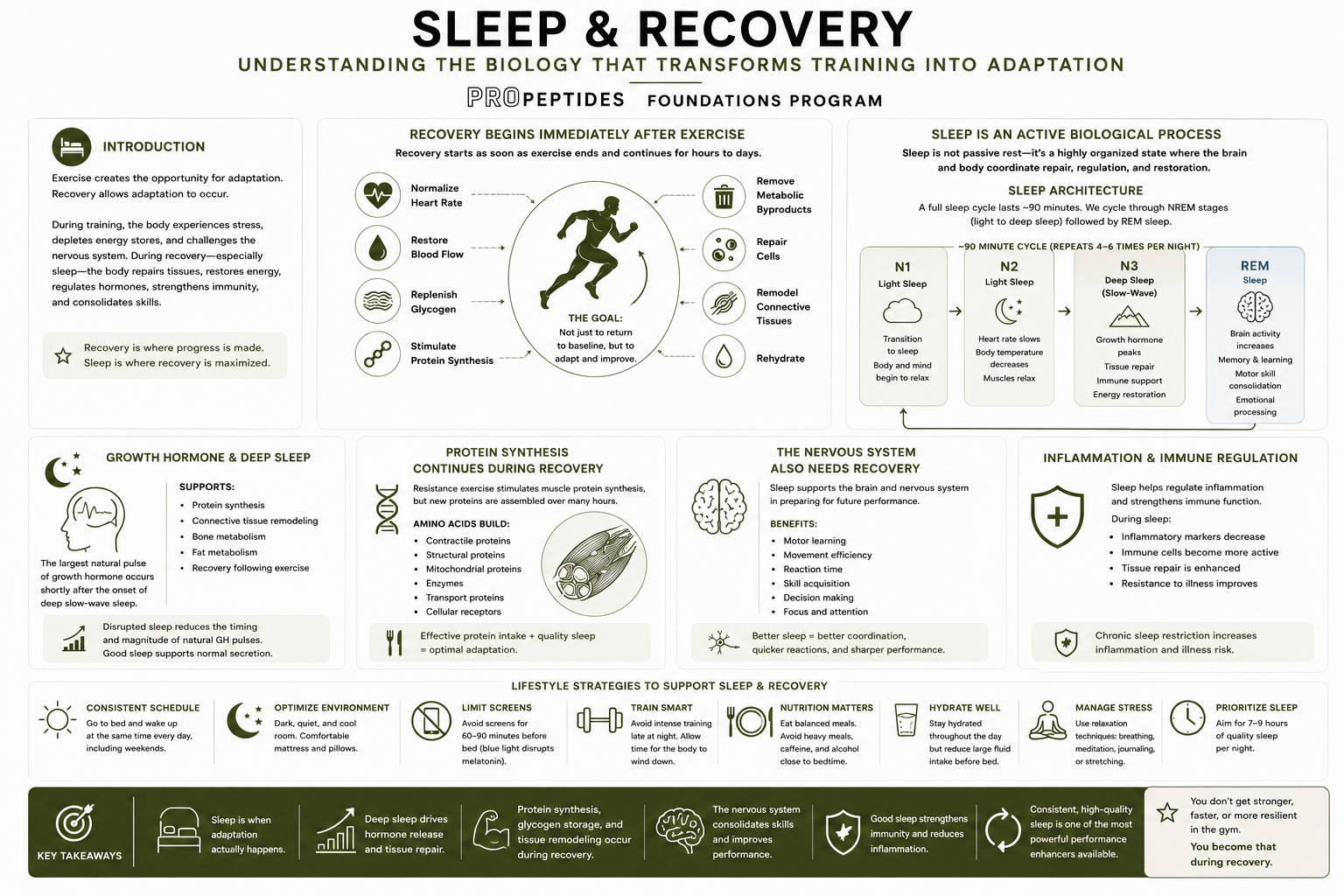
Recovery Begins Immediately After Exercise
Recovery is often thought of as something that begins hours after a workout.
In reality, recovery starts almost immediately.
As exercise concludes, the body begins restoring physiological balance through numerous coordinated processes, including:
Normalization of heart rate
Restoration of blood flow
Glycogen resynthesis
Protein synthesis
Removal of metabolic byproducts
Cellular repair
Connective tissue remodeling
Rehydration
These responses continue for hours—and in some cases days—depending on the intensity of training.
The goal of recovery is not simply to return the body to its previous state, but to prepare it to tolerate greater demands in the future.
Sleep Is an Active Biological Process
For many years, sleep was viewed primarily as a period of inactivity.
Modern neuroscience has shown the opposite.
Sleep is an active physiological state characterized by precisely coordinated changes in brain activity, hormone secretion, autonomic nervous system function, metabolism, and cellular repair.
During normal sleep, the body cycles through multiple stages, each contributing unique biological functions.
These stages broadly include:
Non-rapid eye movement (NREM) sleep
Rapid eye movement (REM) sleep
Rather than serving identical purposes, each stage supports different aspects of physical and neurological recovery.
Sleep Architecture
A healthy night's sleep consists of repeated cycles lasting approximately 90 minutes.
Each cycle progresses through progressively deeper stages of NREM sleep before entering REM sleep.
Light Sleep (N1 and N2)
These early stages prepare the brain and body for deeper restorative sleep.
Heart rate slows.
Body temperature decreases.
Muscle activity relaxes.
Deep Sleep (N3)
Often referred to as slow-wave sleep, this stage is particularly important for physical recovery.
During deep sleep:
Growth hormone secretion reaches its highest levels.
Protein synthesis increases.
Tissue repair accelerates.
Immune regulation is enhanced.
Energy stores begin to recover.
Deep sleep is especially important following strenuous physical activity.
REM Sleep
Rapid eye movement sleep is characterized by increased brain activity.
During REM sleep:
Learning is reinforced.
Motor skills consolidate.
Emotional processing occurs.
Memory integration improves.
Although REM contributes less directly to tissue repair, it plays an essential role in athletic skill development and cognitive performance.
Growth Hormone and Deep Sleep
One of the strongest physiological links between sleep and recovery involves the growth hormone–IGF-1 axis.
As discussed earlier in this section, endogenous growth hormone is released in pulses rather than continuously.
The largest pulse in healthy adults typically occurs shortly after the onset of deep slow-wave sleep.
This pulse supports numerous physiological processes, including:
Protein synthesis
Connective tissue remodeling
Bone metabolism
Fat metabolism
Recovery following exercise
Disrupted sleep architecture may reduce both the timing and magnitude of these natural hormone pulses.
Although many factors influence growth hormone physiology, maintaining healthy sleep remains one of the most effective ways to support normal endogenous secretion.
Protein Synthesis Continues During Recovery
Resistance exercise stimulates muscle protein synthesis, but new proteins are assembled over many hours following training.
During recovery, amino acids obtained from dietary protein are incorporated into:
Contractile proteins
Structural proteins
Mitochondrial proteins
Enzymes
Cellular transport proteins
This remodeling gradually increases the muscle's capacity to generate force and tolerate future workloads.
The effectiveness of this process depends on multiple factors, including:
Mechanical loading
Nutrition
Hormonal signaling
Sleep quality
Energy availability
Recovery therefore represents the completion of the adaptive process initiated during exercise.
The Nervous System Also Needs Recovery
Athletic performance depends as much on the nervous system as it does on skeletal muscle.
Every movement requires precise coordination between the brain, spinal cord, peripheral nerves, and muscle fibers.
Training challenges this system continuously.
Recovery allows it to adapt.
Sleep contributes to:
Motor learning
Movement efficiency
Reaction time
Skill acquisition
Decision making
Coordination
These neurological adaptations help explain why adequate sleep improves not only physical recovery but also athletic performance.
The Immune System Supports Adaptation
Exercise temporarily activates the immune system.
Inflammatory signaling following training is not inherently harmful.
Instead, controlled inflammation serves as an essential component of tissue remodeling.
During recovery, immune cells:
Remove damaged cellular components
Coordinate tissue repair
Regulate collagen remodeling
Influence satellite cell activity
Support adaptation
Sleep plays an important role in regulating these immune responses.
Chronic sleep restriction may impair normal immune function, delay recovery, and increase susceptibility to illness.
The goal is not to eliminate inflammation entirely, but to allow it to resolve appropriately.
Mitochondrial Recovery
Exercise places substantial demands on the mitochondria.
Following training, mitochondria undergo numerous adaptive processes, including:
Increased mitochondrial biogenesis
Improved oxidative enzyme activity
Enhanced ATP production
Greater metabolic flexibility
Improved resistance to oxidative stress
These adaptations improve endurance, fatigue resistance, and overall metabolic health.
Adequate recovery supports these mitochondrial changes, reinforcing that improvements in endurance occur during recovery rather than during exercise itself.
Recovery Is Individual
Recovery is highly variable between individuals.
Numerous factors influence how quickly someone recovers from training, including:
Age
Training status
Exercise intensity
Nutrition
Sleep quality
Stress
Injury history
Overall health
Because recovery capacity differs substantially between individuals, optimal training programs should account for both workload and recovery rather than emphasizing exercise volume alone.
More training is not always better.
More recoverable training is.
Lifestyle Remains the Foundation
Many therapies—including nutritional strategies, physical therapy, recovery modalities, and investigational peptides—are designed to support adaptation.
However, none can fully compensate for chronically inadequate recovery.
The physiological foundations remain remarkably consistent:
Progressive exercise
Adequate nutrition
Healthy sleep
Appropriate recovery
Long-term consistency
These factors continue to produce the largest and most reproducible improvements in human performance.
Emerging therapies should be viewed within this larger physiological framework rather than as substitutes for it.
Bringing It All Together
Recovery is not the absence of training—it is the biological process through which training produces lasting change. Every improvement in strength, endurance, mobility, or athletic skill reflects coordinated adaptations that occur after exercise, when muscles rebuild, connective tissues remodel, mitochondria become more efficient, and the nervous system refines movement patterns.
Sleep is central to this process. Through its effects on hormone secretion, protein synthesis, immune regulation, mitochondrial adaptation, and neurological recovery, sleep transforms the temporary stress of exercise into long-term physiological improvement. Understanding this biology reinforces one of the central themes of performance medicine: exercise provides the stimulus, but recovery determines the outcome.
Looking Ahead
Performance optimization extends far beyond individual peptides, workouts, or nutritional strategies. It is the product of integrating exercise physiology, endocrine regulation, metabolism, recovery, and evidence-based clinical decision making. In the following Performance FAQ, we'll address many of the most common questions surrounding training, peptide therapy, recovery, body composition, and the practical application of the scientific principles discussed throughout this section.
Key References
Fullagar HHK, Skorski S, Duffield R, et al. Sleep and Athletic Performance: The Effects of Sleep Loss on Exercise Performance and Physiological and Cognitive Responses to Exercise. Sports Medicine.
Dattilo M, Antunes HKM, Medeiros A, et al. Sleep and Muscle Recovery: Endocrinological and Molecular Basis for a New and Promising Hypothesis. Medical Hypotheses.
Halson SL. Sleep in Elite Athletes and Nutritional Interventions to Enhance Sleep. Sports Medicine.
Walker MP. Why We Sleep: Unlocking the Power of Sleep and Dreams.
American College of Sports Medicine. ACSM's Guidelines for Exercise Testing and Prescription.
Clinical Perspective
Recovery is one of the most underestimated components of performance medicine. While exercise initiates the physiological signals necessary for adaptation, meaningful improvements occur only when adequate recovery allows those signals to be translated into tissue remodeling, neurological refinement, and metabolic adaptation. Sleep occupies a uniquely important role within this process by coordinating endocrine function, immune regulation, protein synthesis, and cognitive recovery. For clinicians, evaluating recovery habits—including sleep duration, sleep quality, nutritional adequacy, training load, and psychosocial stress—should be considered as fundamental as evaluating exercise prescription itself. As research into peptide medicine continues to evolve, the most effective interventions will remain those that complement, rather than attempt to replace, the body's intrinsic capacity for recovery and adaptation.