
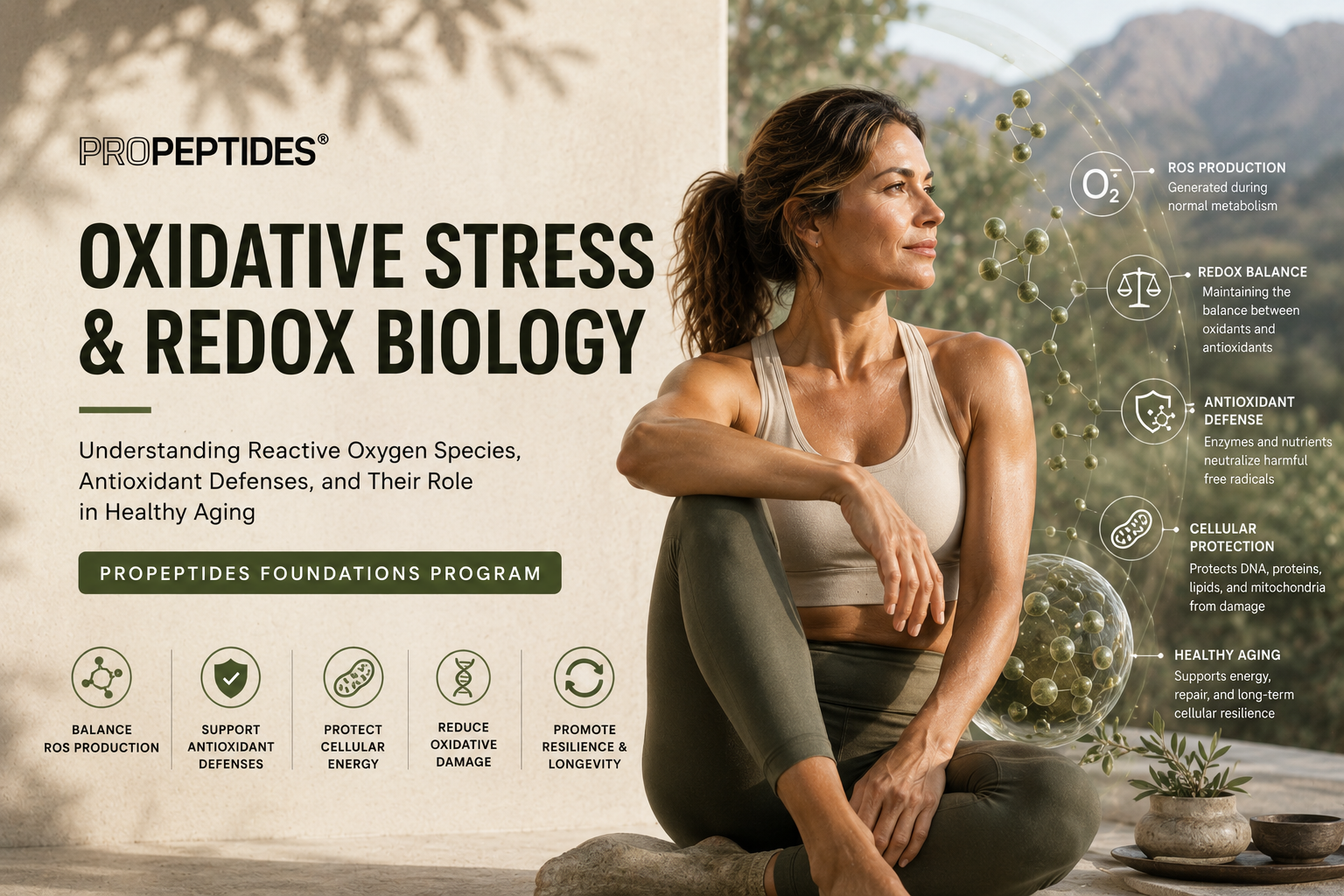
Oxidative Stress & Redox Biology
Understanding Reactive Oxygen Species, Antioxidant Defenses, and Their Role in Healthy Aging
PROPeptides Foundations Program
Every second of every day, billions of chemical reactions occur inside the human body.
Cells produce energy, repair tissues, synthesize proteins, eliminate waste, and respond to constantly changing environmental conditions. While these processes are essential for life, they also generate highly reactive molecules capable of altering proteins, lipids, and DNA.
These molecules are collectively known as reactive oxygen species (ROS).
For decades, ROS were viewed almost exclusively as harmful byproducts of metabolism and were considered one of the primary causes of aging. This perspective fueled enormous interest in antioxidant supplements as a means of slowing the aging process.
Modern research has revealed a far more sophisticated picture.
Reactive oxygen species are not simply cellular toxins. In appropriate amounts, they function as essential signaling molecules that regulate immune function, exercise adaptation, tissue repair, and cellular communication. Problems arise not because ROS exist, but because the balance between oxidant production and antioxidant defense becomes disrupted.
This balance, known as redox homeostasis, is fundamental to healthy aging.
Understanding oxidative stress requires appreciating that biology rarely operates in absolutes. Just as inflammation is necessary for healing but harmful when chronic, reactive oxygen species are both essential and potentially damaging depending on their concentration, location, and duration.
What Are Reactive Oxygen Species?
Reactive oxygen species are highly reactive oxygen-containing molecules produced during normal cellular metabolism.
Common ROS include:
Superoxide (O₂⁻)
Hydrogen peroxide (H₂O₂)
Hydroxyl radicals (•OH)
The majority of ROS are generated within mitochondria during ATP production.
As electrons move through the electron transport chain, a small percentage escape and react with oxygen, producing reactive oxygen species.
Although this process sounds inefficient, it is actually a normal and unavoidable consequence of aerobic metabolism.
Every healthy cell continuously produces ROS.
The goal is not to eliminate them.
The goal is to regulate them.
Reactive Oxygen Species Are Essential Signals
One of the biggest changes in modern biology has been the recognition that ROS serve important physiological functions.
At healthy concentrations, reactive oxygen species regulate:
Cellular adaptation
Gene expression
Immune cell activation
Wound healing
Stem cell behavior
Exercise adaptation
Mitochondrial biogenesis
For example, during exercise, skeletal muscle temporarily produces increased ROS.
Rather than causing damage, these molecules activate signaling pathways that stimulate:
New mitochondria
Increased antioxidant enzymes
Improved endurance
Greater metabolic efficiency
Without this temporary ROS signal, many beneficial exercise adaptations would never occur.
This illustrates another example of hormesis, where temporary physiological stress promotes long-term biological resilience.
What Is Oxidative Stress?
Oxidative stress occurs when reactive oxygen species exceed the body's ability to neutralize them.
This imbalance allows excessive ROS to react with important cellular structures.
Potential targets include:
DNA
Proteins
Lipid membranes
Mitochondrial enzymes
Cellular receptors
Over time, accumulated oxidative damage can impair cellular function and contribute to aging.
Importantly, oxidative stress does not result simply from producing ROS.
Instead, it reflects an imbalance between oxidant production and antioxidant defense.
The Body's Antioxidant Defense System
The human body possesses remarkably sophisticated antioxidant systems designed to maintain redox balance.
These defenses include both enzymatic and non-enzymatic antioxidants.
Enzymatic antioxidants
These include:
Superoxide dismutase (SOD)
Catalase
Glutathione peroxidase
These enzymes continuously convert reactive oxygen species into less reactive molecules before they damage cellular structures.
Non-enzymatic antioxidants
Examples include:
Glutathione
Vitamin C
Vitamin E
Coenzyme Q10
Uric acid
Carotenoids
Rather than functioning independently, these systems work together to maintain redox homeostasis throughout the body.
Oxidative Stress and Aging
As people age, several changes contribute to increasing oxidative stress.
These include:
Reduced mitochondrial efficiency
Increased mitochondrial DNA mutations
Declining antioxidant enzyme activity
Chronic inflammation
Impaired autophagy
Accumulation of damaged mitochondria
Together, these changes gradually increase the burden of oxidative damage throughout tissues.
Organs with particularly high metabolic demands—including the brain, heart, skeletal muscle, and kidneys—are especially dependent upon maintaining healthy redox balance.
Because oxidative stress interacts with nearly every hallmark of aging, it has become one of the central concepts in geroscience.
Oxidative Stress and Chronic Disease
Persistent oxidative stress has been associated with numerous chronic diseases.
Research has identified increased oxidative damage in conditions including:
Cardiovascular disease
Type 2 diabetes
Alzheimer's disease
Parkinson's disease
Chronic kidney disease
Chronic obstructive pulmonary disease
Osteoarthritis
It is important to recognize that oxidative stress rarely acts alone.
Instead, it interacts with chronic inflammation, mitochondrial dysfunction, cellular senescence, and impaired protein quality control to influence disease progression.
Again, aging reflects the interaction of multiple biological systems rather than a single pathological process.
Exercise Demonstrates the Importance of Balance
Exercise provides one of the best examples of why oxidative stress cannot simply be viewed as harmful.
During strenuous exercise:
ROS production increases.
Oxidative stress temporarily rises.
Cellular signaling pathways become activated.
Antioxidant enzymes increase.
Mitochondrial biogenesis is stimulated.
Tissue resilience improves.
Repeated exposure to these temporary stressors strengthens the body's endogenous antioxidant systems.
Ironically, excessive antioxidant supplementation immediately surrounding exercise may blunt some of these adaptive responses by reducing the ROS signals necessary for adaptation.
This has become one of the clearest examples of why eliminating all oxidative stress is neither possible nor desirable.
Nutrition and Redox Balance
Diet provides many nutrients that support normal antioxidant defenses.
Whole-food dietary patterns rich in:
Fruits
Vegetables
Nuts
Legumes
Whole grains
Fish
provide vitamins, minerals, and plant compounds that contribute to healthy redox regulation.
Rather than relying on large doses of isolated antioxidant supplements, current research increasingly supports obtaining antioxidants through diverse dietary patterns that naturally complement the body's endogenous defense systems.
Nutrition therefore supports antioxidant capacity rather than replacing it.
Where Peptides Enter Oxidative Stress Research
Because oxidative stress contributes to many age-related conditions, several investigational peptides have been studied for their potential influence on mitochondrial function and cellular resilience.
Current areas of investigation include peptides that may influence:
Mitochondrial efficiency
Cellular metabolism
Inflammatory signaling
Tissue repair
Redox balance
Examples include:
SS-31 (Elamipretide), which has demonstrated the ability to improve mitochondrial function and reduce oxidative damage in several preclinical models and selected clinical studies involving mitochondrial dysfunction.
MOTS-c, which influences mitochondrial signaling and metabolic adaptation.
Other experimental peptides currently undergoing laboratory investigation.
Although these findings are encouraging, relatively few peptide therapies have demonstrated sufficient evidence to support routine clinical use specifically for reducing oxidative stress in healthy aging.
Redox Biology Connects Every Hallmark of Aging
Oxidative stress influences nearly every major biological process involved in aging.
Excessive oxidative stress can contribute to:
DNA damage
Mitochondrial dysfunction
Cellular senescence
Chronic inflammation
Stem cell exhaustion
Impaired autophagy
Loss of proteostasis
Conversely, dysfunction within any of these systems may further increase oxidative stress.
This creates a self-reinforcing cycle that gradually reduces cellular resilience over time.
Maintaining healthy redox balance therefore represents one component of preserving long-term physiological function.
Bringing It All Together
Reactive oxygen species are no longer viewed simply as harmful byproducts of metabolism. Modern biology recognizes ROS as essential signaling molecules that help regulate exercise adaptation, immune responses, tissue repair, and cellular communication. Healthy physiology depends on maintaining a delicate balance between oxidant production and antioxidant defense rather than eliminating oxidative stress altogether.
As aging progresses, mitochondrial dysfunction, impaired autophagy, chronic inflammation, and declining antioxidant capacity gradually shift this balance toward persistent oxidative stress. The resulting damage contributes to many hallmarks of aging and numerous chronic diseases. Lifestyle interventions—including regular physical activity, nutritious dietary patterns, and metabolic health—remain the strongest evidence-based methods for supporting healthy redox regulation, while ongoing research continues to investigate therapies that may further preserve cellular resilience.
Looking Ahead
While oxidative stress affects virtually every component of the cell, one structure is particularly vulnerable: the cell's genetic material. Every day, DNA experiences thousands of small injuries caused by normal metabolism, environmental exposures, and cellular stress. Fortunately, cells possess sophisticated repair systems that continuously identify and correct many of these errors. As these repair mechanisms gradually become less efficient with age, accumulated genetic damage begins to influence cellular function, tissue health, and long-term aging.
In the next article, we'll explore DNA Damage, Repair & Genomic Stability, examining how cells preserve genetic information, why repair systems decline with age, and how genomic instability has become one of the central hallmarks of aging.
Clinical Perspective
Oxidative stress has evolved from a simplistic theory of aging into a central concept in redox biology that emphasizes balance rather than elimination of reactive oxygen species. While excessive oxidative stress contributes to genomic instability, mitochondrial dysfunction, chronic inflammation, and numerous age-related diseases, physiological ROS production remains essential for normal cellular signaling, exercise adaptation, immune function, and tissue repair. This shift in understanding explains why indiscriminate suppression of ROS has generally failed to produce meaningful clinical benefits in healthy aging. Instead, preserving mitochondrial function, supporting endogenous antioxidant systems, and maintaining overall metabolic health appear to be more effective strategies for promoting long-term cellular resilience. Investigational mitochondrial-targeted peptides continue to expand our understanding of redox regulation, but lifestyle interventions remain the cornerstone of evidence-based approaches to healthy aging.