
Nutrition for Performance
How Food Fuels Adaptation, Recovery, and Human Performance
PROPeptides Foundations Program
Every adaptation discussed throughout this section depends upon one fundamental requirement: the availability of nutrients.
Muscle cannot synthesize new proteins without amino acids.
Bone cannot remodel without minerals.
Mitochondria cannot produce energy without metabolic substrates.
Connective tissues cannot repair collagen without adequate nutrition.
Even the hormones and signaling pathways explored in previous chapters ultimately depend on the body's ability to obtain, process, and utilize nutrients from food.
Exercise provides the stimulus for adaptation.
Nutrition provides the materials required to complete it.
This distinction is one of the central principles of exercise physiology. Regardless of training intensity, peptide therapy, or recovery strategies, adaptation cannot occur without sufficient energy and appropriate building blocks.
Modern performance nutrition has therefore shifted away from simply counting calories toward understanding how nutrients support cellular physiology, tissue remodeling, endocrine function, immune regulation, and long-term health.
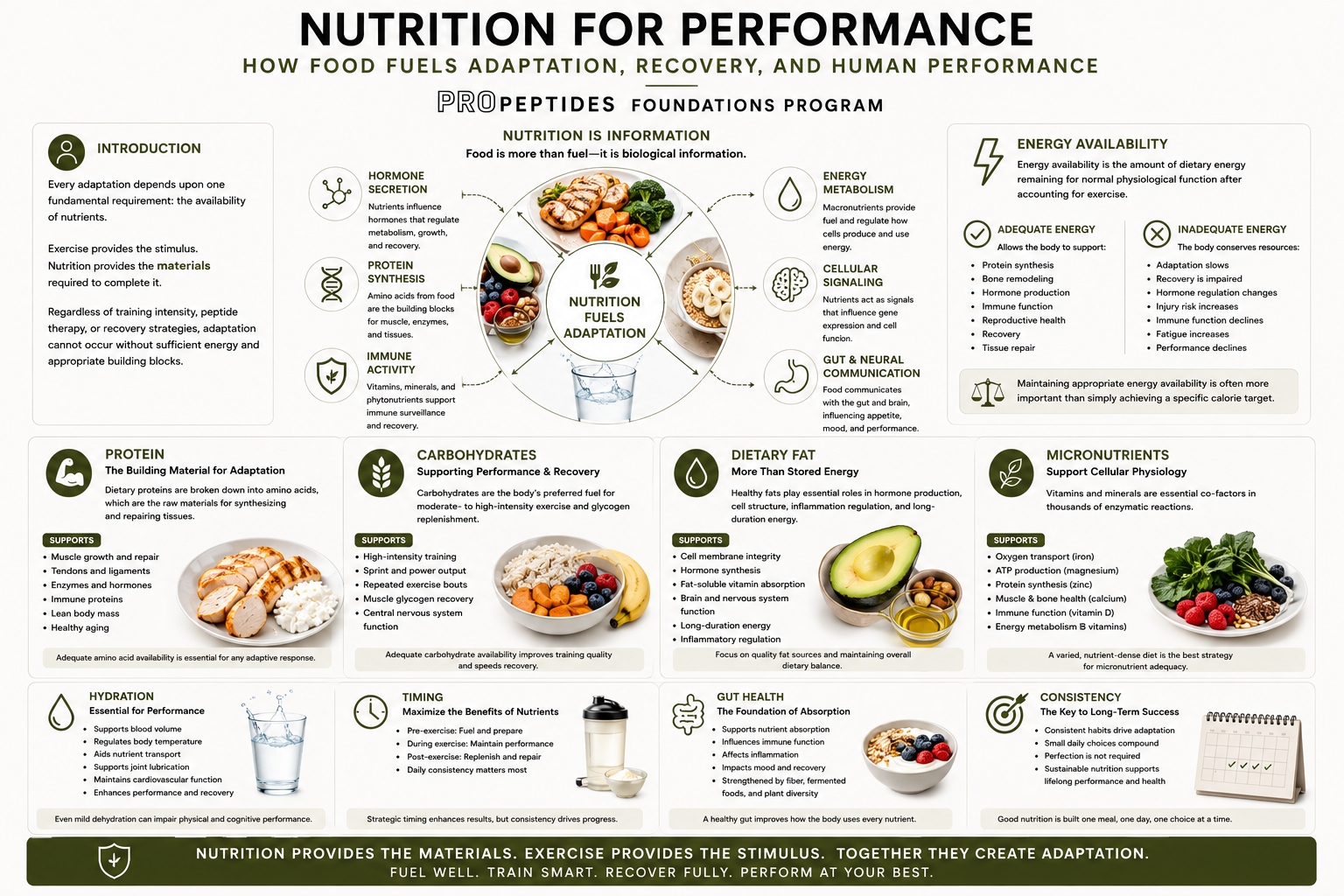
Nutrition Is Information
Food is often viewed simply as fuel.
While nutrients certainly provide energy, they also function as biological signals.
Every meal influences:
Hormone secretion
Blood glucose regulation
Protein synthesis
Immune activity
Cellular metabolism
Gene expression
Gastrointestinal signaling
Neural communication
Proteins, carbohydrates, fats, vitamins, minerals, and water each provide unique information that helps cells determine how to respond to changing physiological demands.
Nutrition therefore represents one of the body's most powerful forms of environmental communication.
Energy Availability
Before muscles can grow or endurance can improve, the body must determine whether enough energy is available to support adaptation.
This concept is known as energy availability.
Energy availability represents the amount of dietary energy remaining for normal physiological function after accounting for exercise.
When adequate energy is available, the body can support:
Protein synthesis
Bone remodeling
Hormone production
Immune function
Reproductive health
Recovery
Tissue repair
When energy availability becomes chronically inadequate, the body begins conserving resources.
Adaptation slows.
Recovery becomes impaired.
Hormonal regulation changes.
Injury risk increases.
For athletes and active individuals, maintaining appropriate energy availability is often more important than simply achieving a specific calorie target.
Protein: The Building Material for Adaptation
Among all dietary nutrients, protein plays the most direct role in tissue remodeling.
Dietary proteins are broken down into amino acids, which serve as the raw materials for synthesizing:
Skeletal muscle proteins
Tendons
Ligaments
Enzymes
Transport proteins
Immune proteins
Hormones
Cellular receptors
Resistance exercise increases the demand for these building blocks by stimulating muscle protein synthesis.
Without adequate amino acid availability, the adaptive response remains limited regardless of training intensity.
Protein intake therefore supports not only muscle growth but also recovery from injury, maintenance of lean body mass, connective tissue health, and healthy aging.
Carbohydrates: Supporting Performance and Recovery
Carbohydrates remain the body's preferred fuel for many forms of moderate- to high-intensity exercise.
During physical activity, carbohydrates are stored primarily as glycogen within skeletal muscle and the liver.
As exercise intensity increases, glycogen becomes an increasingly important energy source.
Adequate carbohydrate availability helps support:
High-intensity training
Sprint performance
Repeated bouts of exercise
Recovery of muscle glycogen
Central nervous system function
Although carbohydrate requirements vary considerably depending on training goals, avoiding unnecessary depletion may improve both performance and the quality of future training sessions.
Dietary Fat: More Than Stored Energy
Dietary fat has often been misunderstood within sports nutrition.
Beyond providing energy, fats serve numerous essential physiological functions.
Healthy dietary fats contribute to:
Cell membrane integrity
Hormone synthesis
Fat-soluble vitamin absorption
Nervous system function
Long-duration energy production
Inflammatory regulation
Fat also provides the essential fatty acids that humans cannot synthesize on their own.
Rather than viewing fat as something to minimize universally, modern nutrition emphasizes selecting appropriate dietary fat sources while maintaining overall dietary balance.
Micronutrients Support Cellular Physiology
Although vitamins and minerals contribute little energy, they are indispensable for normal physiology.
Micronutrients participate in thousands of enzymatic reactions throughout the body.
Examples include:
Iron supporting oxygen transport
Magnesium participating in ATP production
Zinc supporting protein synthesis and immune function
Calcium contributing to muscle contraction and bone health
Vitamin D influencing bone, muscle, and immune function
B vitamins supporting energy metabolism
Even modest deficiencies may impair performance by limiting the efficiency of normal physiological processes.
For most healthy individuals, consuming a varied, nutrient-dense diet remains the preferred strategy for achieving micronutrient adequacy.
Hydration and Performance
Water is frequently overlooked despite being one of the most important nutrients for human performance.
Adequate hydration supports:
Blood volume
Cardiovascular function
Temperature regulation
Nutrient transport
Joint lubrication
Cellular metabolism
Cognitive performance
Fluid losses during prolonged or intense exercise reduce plasma volume, increasing cardiovascular strain and impairing heat dissipation.
Even relatively small degrees of dehydration may negatively affect endurance, strength, concentration, and recovery.
Hydration strategies should therefore account for environmental conditions, exercise duration, sweat losses, and individual variability.
Timing Supports Adaptation
While total daily nutrient intake remains the primary determinant of long-term adaptation, the timing of nutrient consumption can influence certain physiological processes.
Following resistance exercise, skeletal muscle becomes particularly responsive to amino acid availability, creating an environment that supports muscle protein synthesis.
Similarly, replenishing carbohydrate stores after prolonged or high-intensity exercise may accelerate glycogen restoration before subsequent training sessions.
Rather than focusing on narrow "anabolic windows," current evidence suggests that consistent nutrient intake throughout the day better supports long-term adaptation than emphasizing a single meal or supplement.
Nutrition and Recovery
Recovery extends well beyond repairing muscle tissue.
Nutritional support during recovery influences:
Glycogen restoration
Protein synthesis
Immune regulation
Connective tissue remodeling
Hormone production
Mitochondrial adaptation
Nervous system recovery
The quality of recovery often determines the quality of future training.
Consequently, nutrition should be viewed not as a separate component of performance but as an integral part of every adaptive process initiated by exercise.
Nutrition and Peptide Physiology
Throughout this section, we've explored peptides that influence growth hormone signaling, IGF-1 biology, mitochondrial function, and metabolic regulation.
These pathways do not operate independently of nutrition.
For example:
Protein provides the amino acids required for muscle remodeling.
Carbohydrates replenish glycogen and support repeated training.
Healthy fats contribute to endocrine function and cell membrane integrity.
Micronutrients enable countless metabolic reactions.
Adequate energy intake supports the anabolic environment necessary for adaptation.
In other words, peptides may influence signaling pathways, but nutrients provide the substrates those pathways require.
Without adequate nutrition, the biological processes discussed throughout this section remain fundamentally constrained.
Bringing It All Together
Nutrition is far more than a source of calories. It provides the energy, building blocks, and biochemical signals that allow the body to respond to exercise, repair damaged tissues, and adapt to future demands. Every improvement in strength, endurance, recovery, or body composition ultimately depends upon the body's ability to convert nutrients into functional biological change.
From amino acids that support muscle protein synthesis to carbohydrates that replenish glycogen and micronutrients that enable cellular metabolism, nutrition influences every physiological system involved in performance. This interconnected biology explains why dietary quality remains one of the most powerful and evidence-based tools available for improving both athletic performance and long-term health.
As research into peptide medicine continues to evolve, nutrition remains the constant foundation upon which all other interventions are built.
Looking Ahead
Training and nutrition initiate adaptation, but many of the body's most important recovery processes occur during sleep. Hormone secretion, memory consolidation, immune regulation, protein synthesis, and neurological recovery all become highly active during normal sleep cycles. Understanding this physiology is essential for appreciating why recovery is as important as training itself.
In the next article, we'll explore Sleep & Recovery, examining how sleep architecture influences performance, tissue repair, endocrine regulation, and long-term athletic development.
→ Continue to: Sleep & Recovery
Key References
Thomas DT, Erdman KA, Burke LM. Position of the Academy of Nutrition and Dietetics, Dietitians of Canada, and the American College of Sports Medicine: Nutrition and Athletic Performance. Journal of the Academy of Nutrition and Dietetics.
Phillips SM, Van Loon LJC. Dietary Protein for Athletes: From Requirements to Optimum Adaptation. Journal of Sports Sciences.
Burke LM, Hawley JA, Wong SHS, Jeukendrup AE. Carbohydrates for Training and Competition. Journal of Sports Sciences.
Kerksick CM, et al. International Society of Sports Nutrition Position Stand: Nutrient Timing. Journal of the International Society of Sports Nutrition.
Jeukendrup AE. Nutrition for Endurance Sports: Marathon, Triathlon, and Road Cycling. Journal of Sports Sciences.
Clinical Perspective
Performance nutrition is best understood as a component of human physiology rather than a collection of dietary rules. Every physiological adaptation discussed throughout this section—from muscle protein synthesis and mitochondrial remodeling to endocrine regulation and connective tissue repair—depends on adequate energy and nutrient availability. While peptide therapies may influence specific signaling pathways, they cannot replace the fundamental biological role of nutrition. Clinicians should therefore view dietary assessment and optimization as foundational elements of performance medicine, recognizing that nutritional adequacy not only supports athletic goals but also contributes to metabolic health, recovery, injury prevention, and healthy aging.