
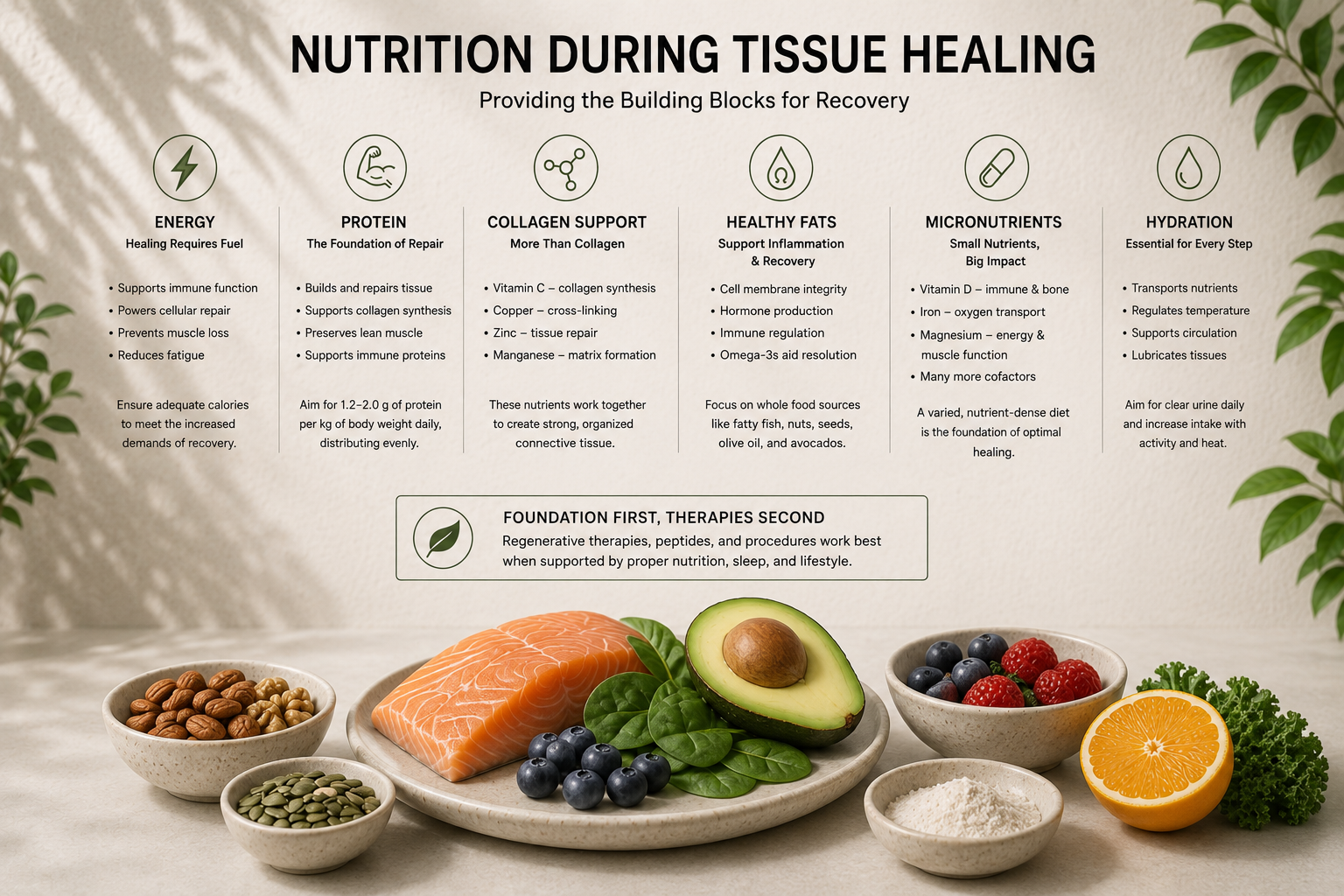
Nutrition During Tissue Healing
Providing the Building Blocks for Recovery
PROPeptides Foundations Program
Every tissue in the human body is built from nutrients.
When an injury occurs, the body's demand for these nutrients increases dramatically. New collagen must be synthesized. Blood vessels must grow into damaged tissue. Immune cells require energy to coordinate inflammation. Muscle proteins are continually broken down and rebuilt. Bone remodeling accelerates, and connective tissues begin constructing an entirely new extracellular matrix.
None of these processes occur without adequate nutritional support.
Although regenerative medicine often focuses on advanced therapies such as platelet-rich plasma (PRP), orthobiologics, or investigational peptides, the success of these treatments ultimately depends on the biological environment in which healing occurs. Without sufficient protein, vitamins, minerals, calories, and hydration, even the most sophisticated regenerative therapies cannot manufacture new tissue.
Nutrition should therefore be viewed as one of the foundational pillars of recovery rather than an afterthought.
Healing Requires Energy
Repair is an energy-intensive process.
Following an injury, the body increases metabolic activity as immune cells become activated, damaged tissue is removed, and new proteins are synthesized. Depending on the severity of the injury, resting energy expenditure may increase substantially during the early stages of healing.
This has important implications.
Individuals recovering from surgery or significant musculoskeletal injuries sometimes reduce their food intake because they are less active. While energy needs may decline slightly due to reduced movement, healing itself continues to require calories.
Chronically under-fueling during recovery may contribute to:
Delayed wound healing
Loss of lean muscle mass
Reduced collagen production
Impaired immune function
Increased fatigue
Prolonged rehabilitation
The goal is not excessive caloric intake, but rather providing sufficient energy to support tissue repair while minimizing unnecessary weight gain during periods of reduced activity.
Protein: The Foundation of Repair
Among all nutrients, protein plays the most direct role in tissue healing.
Proteins are broken down into amino acids, which serve as the raw materials for building:
Collagen
Skeletal muscle
Tendons
Ligaments
Skin
Bone matrix
Blood vessels
Enzymes
Immune proteins
Without an adequate supply of amino acids, the body cannot efficiently construct new tissue.
Current evidence generally supports higher protein intake during recovery than during periods of normal activity. While individual needs vary based on age, body composition, activity level, and the nature of the injury, many sports nutrition and rehabilitation specialists recommend approximately 1.2–2.0 grams of protein per kilogram of body weight per dayduring recovery, with some situations requiring even greater intake under medical supervision.
Distributing protein evenly throughout the day may further support muscle protein synthesis and tissue repair.
Collagen Synthesis Requires More Than Collagen
Collagen is the primary structural protein found in tendons, ligaments, skin, bone, and other connective tissues.
Producing healthy collagen requires far more than simply consuming collagen supplements.
The body must assemble collagen using amino acids while simultaneously relying on several essential micronutrients.
Among the most important are:
Vitamin C
Copper
Zinc
Iron
Manganese
Vitamin C is particularly important because it serves as a cofactor for enzymes responsible for stabilizing newly formed collagen fibers. Without adequate vitamin C, collagen production becomes disorganized and mechanically weaker.
Likewise, copper participates in enzymes that create cross-links between collagen molecules, improving the strength and durability of connective tissue.
These relationships illustrate why successful healing depends on an entire nutritional network rather than any single supplement.
Healthy Fats Support Healing
Dietary fat is often misunderstood during recovery.
In addition to serving as an energy source, fats are essential for:
Cell membrane integrity
Hormone production
Fat-soluble vitamin absorption
Immune regulation
Resolution of inflammation
Omega-3 fatty acids have received particular attention because they contribute to the production of specialized pro-resolving mediators, compounds that help transition inflammation toward tissue repair.
This does not mean that very high-dose omega-3 supplementation is appropriate immediately after every injury. Early inflammation is an important part of normal healing, and ongoing research continues to examine how the timing and amount of supplementation may influence recovery.
For most individuals, a balanced dietary intake of healthy fats from foods such as fatty fish, nuts, seeds, olive oil, and avocados supports overall health and tissue maintenance.
Micronutrients Matter
Healing depends upon numerous vitamins and minerals that function as cofactors for cellular metabolism.
Some of the most important include:
Vitamin C
Supports collagen synthesis and antioxidant defense.
Vitamin D
Contributes to immune regulation, muscle function, and bone health.
Zinc
Essential for cell division, protein synthesis, and wound healing.
Copper
Supports collagen cross-linking and connective tissue strength.
Iron
Facilitates oxygen transport to healing tissues and supports cellular energy production.
Magnesium
Participates in hundreds of enzymatic reactions involved in energy metabolism, muscle function, and protein synthesis.
While supplementation may be appropriate for individuals with documented deficiencies, most people benefit from obtaining these nutrients through a varied, nutrient-dense diet whenever possible.
Hydration and Circulation
Water is often overlooked as a component of healing.
Adequate hydration supports:
Blood volume
Nutrient delivery
Waste removal
Joint lubrication
Cellular metabolism
Tissue elasticity
Even mild dehydration may impair physical performance and influence normal physiological function.
While hydration alone does not accelerate healing, maintaining appropriate fluid balance creates a healthier environment for recovery.
Muscle Preservation During Recovery
Periods of immobilization often result in rapid muscle loss.
Even relatively short periods of reduced activity can decrease muscle size and strength.
Nutrition helps reduce—but does not eliminate—this process.
Strategies that may support muscle preservation include:
Adequate daily protein intake
Even protein distribution throughout the day
Early rehabilitation when medically appropriate
Resistance exercise as healing progresses
Maintaining overall energy intake
Preserving muscle mass is especially important because muscle supports joint stability, movement quality, metabolic health, and long-term functional recovery.
Nutrition Cannot Replace Rehabilitation
Although nutrition provides the raw materials for healing, tissues also require appropriate mechanical stimulation.
Collagen fibers strengthen when they are gradually loaded.
Bone remodels in response to stress.
Muscles adapt through contraction.
Nutrition and rehabilitation therefore work together.
Neither is sufficient on its own.
Providing amino acids without progressive loading does not produce optimal tissue organization, just as rehabilitation without adequate nutrition limits the body's ability to rebuild damaged structures.
Successful recovery depends on both.
A Whole-Body Approach
Healing is rarely influenced by a single nutrient.
Recovery reflects the combined effects of:
Adequate calories
Protein intake
Micronutrient status
Hydration
Sleep
Physical activity
Stress management
Metabolic health
Because these factors interact continuously, nutritional strategies should support the individual as a whole rather than focusing on isolated supplements.
This systems-based approach is increasingly recognized throughout sports medicine and regenerative medicine.
Bringing It All Together
Every stage of tissue repair depends on nutrition.
Protein supplies the amino acids needed to build new tissue. Vitamins and minerals support collagen synthesis, immune function, and cellular metabolism. Healthy fats contribute to membrane integrity and inflammatory regulation. Water supports circulation and nutrient delivery.
No regenerative therapy can substitute for these biological necessities.
Whether recovering from a muscle strain, tendon injury, surgical procedure, or orthobiologic treatment, providing the body with adequate nutritional support creates the foundation upon which healing occurs.
Nutrition does not replace regenerative medicine—it enables it.
Looking Ahead
While nutrition supplies the biological building blocks for recovery, tissues also require the correct mechanical stimulus to organize and strengthen newly formed collagen.
Movement is not simply a way to regain function—it is a biological signal that influences how healing tissue develops.
In the next article, we'll explore Exercise & Rehabilitation, examining how progressive loading, physical therapy, and movement guide tissue remodeling and long-term recovery.
Key References
Tipton KD. Nutritional Support for Exercise-Induced Injuries. Sports Medicine.
Phillips SM, Van Loon LJC. Dietary Protein for Athletes: From Requirements to Optimum Adaptation. Journal of Sports Sciences.
Thomas DT, Erdman KA, Burke LM. Position of the Academy of Nutrition and Dietetics, Dietitians of Canada, and the American College of Sports Medicine: Nutrition and Athletic Performance. Medicine & Science in Sports & Exercise.
Calder PC. Omega-3 Fatty Acids and Inflammatory Processes. Nutrients.
Close GL, Sale C, Baar K, Bermon S. Nutrition for the Prevention and Treatment of Injuries in Track and Field Athletes. International Journal of Sport Nutrition and Exercise Metabolism.
Clinical Perspective
Nutrition is one of the few aspects of recovery that every patient can influence beginning on the day of an injury. In our practice, we view nutrition as a foundational component of regenerative care rather than a secondary recommendation. Patients recovering from tendon injuries, ligament sprains, muscle tears, fractures, or regenerative procedures are encouraged to focus on adequate protein intake, nutrient-dense foods, hydration, and overall metabolic health throughout rehabilitation. While supplements may have a role in selected individuals, the greatest impact usually comes from consistently meeting the body's basic nutritional needs. Advanced regenerative therapies work best when they are supported by an internal environment that has the resources necessary to repair, remodel, and restore healthy tissue.