
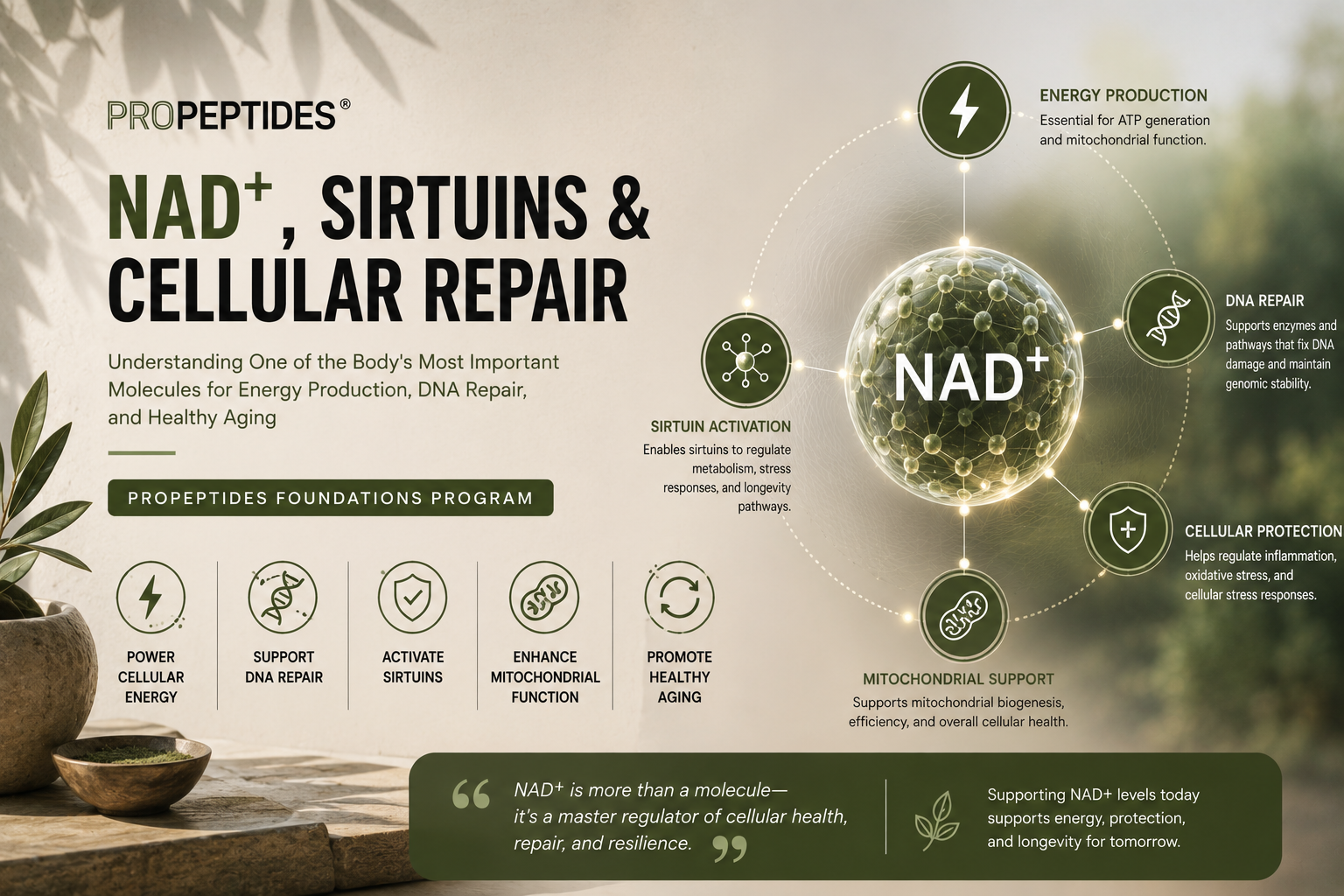
NAD⁺, Sirtuins & Cellular Repair
Understanding One of the Body's Most Important Molecules for Energy Production, DNA Repair, and Healthy Aging
PROPeptides Foundations Program
Every cell in the human body requires an enormous amount of energy simply to remain alive.
Cells must produce ATP, repair damaged DNA, maintain proteins, regulate inflammation, respond to stress, and communicate with neighboring tissues—all while continuously adapting to changing environmental conditions. Coordinating these countless processes requires more than energy alone. It also requires specialized molecules that serve as biochemical messengers between metabolic activity and cellular maintenance.
One of the most important of these molecules is nicotinamide adenine dinucleotide (NAD⁺).
Although relatively unfamiliar outside the scientific community, NAD⁺ participates in hundreds of biochemical reactions throughout the body. It is essential for energy metabolism, mitochondrial function, DNA repair, antioxidant defenses, cellular stress responses, and the regulation of proteins known as sirtuins, which have become major subjects of longevity research.
Unlike DNA or proteins, NAD⁺ is not simply a structural component of the cell.
It is continuously consumed, recycled, and regenerated.
As people age, cellular NAD⁺ levels gradually decline. This reduction has been associated with decreased mitochondrial function, impaired DNA repair, altered metabolic regulation, and reduced cellular resilience. These observations have made NAD⁺ biology one of the most actively investigated areas in modern geroscience.
Understanding NAD⁺ provides insight into how cells coordinate the enormous metabolic demands required to preserve health throughout life.
What Is NAD⁺?
NAD⁺ is a coenzyme present in virtually every living cell.
Unlike enzymes, which directly catalyze chemical reactions, coenzymes assist enzymes by transferring molecules or electrons during metabolic reactions.
NAD⁺ serves primarily as an electron carrier.
As nutrients are broken down for energy, NAD⁺ accepts electrons and becomes its reduced form, NADH.
NADH then transports these electrons to the mitochondrial electron transport chain, where they ultimately contribute to ATP production.
Without NAD⁺, oxidative metabolism would rapidly cease.
Life depends on this continuous cycle between NAD⁺ and NADH.
NAD⁺ Powers Cellular Energy Production
One of the primary functions of NAD⁺ is supporting cellular respiration.
Throughout glycolysis, the citric acid cycle, and oxidative phosphorylation, NAD⁺ repeatedly transfers electrons that ultimately allow mitochondria to produce ATP.
Virtually every tissue depends upon this process, especially organs with high energy demands such as:
Brain
Heart
Skeletal muscle
Liver
Kidneys
As NAD⁺ availability decreases, mitochondrial efficiency may decline, reducing the cell's ability to generate energy during periods of increased physiological demand.
This relationship explains why NAD⁺ biology is closely linked with mitochondrial health.
NAD⁺ Does More Than Produce Energy
Although energy metabolism remains its best-known function, NAD⁺ participates in numerous additional cellular processes.
These include:
DNA repair
Cellular stress responses
Mitochondrial maintenance
Circadian rhythm regulation
Inflammatory signaling
Gene expression
Protein modification
Cellular adaptation
Many of these functions depend upon specialized enzymes that require NAD⁺ as an essential substrate.
Among the most important are sirtuins and PARPs.
Sirtuins: Cellular Maintenance Proteins
Sirtuins are a family of enzymes that regulate numerous aspects of cellular health.
Humans possess seven known sirtuins (SIRT1–SIRT7), each with specialized functions throughout different cellular compartments.
Collectively, sirtuins influence:
DNA repair
Mitochondrial function
Metabolic regulation
Inflammation
Oxidative stress
Circadian rhythm
Stem cell maintenance
Cellular adaptation
Unlike many enzymes, sirtuins cannot function effectively without NAD⁺.
As cellular NAD⁺ declines, sirtuin activity may also decrease.
This relationship has become one of the central concepts in longevity biology.
PARPs: Protecting the Genome
Another major consumer of NAD⁺ is the family of enzymes known as poly(ADP-ribose) polymerases (PARPs).
PARPs serve as DNA damage sensors.
When DNA injury occurs, PARPs rapidly bind damaged DNA and recruit repair proteins necessary to restore genomic integrity.
This repair process requires substantial amounts of NAD⁺.
When DNA damage becomes extensive:
PARP activity increases.
NAD⁺ consumption rises.
Cellular energy demand increases.
Under normal conditions this response is beneficial.
However, chronic DNA damage may contribute to progressive NAD⁺ depletion over time.
This illustrates how multiple hallmarks of aging become biologically interconnected.
Why NAD⁺ Declines With Age
Researchers continue investigating the reasons NAD⁺ levels decrease throughout life.
Current evidence suggests multiple contributing factors.
These include:
Increased DNA damage
Greater PARP activation
Reduced NAD⁺ synthesis
Increased inflammation
Declining mitochondrial function
Increased activity of NAD⁺-consuming enzymes such as CD38
Rather than resulting from one isolated mechanism, declining NAD⁺ appears to reflect cumulative changes across numerous physiological systems.
This again reinforces the concept that aging is fundamentally a systems biology process.
NAD⁺ and Mitochondrial Health
Healthy mitochondria require adequate NAD⁺ availability.
Reduced NAD⁺ may contribute to:
Lower ATP production
Reduced mitochondrial biogenesis
Impaired metabolic flexibility
Increased oxidative stress
Decreased exercise capacity
Conversely, healthy mitochondrial function helps maintain efficient NAD⁺ cycling.
These two systems continuously support one another.
As dysfunction develops in one, the other often becomes affected as well.
NAD⁺ and Circadian Rhythm
One of the more fascinating discoveries in recent years is the relationship between NAD⁺ and the body's internal biological clock.
NAD⁺ levels fluctuate throughout the day in response to:
Feeding
Fasting
Physical activity
Sleep
Light exposure
These fluctuations help regulate circadian genes involved in:
Hormone secretion
Energy metabolism
DNA repair
Cellular maintenance
Disruption of normal circadian rhythms—including chronic sleep deprivation and shift work—may alter NAD⁺ metabolism and contribute to reduced cellular resilience over time.
NAD⁺ Supplementation: Current Research
Because NAD⁺ declines with age, researchers have investigated methods of increasing intracellular NAD⁺.
Current areas of investigation include:
Nicotinamide riboside (NR)
Nicotinamide mononucleotide (NMN)
Intravenous NAD⁺
Oral NAD⁺ precursors
Lifestyle interventions that influence endogenous NAD⁺ metabolism
Early studies demonstrate that several of these approaches can increase circulating NAD⁺ metabolites.
Whether these increases consistently translate into meaningful improvements in healthy aging remains an area of active scientific investigation.
At present, evidence varies depending upon the specific intervention, population studied, and clinical outcome being measured.
Where Peptides Enter NAD⁺ Biology
Although NAD⁺ itself is not a peptide, several investigational peptides interact with physiological systems closely connected to NAD⁺ metabolism.
Examples include peptides being studied for their effects on:
Mitochondrial function
Energy metabolism
Exercise adaptation
Cellular resilience
For example:
MOTS-c influences metabolic signaling pathways that overlap with NAD⁺-dependent cellular adaptation.
SS-31 (Elamipretide) has been investigated for improving mitochondrial efficiency, indirectly supporting processes that rely on adequate cellular energy production.
At present, no peptide therapy has been approved specifically to restore NAD⁺ levels or reverse age-related NAD⁺ decline.
Research continues to explore how mitochondrial health, metabolism, and peptide signaling intersect with NAD⁺ biology.
Lifestyle Strongly Influences NAD⁺ Biology
Current evidence suggests several lifestyle factors naturally support healthy NAD⁺ metabolism.
These include:
Regular aerobic exercise
Resistance training
Healthy sleep patterns
Metabolic health
Appropriate nutritional intake
Maintenance of healthy body composition
Exercise, in particular, appears to stimulate many of the same mitochondrial and metabolic pathways regulated by NAD⁺ and sirtuins.
This reinforces an important principle seen throughout this educational program:
Healthy physiology is built upon integrated biological systems rather than isolated interventions.
Bringing It All Together
NAD⁺ is one of the most important molecules in human physiology, serving as a critical link between cellular energy production, DNA repair, mitochondrial function, and metabolic regulation. Every cell depends upon adequate NAD⁺ availability to maintain normal function, respond to stress, and preserve genomic integrity. Because NAD⁺ is continuously consumed and regenerated, maintaining its balance requires healthy mitochondrial activity, efficient metabolism, and intact cellular repair systems.
As aging progresses, declining NAD⁺ levels appear to contribute to reduced mitochondrial efficiency, impaired DNA repair, altered circadian regulation, and diminished cellular resilience. These observations have made NAD⁺ biology one of the most active areas of longevity research. Although supplementation strategies and investigational therapies continue to evolve, lifestyle interventions that support mitochondrial health, metabolic flexibility, and overall physiological function remain the strongest evidence-based approaches for preserving the biological systems that depend upon NAD⁺.
Looking Ahead
While NAD⁺ supports the molecular machinery responsible for maintaining healthy cells, aging also affects how entire tissues communicate with one another. Over time, the immune system undergoes gradual functional changes that contribute to persistent low-grade inflammation, even in the absence of infection. This phenomenon, often referred to as inflammaging, has become one of the defining features of biological aging and influences nearly every organ system.
In the next article, we'll explore Inflammaging & Chronic Low-Grade Inflammation, examining why inflammation changes with age, how it interacts with the hallmarks of aging, and why controlling chronic inflammation has become a central goal of healthy aging research.
Clinical Perspective
NAD⁺ occupies a central position in human physiology because it connects energy metabolism, mitochondrial function, DNA repair, circadian biology, and cellular stress responses. Declining NAD⁺ availability has been observed across multiple tissues during aging and is associated with reduced metabolic flexibility and diminished cellular resilience. While considerable attention has focused on NAD⁺ supplementation through precursors such as nicotinamide riboside and nicotinamide mononucleotide, the long-term clinical significance of increasing NAD⁺ levels in otherwise healthy individuals remains under investigation. Likewise, peptide therapies that influence mitochondrial function and metabolism may interact with NAD⁺-dependent pathways but have not been approved specifically to restore NAD⁺ biology. Current evidence continues to support an integrated approach in which regular exercise, healthy sleep, sound nutrition, and metabolic health provide the physiological foundation upon which future longevity interventions may build.