
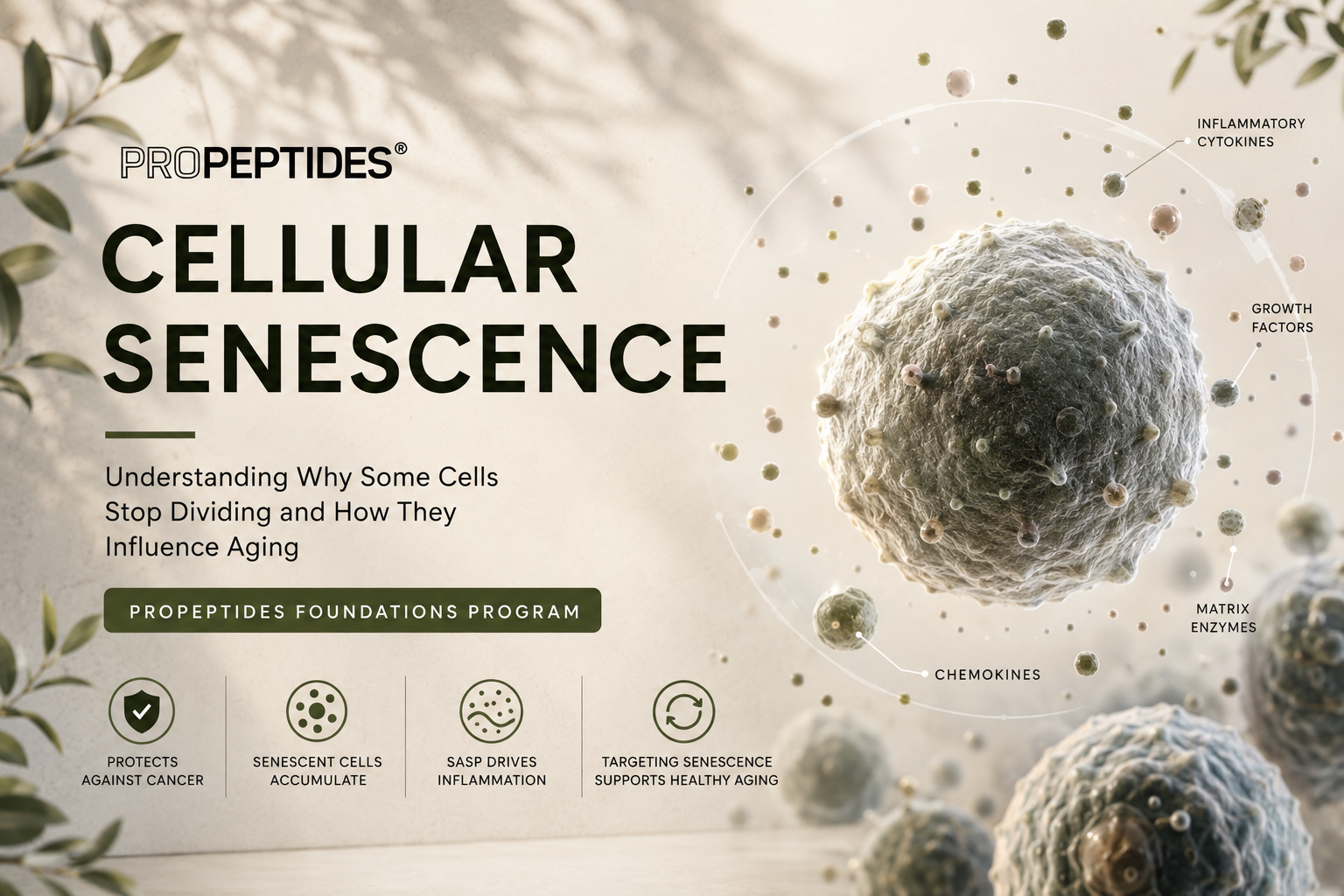
Cellular Senescence
Understanding Why Some Cells Stop Dividing and How They Influence Aging
PROPeptides Foundations Program
Introduction
Every cell in the human body has a finite lifespan.
Some cells, such as skin and intestinal cells, divide frequently throughout life to replace worn or damaged tissue. Others, including neurons and cardiac muscle cells, divide very little after development. Regardless of their normal lifespan, every cell is constantly exposed to physiological stress from DNA damage, oxidative stress, inflammation, metabolic activity, infection, and environmental exposures.
When damage becomes too extensive to safely repair, cells must make an important biological decision.
They may repair themselves and continue functioning.
They may undergo apoptosis, a highly regulated form of programmed cell death.
Or they may enter a third state known as cellular senescence.
Cellular senescence is a protective biological mechanism that prevents damaged cells from continuing to divide. While this process plays an essential role in preventing cancer and supporting wound healing, the long-term accumulation of senescent cells is now recognized as one of the major contributors to biological aging.
Understanding cellular senescence provides important insight into why tissues gradually lose resilience with age and why researchers have become increasingly interested in therapies that influence senescent cell biology.
What Is Cellular Senescence?
Cellular senescence is a state in which a cell permanently stops dividing while remaining metabolically active.
Unlike apoptosis, the cell does not die.
Unlike healthy cells, it no longer contributes to tissue renewal through normal cell division.
Instead, senescent cells remain within tissues where they continue producing proteins, inflammatory molecules, growth factors, and signaling compounds that influence neighboring cells.
Initially, this response serves an important protective purpose.
Preventing damaged cells from dividing reduces the risk of passing harmful genetic mutations to future generations of cells.
In this way, senescence functions as one of the body's natural defenses against cancer development.
Why Do Cells Become Senescent?
Cells enter senescence when they experience sufficient stress or damage that continued division could become harmful.
Common triggers include:
DNA damage
Oxidative stress
Chronic inflammation
Telomere shortening
Radiation exposure
Certain chemotherapy medications
Mitochondrial dysfunction
Persistent cellular injury
These stressors activate intracellular pathways that permanently arrest the cell cycle.
Rather than allowing damaged cells to continue replicating, the body effectively places them into a biological "retirement."
The Hayflick Limit
One of the earliest discoveries leading to our understanding of senescence came from the work of Leonard Hayflick in the 1960s.
Hayflick demonstrated that normal human cells cannot divide indefinitely.
Instead, most cells divide a limited number of times before permanently exiting the cell cycle.
This phenomenon became known as the Hayflick Limit.
One major contributor to this limit involves structures called telomeres, repetitive DNA sequences located at the ends of chromosomes.
Each time a cell divides, telomeres gradually shorten.
When they become critically short, the cell interprets this as DNA damage and activates senescence pathways to prevent further division.
Although telomere shortening is only one pathway leading to senescence, it remains one of the best-known mechanisms associated with biological aging.
Senescence Protects Against Cancer
At first glance, permanently stopping cell division may appear harmful.
In reality, senescence represents one of the body's most effective anti-cancer defenses.
Cancer develops when damaged cells continue dividing despite accumulated genetic mutations.
By forcing these damaged cells into permanent growth arrest, senescence helps prevent uncontrolled cellular proliferation.
For this reason, senescence illustrates an important concept in biology:
A mechanism that is beneficial early in life may become less advantageous later in life.
Young organisms benefit enormously from strong tumor suppression.
As senescent cells accumulate with age, however, these same protective mechanisms may begin contributing to chronic tissue dysfunction.
The Senescence-Associated Secretory Phenotype (SASP)
Although senescent cells no longer divide, they remain biologically active.
One of their defining characteristics is the production of a collection of signaling molecules known as the Senescence-Associated Secretory Phenotype, or SASP.
The SASP includes:
Inflammatory cytokines
Chemokines
Growth factors
Matrix-remodeling enzymes
Extracellular signaling proteins
Initially, these molecules serve useful purposes.
They recruit immune cells to remove damaged tissue.
They assist wound healing.
They help coordinate tissue remodeling.
Problems arise when senescent cells persist instead of being removed.
When Senescent Cells Accumulate
In younger individuals, the immune system efficiently recognizes and removes many senescent cells.
As immune function gradually changes with age, this clearance becomes less efficient.
Senescent cells begin accumulating throughout multiple tissues, including:
Skeletal muscle
Skin
Bone
Blood vessels
Fat tissue
Joints
Liver
Brain
Persistent SASP signaling creates a state of chronic, low-grade inflammation that can influence neighboring healthy cells.
Rather than functioning as isolated damaged cells, senescent cells actively alter their surrounding tissue environment.
This accumulation is now considered one of the central biological features of aging.
Senescence and Chronic Disease
Researchers have identified increased numbers of senescent cells in many age-related diseases.
Current evidence suggests senescence may contribute to:
Osteoarthritis
Pulmonary fibrosis
Atherosclerosis
Type 2 diabetes
Alzheimer's disease
Chronic kidney disease
Osteoporosis
Sarcopenia
It is important to recognize that senescence is unlikely to be the sole cause of these conditions.
Instead, senescent cells appear to interact with other biological processes—including mitochondrial dysfunction, chronic inflammation, impaired autophagy, and immune aging—to influence disease progression.
This reinforces the concept that aging is a systems-level process rather than the result of a single mechanism.
Senolytics and Senomorphics
Because accumulated senescent cells appear to contribute to aging, researchers have begun investigating therapies that target these cells.
Two major approaches have emerged.
Senolytics are therapies designed to selectively eliminate senescent cells while leaving healthy cells largely unaffected.
Animal studies have demonstrated improvements in physical function, lifespan, and multiple markers of tissue health following senescent cell clearance.
Human research remains in its early stages, and no senolytic therapy has yet been approved specifically for healthy aging.
A second strategy involves senomorphics.
Rather than eliminating senescent cells, senomorphic therapies aim to reduce or modify SASP signaling, decreasing the harmful inflammatory effects of these cells while preserving potential beneficial functions.
Both approaches remain active areas of investigation.
Where Peptides Enter Senescence Research
Several investigational peptides have attracted interest because they may influence biological pathways associated with senescence or tissue repair.
Researchers are exploring whether certain peptides affect:
Cellular stress responses
Inflammatory signaling
Mitochondrial function
Tissue regeneration
Immune regulation
Clearance of damaged cells
At present, however, there are no peptide therapies approved specifically for eliminating senescent cells or reversing cellular senescence in humans.
Future research may clarify whether peptide-based therapies can safely influence these complex biological systems.
For now, senescence research remains one of the most promising—and carefully evolving—areas of longevity science.
Healthy Lifestyle Supports Cellular Resilience
Although senolytic research receives considerable attention, lifestyle continues to influence many biological pathways involved in senescence.
Regular exercise has been associated with:
Improved mitochondrial health
Reduced chronic inflammation
Better immune surveillance
Enhanced metabolic function
Nutritious dietary patterns, adequate sleep, stress management, and maintaining a healthy body composition similarly support the cellular maintenance systems responsible for limiting accumulated damage throughout life.
These interventions cannot completely prevent senescence, but they may help preserve tissue resilience over time.
Bringing It All Together
Cellular senescence represents one of the body's most important protective mechanisms. By permanently stopping damaged cells from dividing, senescence reduces the risk of cancer and supports normal tissue repair following injury. However, as senescent cells accumulate with age, their persistent inflammatory signaling can disrupt neighboring tissues, contributing to chronic inflammation, impaired regeneration, and many of the physiological changes associated with aging.
Modern longevity research seeks to better understand this balance between protection and dysfunction. Rather than viewing senescence as inherently beneficial or harmful, scientists recognize it as a complex biological process whose effects depend on timing, tissue context, immune surveillance, and the body's ability to remove damaged cells. This nuanced understanding has driven growing interest in therapies that target senescent cell biology while preserving the protective functions that senescence provides.
Looking Ahead
Cellular senescence is only one contributor to biological aging. Another process that plays a central role is the gradual decline in the cell's ability to produce energy efficiently. Nearly every biological function—from muscle contraction and tissue repair to immune defense and cognitive performance—depends on healthy mitochondria. As mitochondrial function changes with age, cells become less efficient, more vulnerable to stress, and less capable of meeting the body's energy demands.
In the next article, we'll explore Mitochondria & Cellular Energy, examining how these remarkable organelles generate ATP, why mitochondrial dysfunction develops with age, and why preserving mitochondrial health has become a major focus of longevity research.
→ Continue to: Mitochondria & Cellular Energy
Clinical Perspective
Cellular senescence has emerged as one of the defining mechanisms of biological aging because it sits at the intersection of cancer prevention, tissue repair, immune regulation, and chronic inflammation. While senescence is an essential protective response that prevents damaged cells from proliferating, the gradual accumulation of senescent cells appears to contribute to declining tissue function across multiple organ systems. This has led to significant interest in senolytic and senomorphic therapies aimed at modifying senescent cell biology. Although several investigational compounds—including some peptides—are being explored for their potential influence on pathways related to senescence, no peptide therapy has been conclusively shown to reverse cellular senescence or has been approved specifically for healthy aging. Continued research will determine whether targeted modulation of senescent cells can safely improve healthspan while preserving the important protective functions that senescence provides.