
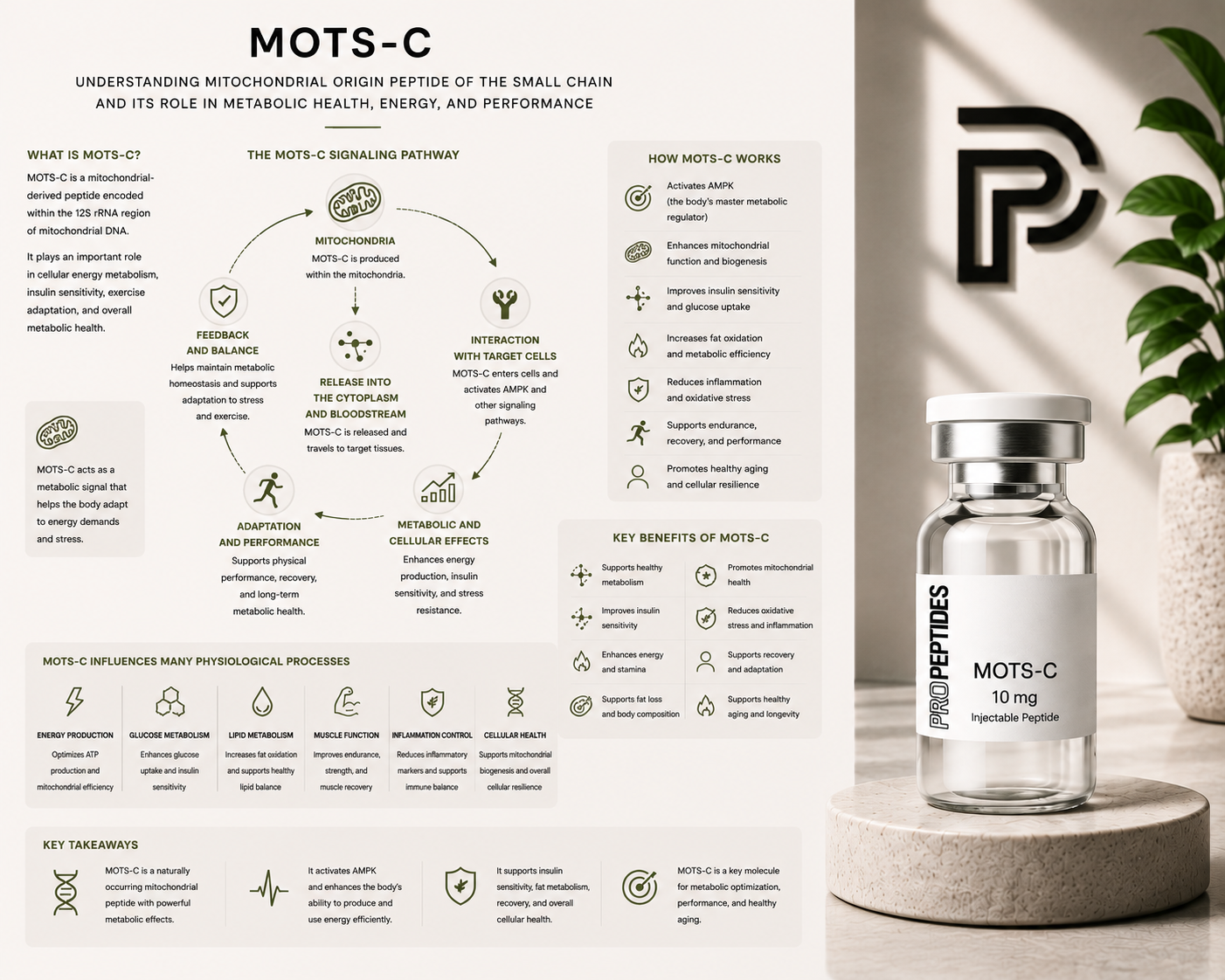
MOTS-c
Understanding the Mitochondrial Peptide That Connects Energy Production, Metabolism, and Exercise Adaptation
PROPeptides Foundations Program
Every movement begins with energy.
Whether sprinting down a track, recovering from a workout, climbing stairs, or simply maintaining posture, the body depends upon a continuous supply of adenosine triphosphate (ATP) to fuel cellular function. Producing that energy is one of the primary responsibilities of the mitochondria, often referred to as the "powerhouses" of the cell.
For decades, mitochondria were viewed primarily as microscopic energy factories whose main purpose was converting nutrients into ATP.
Modern biology has dramatically expanded that understanding.
Researchers now recognize mitochondria as dynamic signaling organelles that continuously communicate with the nucleus, influence immune function, regulate oxidative stress, coordinate metabolism, and help determine how cells adapt to physiological stress.
One of the most surprising discoveries supporting this new perspective was the identification of a small group of biologically active molecules encoded within mitochondrial DNA itself.
These molecules are known as mitochondrial-derived peptides (MDPs).
Among the first and most extensively studied of these peptides is MOTS-c.
Rather than functioning through the growth hormone axis, MOTS-c appears to influence cellular metabolism, insulin sensitivity, mitochondrial adaptation, and exercise physiology. Although research remains in relatively early stages, MOTS-c has become an important model for understanding how mitochondrial signaling contributes to human performance and healthy aging.
Mitochondria Are More Than Power Plants
Every cell contains structures specialized for producing energy.
These structures—the mitochondria—generate ATP through oxidative phosphorylation, a process that converts carbohydrates, fats, and, under certain conditions, amino acids into usable cellular energy.
While ATP production remains their best-known function, mitochondria participate in many additional physiological processes, including:
Calcium regulation
Reactive oxygen species signaling
Apoptosis (programmed cell death)
Heat production
Innate immune signaling
Cellular adaptation
Metabolic regulation
Rather than functioning independently, mitochondria constantly communicate with the rest of the cell.
This bidirectional communication allows cells to continuously adjust metabolism according to changing physiological demands.
Mitochondria Have Their Own DNA
One of the most fascinating aspects of mitochondria is that they possess their own genetic material.
Unlike nuclear DNA, which contains approximately 20,000 protein-coding genes, mitochondrial DNA is much smaller and was traditionally believed to encode only proteins involved in energy production.
This assumption changed when researchers discovered that mitochondrial DNA also produces several biologically active signaling peptides.
These discoveries fundamentally altered our understanding of mitochondrial biology.
Rather than serving only as energy producers, mitochondria also function as endocrine-like signaling organelles capable of influencing physiology throughout the body.
What Is MOTS-c?
MOTS-c (Mitochondrial Open Reading Frame of the 12S rRNA-c) is a naturally occurring peptide encoded within mitochondrial DNA.
Unlike most signaling peptides discussed throughout this educational program, MOTS-c is not synthesized from genes located within the cell nucleus.
Instead, it originates from the mitochondrial genome itself.
After being produced, MOTS-c appears capable of influencing both local cellular function and broader systemic metabolism.
Although many aspects of its biology remain under investigation, current research suggests that MOTS-c functions as a metabolic stress-response peptide.
Exercise and Metabolic Stress
Every exercise session temporarily disrupts cellular homeostasis.
Working muscles experience:
Increased ATP consumption
Rising AMP concentrations
Glycogen depletion
Increased oxygen demand
Reactive oxygen species production
Mechanical stress
Rather than representing damage alone, these changes serve as signals that stimulate adaptation.
Cells respond by improving:
Mitochondrial function
Glucose utilization
Fat oxidation
Antioxidant defenses
Metabolic flexibility
MOTS-c appears to participate in coordinating some of these adaptive responses.
AMPK: The Cell's Energy Sensor
One of the most important regulators of cellular energy metabolism is AMP-activated protein kinase (AMPK).
AMPK becomes activated whenever the cell detects declining energy availability.
Its role is straightforward:
Restore energy balance.
To accomplish this, AMPK promotes:
Glucose uptake
Fatty acid oxidation
Mitochondrial biogenesis
ATP conservation
Reduced energy expenditure on nonessential processes
Because of its central role in exercise physiology, AMPK has become one of the most extensively studied metabolic signaling pathways.
Experimental evidence suggests MOTS-c may influence this pathway, although the precise mechanisms continue to be investigated.
Nuclear–Mitochondrial Communication
One of the most intriguing discoveries surrounding MOTS-c is its potential ability to influence gene expression.
Experimental studies suggest that under conditions of metabolic stress, MOTS-c may translocate from the mitochondria to the nucleus, where it appears to interact with transcriptional programs involved in cellular adaptation.
This process—known as mitochondrial retrograde signaling—illustrates that communication between the mitochondria and nucleus is bidirectional.
Rather than functioning independently, these two genetic systems continuously exchange information to coordinate metabolism and adaptation.
Although this remains an active area of research, it represents one of the most novel aspects of MOTS-c biology.
Exercise Mimetic or Exercise Enhancer?
MOTS-c has sometimes been described as an "exercise mimetic."
This description should be interpreted cautiously.
Exercise influences thousands of biological pathways simultaneously, including:
Mechanical loading
Neuromuscular adaptation
Cardiovascular conditioning
Hormonal regulation
Connective tissue remodeling
Bone adaptation
Mitochondrial biogenesis
Immune modulation
No single molecule reproduces these complex physiological responses.
Instead, current evidence suggests MOTS-c may influence some of the metabolic pathways activated during exercise, particularly those related to mitochondrial adaptation and energy metabolism.
It should therefore be viewed as a potential modulator of exercise-related physiology rather than a replacement for physical activity.
Current Research
Research involving MOTS-c has expanded rapidly over the past decade.
Areas under investigation include:
Insulin sensitivity
Obesity
Metabolic syndrome
Exercise adaptation
Skeletal muscle metabolism
Healthy aging
Physical performance
Mitochondrial dysfunction
Animal studies have demonstrated promising biological effects, including improvements in metabolic regulation and exercise capacity under certain experimental conditions.
Human research, however, remains relatively limited.
Additional clinical trials are needed to determine whether these findings translate into meaningful health or performance outcomes.
Safety and Current Evidence
At present, MOTS-c remains an investigational peptide.
Although early human studies have generally reported acceptable tolerability, the overall clinical evidence remains limited.
Questions that continue to be investigated include:
Long-term safety
Optimal dosing
Duration of therapy
Appropriate patient selection
Effects across different age groups
Interactions with exercise and nutrition
As with other investigational peptides discussed throughout this program, current enthusiasm should be balanced with recognition of the existing evidence gaps.
MOTS-c Compared with the Growth Hormone Axis
Unlike the peptides discussed in previous chapters, MOTS-c does not primarily influence the GH–IGF-1 axis.
Feature
GH Axis Peptides / MOTS-c
Primary biological target
Endocrine regulation / Cellular metabolism
Primary physiological focus
Growth, tissue remodeling / Energy regulation and metabolic adaptation
Main pathways
GHRH, ghrelin, GH, IGF-1 / AMPK, mitochondrial signaling, metabolic stress responses
Origin
Hypothalamic and pituitary physiology / Mitochondrial-derived peptide
This distinction illustrates an important evolution in peptide medicine: not all therapeutic peptides act through traditional endocrine systems. Some, like MOTS-c, are being studied for their potential role in regulating intracellular metabolism and cellular adaptation.
Bringing It All Together
MOTS-c represents one of the most intriguing discoveries in modern peptide biology because it challenges the traditional view of mitochondria as simple energy-producing organelles. Instead, mitochondria are increasingly recognized as dynamic signaling centers that help coordinate metabolism, stress responses, and adaptation throughout the body.
As a mitochondrial-derived peptide, MOTS-c appears to participate in communication between cellular energy status and gene regulation. Experimental evidence suggests it may influence pathways involved in glucose metabolism, insulin sensitivity, mitochondrial adaptation, and responses to exercise-related metabolic stress. Although many aspects of its biology remain under investigation, MOTS-c has expanded our understanding of how intracellular signaling contributes to performance and healthy aging.
Perhaps most importantly, MOTS-c reinforces a central theme of this section: optimal performance depends not only on hormones and muscle growth but also on the ability of cells to efficiently produce and manage energy.
Looking Ahead
Building strength and improving performance require far more than activating individual biological pathways. In practice, clinicians often consider how multiple physiological systems interact—including the growth hormone axis, mitochondrial function, recovery, nutrition, and exercise adaptation. Understanding these interactions provides the foundation for evaluating combination approaches rather than focusing on any single peptide in isolation.
In the next article, we'll explore Combination Performance Therapy, examining the physiological rationale for combining peptides that target different biological systems, the current evidence supporting these strategies, and the importance of integrating peptide therapy with exercise, nutrition, sleep, and recovery.
Key References
Lee C, Zeng J, Drew BG, et al. The Mitochondrial-Derived Peptide MOTS-c Promotes Metabolic Homeostasis and Reduces Obesity and Insulin Resistance. Cell Metabolism.
Kim KH, Son JM, Benayoun BA, Lee C. The Mitochondrial-Encoded Peptide MOTS-c Translocates to the Nucleus to Regulate Adaptive Gene Expression During Metabolic Stress. Cell Metabolism.
Reynolds JC, Lai RW, Woodhead JST, et al. MOTS-c Is an Exercise-Induced Mitochondrial-Encoded Regulator of Age-Dependent Physical Decline and Muscle Homeostasis. Nature Communications.
Wallace DC. Mitochondria as Organelles of Cellular Signaling and Disease. Cell.
Nunnari J, Suomalainen A. Mitochondria: In Sickness and in Health. Cell.
Clinical Perspective
MOTS-c has introduced a new dimension to peptide medicine by highlighting the role of mitochondria as signaling organelles rather than simply producers of cellular energy. Its investigation has shifted attention toward metabolic resilience, mitochondrial communication, and the adaptive responses that occur during exercise and aging. While preclinical studies have generated considerable interest, human evidence remains in its early stages, and many questions regarding long-term efficacy, safety, and clinical application remain unanswered. For clinicians and patients alike, MOTS-c serves as a reminder that improving performance is not solely about increasing anabolic signaling—it also depends on optimizing the cellular systems responsible for producing the energy that powers every physiological adaptation.