
Ipamorelin
Understanding Ghrelin Signaling and Selective Growth Hormone Secretion
PROPeptides Foundations Program
Growth hormone secretion is regulated through multiple physiological pathways that work together to maintain endocrine balance.
In the previous chapter, we explored how growth hormone-releasing hormone (GHRH) stimulates the pituitary gland to initiate growth hormone release. However, GHRH is only one component of the body's regulatory system. Another important signal originates outside the brain, linking nutritional status, energy balance, and endocrine function.
This signal is ghrelin.
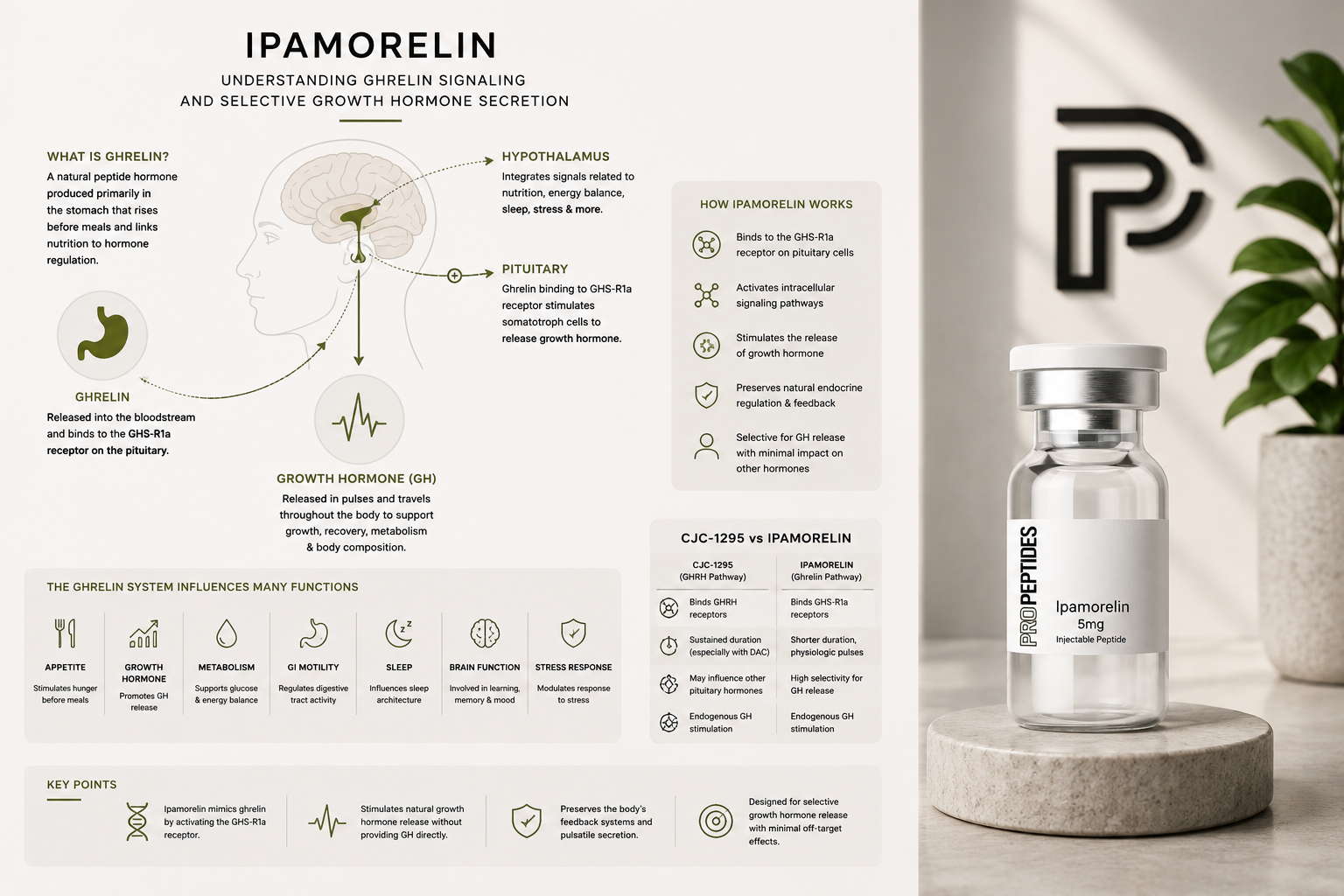
Discovered in 1999, ghrelin was initially recognized for its role in stimulating appetite, but researchers soon identified another important function. Ghrelin also acts as one of the body's natural stimulators of growth hormone secretion through activation of the growth hormone secretagogue receptor (GHS-R1a).
This discovery led to the development of several synthetic compounds designed to activate the same receptor. Among these, Ipamorelin has attracted considerable attention because of its high receptor selectivity and relatively limited stimulation of other pituitary hormones compared with earlier growth hormone secretagogues.
Like CJC-1295, Ipamorelin does not function as growth hormone itself. Instead, it works upstream within the body's existing endocrine system, influencing one of the physiological pathways responsible for endogenous growth hormone release.
Understanding how Ipamorelin works begins with understanding the biology of ghrelin.
What Is Ghrelin?
Ghrelin is a naturally occurring peptide hormone produced primarily by specialized endocrine cells within the stomach.
Although smaller amounts are produced elsewhere in the body, circulating ghrelin originates predominantly from the gastrointestinal tract.
Ghrelin concentrations typically:
Rise before meals
Decline after eating
Increase during fasting
Respond to changes in energy balance
These fluctuations help coordinate communication between the digestive system, the brain, and the endocrine system.
Because of this relationship, ghrelin is often referred to as the body's hunger hormone.
However, appetite regulation represents only one aspect of its physiological role.
Ghrelin Is More Than an Appetite Hormone
Beyond regulating hunger, ghrelin influences numerous physiological systems.
Current research suggests ghrelin participates in:
Growth hormone secretion
Appetite regulation
Energy balance
Glucose metabolism
Gastrointestinal motility
Cardiovascular physiology
Sleep regulation
Learning and memory
Stress responses
These diverse functions reflect the widespread distribution of ghrelin receptors throughout the body.
The endocrine system rarely assigns a single function to one hormone.
Instead, hormones coordinate multiple physiological processes simultaneously.
The Growth Hormone Secretagogue Receptor
The biological effects of ghrelin are mediated through the growth hormone secretagogue receptor (GHS-R1a).
This receptor is expressed in several tissues but is especially important within:
The hypothalamus
The anterior pituitary
When ghrelin binds to this receptor, intracellular signaling pathways stimulate the release of growth hormone from pituitary somatotroph cells.
Importantly, this pathway operates independently of the GHRH receptor discussed in the previous chapter.
The existence of two separate regulatory systems illustrates the redundancy built into human physiology.
Rather than relying upon a single signal, the body integrates multiple sources of information before determining how much growth hormone should be released.
What Is Ipamorelin?
Ipamorelin is a synthetic peptide classified as a growth hormone secretagogue.
Rather than mimicking growth hormone itself, it selectively activates the GHS-R1a receptor, reproducing one aspect of endogenous ghrelin physiology.
Unlike ghrelin, however, Ipamorelin has been engineered to minimize many of ghrelin's effects on appetite and other endocrine systems.
This selective receptor activity distinguishes Ipamorelin from earlier generations of growth hormone secretagogues.
Why Was Ipamorelin Developed?
Earlier growth hormone secretagogues demonstrated that activation of the ghrelin receptor could increase endogenous growth hormone secretion.
However, many of these compounds also stimulated:
Cortisol
Prolactin
Appetite
Gastrointestinal activity
Researchers therefore sought a molecule capable of stimulating growth hormone release while minimizing unwanted endocrine effects.
Ipamorelin was developed with this objective.
Its relatively selective receptor profile has made it one of the most extensively discussed investigational peptides within the growth hormone secretagogue class.
How Ipamorelin Works
After administration, Ipamorelin binds to the growth hormone secretagogue receptor (GHS-R1a) on pituitary somatotroph cells.
Activation of this receptor initiates intracellular signaling that promotes endogenous growth hormone release.
Unlike recombinant growth hormone, Ipamorelin does not deliver growth hormone directly.
Instead, it stimulates the pituitary to release growth hormone already stored within the gland.
This distinction preserves much of the body's normal endocrine architecture.
Growth hormone secretion continues to remain subject to:
Somatostatin inhibition
Negative feedback from IGF-1
Physiological endocrine regulation
Although endocrine physiology is influenced, it is not completely bypassed.
CJC-1295 and Ipamorelin: Two Different Physiological Signals
Because CJC-1295 and Ipamorelin influence different receptors, they are frequently discussed together.
However, they should not be viewed as interchangeable therapies.
Characteristic
CJC-1295 / Ipamorelin
Mimics
Growth hormone-releasing hormone (GHRH) / Ghrelin
Primary receptor
GHRH receptor / Growth hormone secretagogue receptor (GHS-R1a)
Physiological pathway
Hypothalamic GHRH signaling / Ghrelin signaling
Primary action
Stimulates pituitary through GHRH receptor / Stimulates pituitary through ghrelin receptor
From a physiological perspective, this relationship resembles the body's own regulatory network.
Normal growth hormone secretion reflects the combined influence of GHRH, ghrelin, somatostatin, sleep, exercise, nutrition, and negative feedback from IGF-1.
By acting through different receptors, CJC-1295 and Ipamorelin target complementary components of this natural system.
Why Researchers Study Combination Therapy
One reason CJC-1295 and Ipamorelin are frequently investigated together is that endogenous growth hormone secretion normally depends on more than one regulatory signal.
GHRH and ghrelin act through separate receptors but converge on the same pituitary somatotroph cells.
Preclinical and early clinical research has explored whether simultaneous stimulation of both pathways may produce different endocrine responses than stimulation of either pathway alone.
Although this physiological rationale is well established, additional high-quality clinical trials are needed to determine whether combined therapy produces meaningful long-term differences in body composition, recovery, muscle adaptation, or functional outcomes.
Exercise, Sleep, and Ghrelin
Like other endocrine pathways, ghrelin signaling is influenced by lifestyle.
Research has demonstrated relationships between ghrelin physiology and:
Sleep duration
Caloric intake
Fasting
Exercise
Body composition
Circadian rhythms
These interactions reinforce an important concept emphasized throughout this educational program.
Peptides function within physiology.
They do not replace physiology.
Training, nutrition, recovery, and sleep continue to influence endocrine function regardless of whether peptide therapies are being investigated.
Clinical Research
Human studies involving Ipamorelin have primarily examined:
Endogenous growth hormone secretion
Endocrine physiology
Body composition
Metabolic effects
Growth hormone deficiency research
Compared with recombinant growth hormone, relatively limited long-term clinical evidence exists evaluating Ipamorelin in healthy individuals seeking improvements in athletic performance.
Although endocrine responses have been demonstrated, additional research is needed to determine how these hormonal changes influence clinically meaningful outcomes such as strength, muscle hypertrophy, recovery, or healthy aging.
Safety and Current Evidence
Published studies have generally reported that Ipamorelin was well tolerated under the conditions investigated.
Reported adverse effects have included:
Injection-site discomfort
Headache
Flushing
Mild nausea
Because Ipamorelin influences the GH–IGF-1 axis, ongoing research continues to evaluate its long-term effects on glucose metabolism, endocrine regulation, and overall safety.
As with many performance-oriented peptides, Ipamorelin remains investigational, and current evidence does not yet establish its long-term effectiveness or safety for routine performance enhancement in otherwise healthy individuals.
Bringing It All Together
Ipamorelin illustrates another layer of the body's sophisticated endocrine regulation. Rather than acting as growth hormone itself, it selectively stimulates the growth hormone secretagogue receptor, reproducing one aspect of the physiological signaling normally provided by ghrelin.
Its mechanism differs fundamentally from CJC-1295, which acts through the GHRH receptor. Together, these two pathways demonstrate that endogenous growth hormone secretion is governed by multiple complementary regulatory systems rather than a single hormone or receptor.
Understanding this physiology is essential when evaluating peptide therapies. The body's endocrine network is designed to integrate signals from sleep, nutrition, exercise, metabolism, and hormonal feedback before determining how growth hormone should be released. Ipamorelin represents one investigational approach to influencing that complex system—not replacing it.
Looking Ahead
Both CJC-1295 and Ipamorelin are investigational peptides designed to stimulate endogenous growth hormone secretion. A different approach is represented by Tesamorelin, a synthetic GHRH analog that has completed extensive clinical development and is FDA approved for a specific medical indication.
In the next article, we'll explore Tesamorelin, examining its mechanism of action, established clinical use in HIV-associated lipodystrophy, and what its development has taught us about growth hormone physiology, visceral adipose tissue, and metabolic health.
Key References
Smith RG, Van der Ploeg LHT, Howard AD, et al. Peptidomimetic Regulation of Growth Hormone Secretion Through the Growth Hormone Secretagogue Receptor. Endocrine Reviews.
Kojima M, Hosoda H, Date Y, et al. Ghrelin Is a Growth Hormone-Releasing Acylated Peptide From Stomach.Nature.
Howard AD, et al. Identification of the Growth Hormone Secretagogue Receptor. Science.
Melmed S, Auchus RJ, Goldfine AB, Koenig RJ, Rosen CJ. Williams Textbook of Endocrinology.
Nass R, Gaylinn BD, Thorner MO. The Ghrelin Axis and Growth Hormone Regulation. Endocrine Reviews.
Clinical Perspective
Ipamorelin is often described simply as a "growth hormone peptide," but its biology is considerably more nuanced. It was developed to selectively activate the growth hormone secretagogue receptor, one of the body's normal pathways for regulating endogenous growth hormone release. This selective mechanism distinguishes it from both recombinant growth hormone and GHRH analogs such as CJC-1295. While the physiological rationale for targeting ghrelin signaling is well established, evidence regarding long-term clinical outcomes in healthy individuals remains limited. As with all investigational performance peptides, understanding the underlying endocrine physiology is essential for placing emerging research into its proper clinical context.