
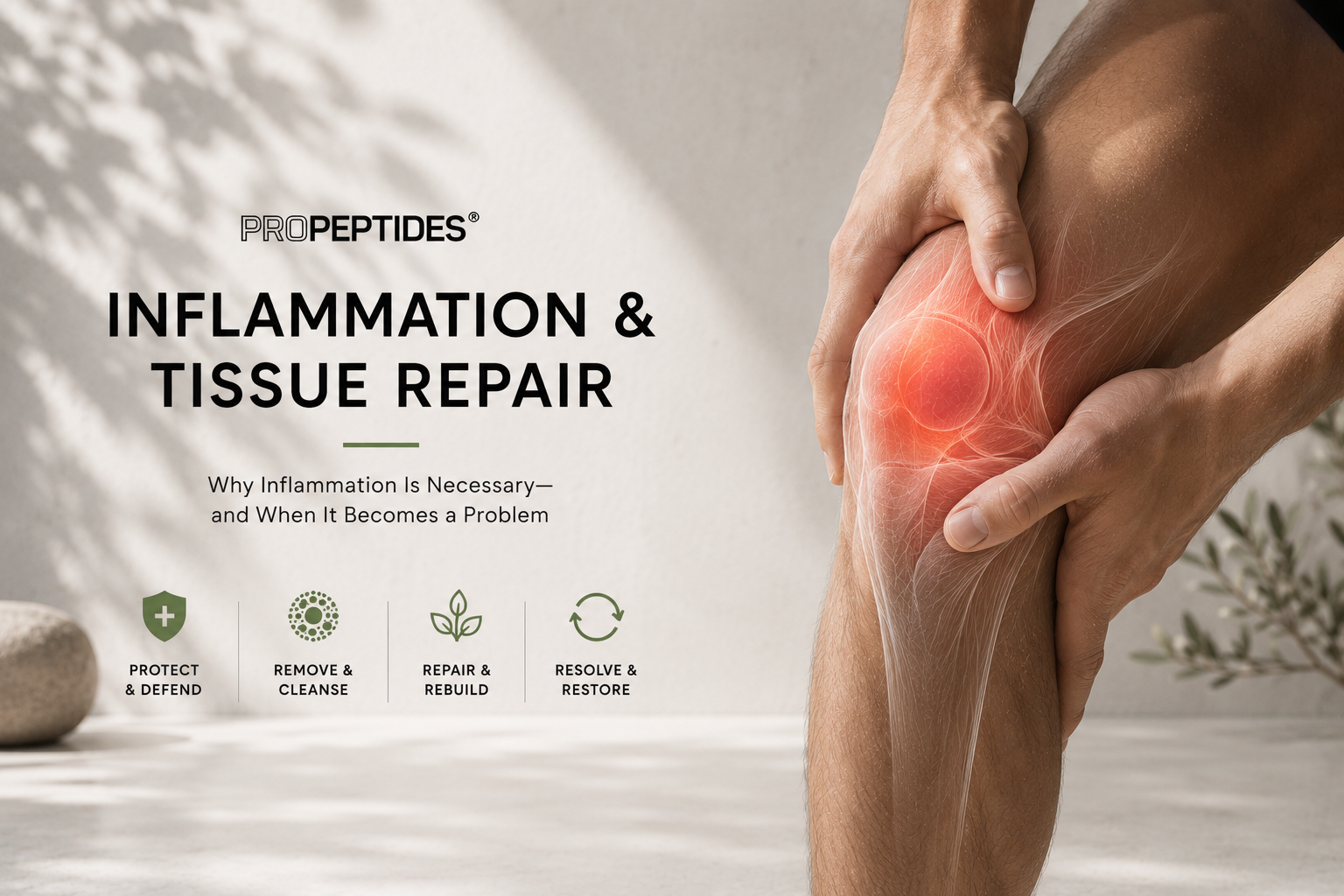
Inflammation & Tissue Repair
Why Inflammation Is Necessary—and When It Becomes a Problem
PROPeptides Foundations Program
Few biological processes are more misunderstood than inflammation.
For many people, inflammation has become synonymous with disease. Television commercials advertise anti-inflammatory medications. Food labels promote anti-inflammatory ingredients. Countless health articles encourage people to "reduce inflammation" as though inflammation itself were inherently harmful.
The reality is far more complex.
Inflammation is not a disease.
It is one of the body's most important survival mechanisms.
Without inflammation, cuts would not heal, fractures would never repair, infections would rapidly spread, and damaged tissues would remain permanently injured. Every successful healing response begins with inflammation.
The problem is not inflammation itself.
The problem occurs when inflammation becomes excessive, persists longer than necessary, or fails to transition into the next phase of healing.
Understanding the difference between healthy acute inflammation and chronic dysregulated inflammation is fundamental to understanding regenerative medicine.
What Is Inflammation?
Inflammation is the body's coordinated response to injury, infection, or cellular damage.
When tissues are injured, specialized cells detect structural damage almost immediately.
Within minutes, these cells release signaling molecules that initiate a cascade of biological events designed to:
Stop bleeding
Remove damaged tissue
Eliminate pathogens
Recruit immune cells
Begin tissue repair
Restore normal function
Although inflammation is often associated with redness and swelling, these visible changes represent only a small portion of a much larger biological response.
Inflammation involves continuous communication among immune cells, blood vessels, connective tissue, and the nervous system.
It is one of the body's primary methods of coordinating repair.
The Five Classic Signs of Inflammation
For over two thousand years, physicians have recognized the characteristic features of acute inflammation.
These include:
Redness (Rubor) — caused by increased blood flow
Heat (Calor) — resulting from vascular dilation
Swelling (Tumor) — produced by increased vascular permeability
Pain (Dolor) — generated by inflammatory mediators and tissue pressure
Loss of Function (Functio Laesa) — temporary reduction in normal tissue function
Although these changes may appear alarming, they are often evidence that the body has initiated an appropriate healing response.
Acute Inflammation: The Beginning of Healing
Acute inflammation begins within minutes after injury.
Blood vessels near the damaged tissue become more permeable, allowing immune cells and proteins to enter the injured area.
This early inflammatory response serves several essential purposes.
Cleaning the Injury
Damaged cells cannot simply remain within injured tissue.
They must be removed before reconstruction can begin.
Neutrophils and macrophages engulf:
Dead cells
Damaged collagen
Cellular debris
Bacteria
Foreign material
This cleanup process creates the environment necessary for new tissue formation.
Calling for Help
Inflammation also serves as a communication system.
Injured tissues release signaling molecules known as cytokines and chemokines that recruit additional repair cells.
Examples include:
Interleukin-1 (IL-1)
Interleukin-6 (IL-6)
Tumor necrosis factor-alpha (TNF-α)
MCP-1
Various growth factors
These molecules coordinate the arrival of immune cells, fibroblasts, endothelial cells, and other participants in healing.
Preparing for Repair
Inflammation does not simply remove damaged tissue.
It also prepares the body to rebuild.
Growth factors released during this stage stimulate:
Angiogenesis
Fibroblast activation
Collagen synthesis
Cell proliferation
Extracellular matrix formation
Without this inflammatory signaling, later stages of healing would be significantly impaired.
The Immune Cells of Healing
The immune system is often viewed primarily as a defense against infection.
In reality, immune cells also function as architects of tissue repair.
Several cell populations play especially important roles.
Neutrophils
Neutrophils are typically the first immune cells to arrive following injury.
Their primary responsibilities include:
Destroying bacteria
Removing damaged tissue
Releasing antimicrobial proteins
Initiating early inflammation
Although they are essential during the first stage of healing, neutrophils normally decline rapidly as repair progresses.
Persistent neutrophil activity may contribute to unnecessary tissue damage.
Macrophages
Macrophages are among the most important cells in regenerative medicine.
Unlike neutrophils, macrophages perform different functions depending on the stage of healing.
Early after injury, macrophages adopt a predominantly inflammatory phenotype.
Their responsibilities include:
Removing damaged tissue
Clearing cellular debris
Eliminating microorganisms
Recruiting additional immune cells
As healing progresses, macrophages undergo a remarkable functional transition.
They begin releasing growth factors that stimulate:
Blood vessel formation
Collagen production
Fibroblast activity
Tissue remodeling
Rather than promoting inflammation, they now promote regeneration.
This shift illustrates one of the most important principles in tissue repair:
Successful healing depends not only on initiating inflammation but on resolving it appropriately.
Resolution Is an Active Process
For many years, scientists believed inflammation simply faded away once healing began.
Research now shows that resolution is an active biological process, regulated by specialized signaling molecules and immune cells.
The body intentionally switches from a pro-inflammatory environment to one focused on tissue repair and remodeling.
This transition involves:
Reduced inflammatory cytokine production
Increased anti-inflammatory mediators
Clearance of apoptotic immune cells
Activation of fibroblasts
Collagen organization
Restoration of tissue homeostasis
Failure of this transition may contribute to persistent pain, delayed healing, fibrosis, and chronic inflammatory disease.
Healing is successful not because inflammation stops, but because it changes.
When Inflammation Becomes Chronic
Unlike acute inflammation, chronic inflammation is characterized by persistent immune activation that continues long after the original injury has occurred.
This prolonged inflammatory state may result from:
Repetitive mechanical overload
Ongoing tissue degeneration
Metabolic disease
Autoimmune disorders
Poor vascular supply
Obesity
Smoking
Persistent infection
Inadequate rehabilitation
Instead of progressing efficiently toward tissue repair, the inflammatory process becomes trapped in a cycle of ongoing injury and incomplete healing.
Over time, this environment may contribute to:
Tendinopathy
Osteoarthritis
Chronic low back pain
Rotator cuff degeneration
Plantar fasciopathy
Persistent muscle dysfunction
These conditions often involve degeneration and failed healing in addition to inflammation.
Pain Does Not Always Equal Inflammation
One of the most common misconceptions is that all pain results from inflammation.
Pain can arise from many different mechanisms, including:
Mechanical overload
Nerve irritation
Structural instability
Central nervous system sensitization
Degenerative tissue changes
Muscle dysfunction
Joint pathology
Likewise, significant inflammation may sometimes be present with relatively little pain.
For this reason, pain intensity alone does not accurately reflect the biological state of injured tissue.
Successful treatment requires understanding the underlying cause rather than treating pain in isolation.
Inflammation and Regenerative Medicine
Many regenerative therapies are designed not simply to suppress inflammation but to support the transition from inflammation to healing.
For example:
Platelet-rich plasma (PRP) delivers concentrated growth factors that participate in early repair signaling.
Progressive rehabilitation provides mechanical stimuli that influence collagen organization.
Nutritional optimization supplies the substrates required for tissue synthesis.
Investigational peptides are being studied for their potential effects on cellular communication, angiogenesis, immune regulation, and tissue remodeling.
The objective is not to eliminate inflammation entirely.
Instead, the goal is to encourage a coordinated healing response that progresses through its normal biological stages.
Because the evidence supporting different regenerative therapies varies, treatment decisions should be based on the quality of available research, the specific injury being treated, and the individual patient's clinical circumstances.
Bringing It All Together
Inflammation is one of the body's oldest and most sophisticated biological defense systems.
When properly regulated, it removes damaged tissue, recruits repair cells, stimulates new blood vessel formation, and initiates the rebuilding process that restores structure and function.
Problems arise when inflammation becomes excessive, fails to resolve, or exists within an environment that cannot support effective healing.
Modern regenerative medicine is built upon understanding this balance.
Rather than viewing inflammation as an enemy, clinicians increasingly recognize it as an essential phase of tissue repair that must be appropriately initiated, carefully regulated, and ultimately resolved.
Looking Ahead
Once inflammation has initiated the healing process, the body relies on a network of signaling molecules to coordinate tissue repair.
One of the most widely discussed investigational peptides in regenerative medicine is BPC-157. Laboratory and animal studies suggest it may influence several biological pathways involved in angiogenesis, cellular migration, and tissue repair, although high-quality human clinical evidence remains limited.
In the next article, we will examine what BPC-157 is, how it is thought to work, the current state of the scientific evidence, and the important questions that remain unanswered.
Key References
Medzhitov R. Origin and Physiological Roles of Inflammation. Nature. 2008.
Serhan CN. Pro-Resolving Lipid Mediators Are Leads for Resolution Physiology. Nature. 2014.
Wynn TA, Vannella KM. Macrophages in Tissue Repair, Regeneration, and Fibrosis. Immunity. 2016.
Frangogiannis NG. The Inflammatory Response in Tissue Repair. Nature Reviews Immunology. 2020.
Eming SA, Martin P, Tomic-Canic M. Wound Repair and Regeneration: Mechanisms, Signaling, and Translation.Science Translational Medicine. 2014.
Nathan C, Ding A. Nonresolving Inflammation. Cell. 2010.
Clinical Perspective
One of the most common discussions we have with patients is that inflammation is not inherently harmful. In the early stages of an injury, inflammation is often a sign that the body has recognized damage and initiated the healing process. The clinical challenge is determining where a patient is within that healing timeline. An acutely injured ligament, a chronically degenerative tendon, and an arthritic joint may all present with pain, yet each exists in a very different biological environment. Effective regenerative care begins with an accurate diagnosis, an understanding of tissue healing, and a treatment strategy that supports the appropriate phase of recovery rather than assuming every painful condition should be managed the same way.