
IGF-1 LR3
Understanding Insulin-Like Growth Factor-1 and Its Role in Growth, Repair, and Performance
PROPeptides Foundations Program
Growth hormone receives much of the attention in discussions surrounding performance medicine, but many of its physiological effects are carried out by another molecule: insulin-like growth factor-1 (IGF-1).
Although closely linked to growth hormone, IGF-1 is not simply a downstream messenger. It is an important hormone and local growth factor with biological effects that extend throughout nearly every stage of human life. From fetal development to skeletal growth, muscle remodeling, bone maintenance, nervous system development, and tissue repair, IGF-1 helps coordinate how tissues respond to mechanical stress, injury, and changing metabolic demands.
Because of these broad biological functions, researchers have investigated whether modifying IGF-1 signaling could influence muscle growth, recovery, and age-related decline.
One investigational compound developed for this purpose is IGF-1 LR3.
IGF-1 LR3 is a modified analog of naturally occurring IGF-1 that was engineered to remain biologically active longer than endogenous IGF-1. Unlike peptides such as CJC-1295, Ipamorelin, or Tesamorelin—which stimulate the body's own endocrine system—IGF-1 LR3 acts directly at the level of the IGF-1 receptor.
Understanding how IGF-1 LR3 works first requires understanding the normal biology of IGF-1 itself.
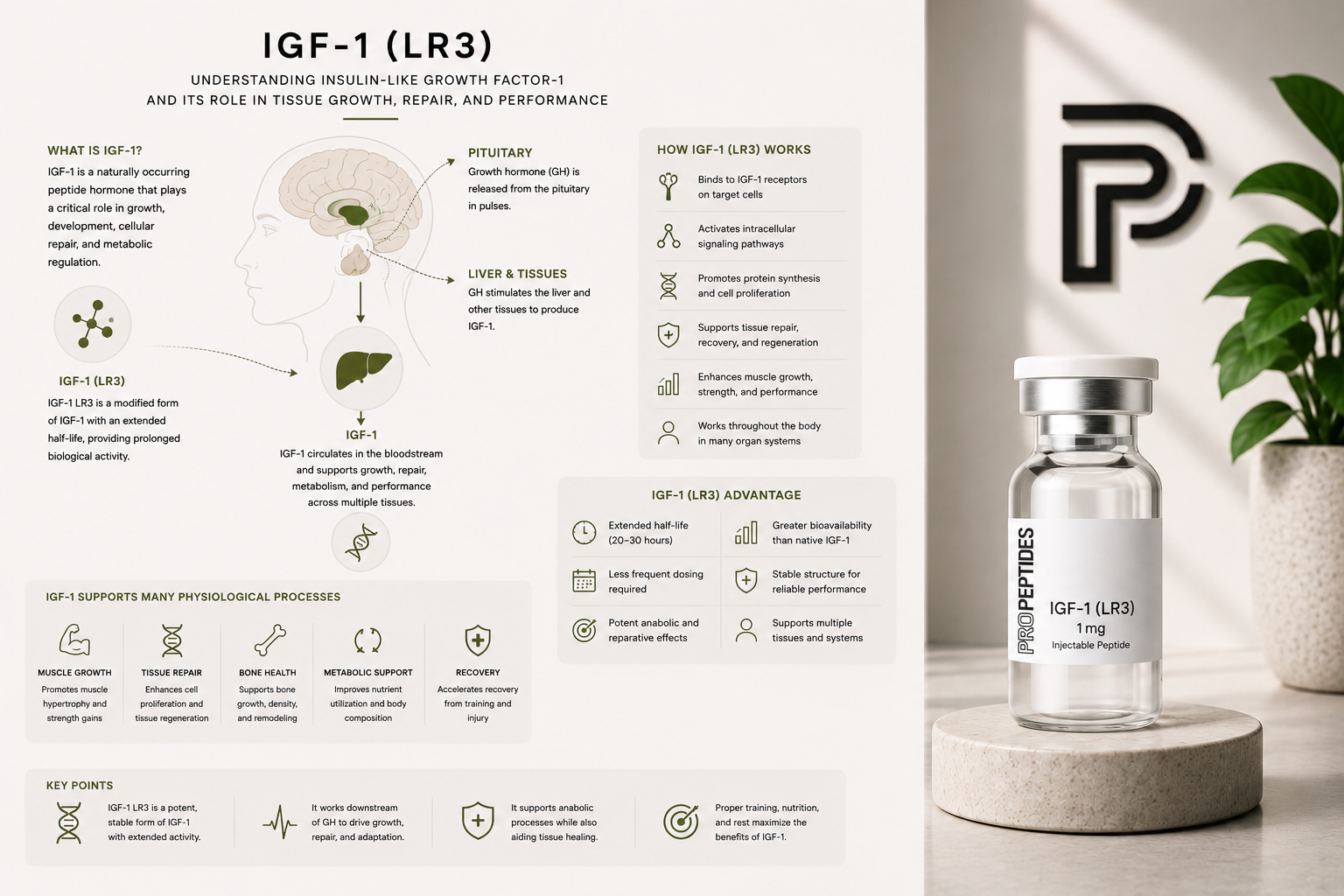
What Is IGF-1?
Insulin-like growth factor-1 is a naturally occurring peptide hormone produced throughout the body.
Although the liver produces much of the circulating IGF-1 found in the bloodstream, many tissues—including skeletal muscle, bone, cartilage, connective tissue, and the nervous system—also synthesize IGF-1 locally.
This local production allows individual tissues to regulate their own growth and repair independently of circulating hormone concentrations.
Consequently, IGF-1 functions through multiple signaling systems simultaneously.
Endocrine IGF-1
Produced primarily by the liver.
Released into the bloodstream.
Influences tissues throughout the body.
Paracrine IGF-1
Produced locally within tissues.
Acts on neighboring cells.
Supports tissue-specific adaptation.
Autocrine IGF-1
Acts directly upon the same cell that produced it.
Allows highly localized regulation of growth and repair.
This distinction is one of the defining characteristics of IGF biology and helps explain why circulating blood levels do not necessarily reflect tissue-specific activity.
How Growth Hormone and IGF-1 Work Together
Growth hormone and IGF-1 are frequently discussed as though they perform identical functions.
They do not.
Instead, they work together as complementary components of the same endocrine system.
Growth hormone primarily coordinates metabolism and stimulates IGF-1 production.
IGF-1 then promotes many of the downstream cellular responses associated with tissue remodeling.
A simplified sequence looks like this:
Hypothalamus releases GHRH.
Pituitary releases growth hormone.
Growth hormone stimulates hepatic and local IGF-1 production.
IGF-1 activates tissue-specific repair and adaptation.
This coordinated pathway allows the body to translate endocrine signals into localized biological change.
The IGF-1 Receptor
The biological effects of IGF-1 occur through binding to the IGF-1 receptor (IGF-1R).
This receptor belongs to the receptor tyrosine kinase family and is expressed throughout numerous tissues including:
Skeletal muscle
Bone
Tendons
Cartilage
Brain
Peripheral nerves
Skin
Heart
Activation of IGF-1R initiates intracellular signaling cascades involving:
PI3K-AKT
mTOR
MAPK/ERK
Together, these pathways regulate:
Protein synthesis
Cell survival
Cell proliferation
Differentiation
Glucose metabolism
Tissue remodeling
Rather than promoting growth indiscriminately, these pathways integrate information from nutrition, mechanical loading, hormones, and cellular energy status.
IGF-1 in Skeletal Muscle
Within skeletal muscle, IGF-1 contributes to adaptation following exercise.
Current evidence suggests IGF-1 participates in:
Satellite cell activation
Protein synthesis
Myonuclear accretion
Muscle fiber remodeling
Recovery following mechanical loading
Importantly, resistance exercise itself stimulates local production of IGF-1 within skeletal muscle.
This locally produced IGF-1 may be particularly important for muscle adaptation because it acts directly within the exercised tissue.
Consequently, muscle remodeling depends upon both endocrine signaling and local biological responses to mechanical loading.
IGF-1 Beyond Muscle
Although frequently associated with muscle growth, IGF-1 influences numerous physiological systems.
Bone
Supports osteoblast activity and skeletal remodeling.
Tendons and Ligaments
Participates in collagen synthesis and connective tissue repair.
Cartilage
Supports extracellular matrix maintenance and chondrocyte biology.
Nervous System
Contributes to neuronal development, synaptic plasticity, and peripheral nerve repair.
Cardiovascular System
Influences vascular biology and cardiac tissue maintenance.
These widespread effects illustrate why IGF-1 should not be viewed solely through the lens of athletic performance.
What Is IGF-1 LR3?
IGF-1 LR3 is an investigational analog of human IGF-1.
Compared with endogenous IGF-1, IGF-1 LR3 contains structural modifications that alter its pharmacological properties.
These modifications include:
An additional 13 amino acids at the amino terminus.
A substitution of arginine for glutamic acid at position 3.
These seemingly small changes substantially influence how the molecule behaves within the body.
Why Was IGF-1 LR3 Developed?
Naturally occurring IGF-1 has a relatively short biological half-life when it is not bound to IGF binding proteins (IGFBPs).
Researchers therefore sought to develop analogs capable of maintaining receptor activity for longer periods.
The structural modifications incorporated into IGF-1 LR3 reduce its affinity for several IGF binding proteins.
As a result:
More free peptide remains available.
Receptor exposure may be prolonged.
Pharmacokinetics differ substantially from endogenous IGF-1.
These characteristics have made IGF-1 LR3 an important research tool for investigating IGF biology.
Endogenous IGF-1 Versus IGF-1 LR3
Although related, these molecules are not biologically identical.
Feature
Endogenous IGF-1 / IGF-1 LR3
Source
Produced naturally / Synthetic analog
Regulation
Controlled by GH and tissue physiology / Exogenous administration
Binding proteins
Strong interaction / Reduced binding affinity
Duration
Shorter physiological activity / Prolonged biological activity
Regulation
Subject to endogenous feedback / Pharmacologic exposure
These pharmacological differences explain why findings from studies involving IGF-1 LR3 should not automatically be generalized to normal human physiology.
Current Research
IGF-1 LR3 has primarily been studied in experimental settings.
Areas of investigation include:
Skeletal muscle adaptation
Muscle wasting disorders
Tissue regeneration
Bone biology
Neurological recovery
Metabolic regulation
Although laboratory and animal studies have demonstrated important biological effects, relatively little high-quality human research has evaluated long-term clinical outcomes in healthy individuals seeking improvements in athletic performance.
Consequently, many questions remain regarding efficacy, optimal dosing strategies, safety, and long-term risk.
Safety Considerations
Because IGF-1 influences fundamental cellular growth pathways, appropriate caution is warranted.
Potential physiological considerations include:
Altered glucose regulation
Hypoglycemia
Fluid retention
Changes in insulin sensitivity
Cellular proliferation
Long-term safety data in healthy populations remain limited.
Current evidence therefore supports viewing IGF-1 LR3 as an investigational compound whose biology continues to be actively studied.
IGF-1 LR3 Compared with GH Secretagogues
IGF-1 LR3 differs fundamentally from peptides such as CJC-1295, Ipamorelin, and Tesamorelin.
Feature
GH Secretagogues / IGF-1 LR3
Primary target
Pituitary gland / IGF-1 receptor
Hormone produced
Endogenous GH / None
Physiological pathway
GH–IGF-1 axis / Direct IGF signaling
Feedback regulation
Largely preserved / Bypasses upstream GH regulation
Mechanism
Stimulates endocrine physiology / Direct receptor agonism
Understanding this distinction is essential because therapies acting at different points within the same biological pathway may produce very different physiological effects.
Bringing It All Together
IGF-1 serves as one of the body's most important regulators of growth, tissue remodeling, and cellular adaptation. Produced both systemically and locally, it translates hormonal signals and mechanical stimuli into coordinated biological responses that influence muscle, bone, connective tissue, and the nervous system.
IGF-1 LR3 was developed to explore this biology by creating a modified analog with prolonged activity and reduced interaction with binding proteins. Unlike peptides that stimulate endogenous growth hormone secretion, IGF-1 LR3 acts directly at the level of the IGF-1 receptor, bypassing much of the upstream endocrine regulation.
This distinction highlights an important principle repeated throughout this section: understanding where a therapy acts within a physiological pathway is just as important as understanding what pathway it influences.
Looking Ahead
Growth hormone and IGF-1 are only part of the biology that determines athletic performance and recovery. Every training session also places enormous demands on the cell's energy-producing machinery. Mitochondria must generate ATP efficiently while adapting to repeated metabolic stress, and declining mitochondrial function can limit endurance, recovery, and healthy aging.
In the next article, we'll explore MOTS-c, a naturally occurring mitochondrial-derived peptide that represents an entirely different approach to performance optimization by influencing cellular energy metabolism rather than the growth hormone axis.
Key References
Le Roith D, Bondy C, Yakar S, Liu JL, Butler A. The Somatomedin Hypothesis Revisited. Endocrine Reviews.
Florini JR, Ewton DZ, Coolican SA. Growth Hormone and the Insulin-Like Growth Factor System in Myogenesis.Endocrine Reviews.
Clemmons DR. Role of Insulin-Like Growth Factor-I in Maintaining Normal Glucose Homeostasis. Endocrine Reviews.
Melmed S, Auchus RJ, Goldfine AB, Koenig RJ, Rosen CJ. Williams Textbook of Endocrinology.
Velloso CP. Regulation of Muscle Mass by Growth Hormone and IGF-1. British Journal of Pharmacology.
Clinical Perspective
IGF-1 occupies a unique position within human physiology, acting as both a circulating hormone and a locally produced growth factor that coordinates tissue adaptation throughout the body. Its role extends well beyond skeletal muscle to include bone remodeling, connective tissue maintenance, nervous system function, and metabolic regulation. IGF-1 LR3 was engineered to modify the pharmacokinetics of endogenous IGF-1, creating a research molecule with prolonged receptor activity. While its biological rationale is well understood, robust clinical evidence evaluating long-term safety and efficacy in healthy individuals remains limited. Appreciating the distinction between endogenous physiology and synthetic analogs is essential for interpreting both the promise and the limitations of current IGF-1 research.