
Growth Hormone & IGF-1 Biology
Understanding the Endocrine System That Coordinates Growth, Recovery, and Adaptation
PROPeptides Foundations Program
Growth hormone is one of the most widely recognized hormones in human physiology, yet it is also one of the most misunderstood.
Many people associate growth hormone exclusively with muscle growth or athletic performance. In reality, growth hormone influences nearly every organ system throughout life. From childhood development to healthy aging, growth hormone participates in regulating metabolism, connective tissue maintenance, bone remodeling, body composition, recovery from exercise, and communication between multiple endocrine systems.
Importantly, growth hormone rarely works alone.
Its physiological effects depend upon an intricate network involving the hypothalamus, pituitary gland, liver, skeletal muscle, insulin-like growth factor-1 (IGF-1), sleep, nutrition, exercise, and numerous feedback mechanisms that continually adjust hormone secretion according to the body's needs.
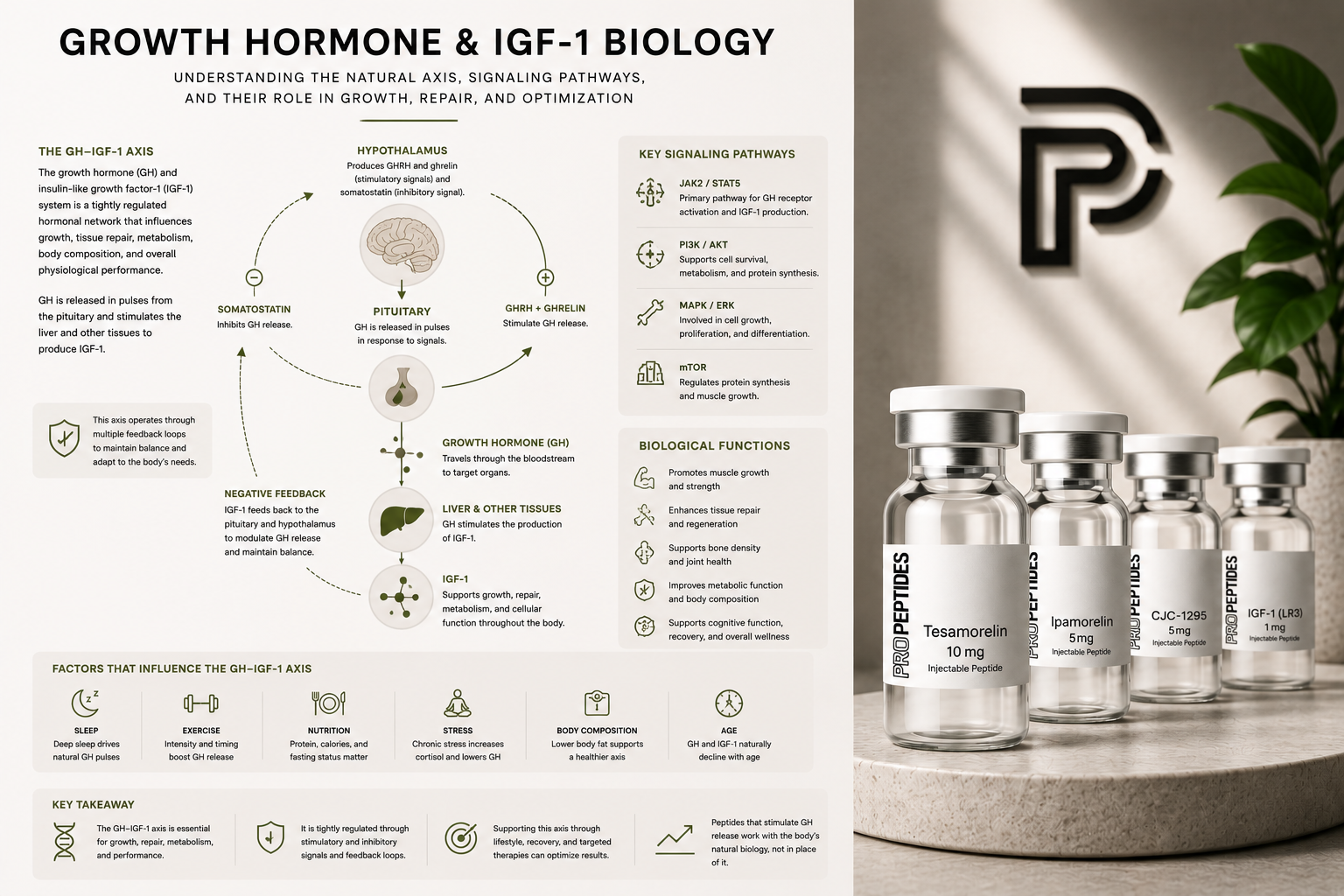
This integrated network is known as the growth hormone–IGF-1 axis.
Understanding how this axis functions naturally provides the biological foundation for interpreting many of the peptide therapies investigated in performance medicine. Before exploring compounds such as CJC-1295, Ipamorelin, Tesamorelin, or IGF-1 LR3, it is essential to understand the physiology they are designed to influence.
The Endocrine System: The Body's Communication Network
The endocrine system allows organs throughout the body to communicate over long distances.
Unlike the nervous system, which transmits electrical signals in milliseconds, the endocrine system uses hormones that travel through the bloodstream to coordinate slower but longer-lasting physiological responses.
Hormones influence virtually every aspect of human biology, including:
Growth and development
Energy metabolism
Reproduction
Stress responses
Sleep
Immune function
Tissue repair
Body composition
Exercise adaptation
Growth hormone represents one component of this larger communication network.
Rather than functioning independently, it continuously interacts with numerous other hormones to maintain physiological balance.
The Hypothalamic–Pituitary Axis
Growth hormone secretion begins in the brain.
At the base of the brain lies the hypothalamus, a small but extraordinarily important region responsible for integrating information about the body's internal environment.
The hypothalamus continuously monitors signals related to:
Sleep
Nutrition
Blood glucose
Exercise
Stress
Body temperature
Hormonal feedback
Based on this information, it regulates hormone secretion from the pituitary gland, often called the body's "master endocrine gland."
The pituitary, located just beneath the hypothalamus, releases growth hormone into the bloodstream in response to hypothalamic signals.
This system ensures that growth hormone secretion reflects the body's current physiological needs rather than remaining constant throughout the day.
GHRH: Stimulating Growth Hormone Release
One of the primary regulators of growth hormone secretion is growth hormone-releasing hormone (GHRH).
GHRH is produced by neurons within the hypothalamus and travels to the anterior pituitary, where it binds to receptors on somatotroph cells.
Activation of these receptors stimulates the synthesis and release of growth hormone into the circulation.
Rather than producing continuous secretion, GHRH contributes to the pulsatile pattern of growth hormone release that characterizes healthy physiology.
This pathway forms the biological basis for several peptide therapies designed to mimic endogenous GHRH signaling.
Somatostatin: The Natural Brake
Every biological system requires balance.
Just as GHRH stimulates growth hormone secretion, another hypothalamic hormone—somatostatin—acts as an inhibitory signal.
Somatostatin suppresses growth hormone release from the pituitary, preventing excessive hormone secretion.
Throughout the day, GHRH and somatostatin alternate in activity, creating a dynamic balance that determines the timing and magnitude of growth hormone pulses.
This constant interaction illustrates an important principle of endocrinology:
Hormone regulation depends on opposing signals working together rather than on continuous stimulation.
Ghrelin: Linking Nutrition and Growth Hormone
A third major regulator of growth hormone secretion is ghrelin.
Often referred to as the "hunger hormone," ghrelin is produced primarily by the stomach and rises before meals.
Although ghrelin is well known for stimulating appetite, it also binds to the growth hormone secretagogue receptor (GHS-R1a) within the pituitary and hypothalamus.
Activation of this receptor promotes additional growth hormone release.
This connection allows nutritional status to influence endocrine function.
The relationship between ghrelin and growth hormone also explains why several investigational peptides, including Ipamorelin, target the ghrelin receptor rather than the GHRH receptor.
Growth Hormone Is Released in Pulses
One of the defining characteristics of growth hormone physiology is that secretion is pulsatile.
Rather than remaining elevated throughout the day, growth hormone is released in brief bursts.
In healthy adults, these pulses occur several times over a 24-hour period, with the largest typically appearing during the early stages of deep, slow-wave sleep.
Additional pulses may occur in response to:
Resistance exercise
High-intensity exercise
Fasting
Hypoglycemia
Physiological stress
Because secretion is pulsatile, a single blood test often provides little information about overall growth hormone production.
This pulsatile physiology is one reason why therapies designed to stimulate endogenous growth hormone release attempt to preserve natural hormone rhythms rather than maintain continuously elevated hormone concentrations.
What Does Growth Hormone Actually Do?
Despite its name, growth hormone performs far more functions than promoting growth.
Growth hormone influences:
Connective Tissue
Supports collagen turnover and extracellular matrix remodeling.
Bone
Stimulates bone remodeling and contributes to skeletal maintenance.
Skeletal Muscle
Supports recovery and adaptation indirectly while influencing protein metabolism.
Fat Metabolism
Promotes lipolysis, increasing the availability of fatty acids for energy.
Glucose Regulation
Produces complex metabolic effects that vary according to nutritional status and duration of exposure.
Organ Function
Contributes to the maintenance of numerous tissues throughout the body.
Many of these effects occur directly.
Others occur through insulin-like growth factor-1.
IGF-1: The Major Downstream Mediator
Growth hormone stimulates the production of insulin-like growth factor-1 (IGF-1).
Although the liver produces much of the circulating IGF-1 found in the bloodstream, many tissues—including skeletal muscle—also produce IGF-1 locally.
This distinction is important.
Endocrine IGF-1
Produced primarily by the liver and released into the circulation, influencing tissues throughout the body.
Paracrine and Autocrine IGF-1
Produced within individual tissues where it acts locally to support repair, remodeling, and adaptation.
This local production allows tissues to respond specifically to mechanical loading and injury without relying solely on circulating hormone concentrations.
Growth Hormone and IGF-1 Work Together
Growth hormone and IGF-1 are often discussed as though they perform identical functions.
In reality, they have complementary roles.
Growth hormone helps coordinate metabolism, mobilize energy, and stimulate IGF-1 production.
IGF-1 promotes many of the downstream cellular processes involved in growth, tissue remodeling, and protein synthesis.
Together they create an integrated signaling system that adapts to nutrition, exercise, sleep, and recovery.
Neither hormone should be viewed in isolation.
Negative Feedback Maintains Balance
Like all endocrine systems, the GH–IGF-1 axis is tightly regulated through negative feedback.
As circulating IGF-1 concentrations increase, signals return to both the hypothalamus and pituitary to reduce further growth hormone secretion.
This feedback loop helps prevent excessive hormone production while maintaining physiological balance.
The body therefore continuously adjusts hormone output according to current needs.
This dynamic regulation is one of the defining characteristics of healthy endocrine physiology.
Growth Hormone Changes Throughout Life
Growth hormone secretion is not constant across the lifespan.
Production is highest during childhood and adolescence, supporting growth and development.
Beginning in early adulthood, average growth hormone secretion gradually declines with age.
This decline contributes to changes in:
Lean body mass
Fat distribution
Bone density
Connective tissue maintenance
Recovery capacity
Importantly, aging represents only one influence.
Sleep quality, obesity, chronic illness, nutritional status, and physical activity also affect growth hormone physiology.
Regular resistance exercise and adequate sleep remain two of the most effective lifestyle interventions for supporting healthy endogenous growth hormone secretion.
Why This Biology Matters
Understanding the normal physiology of the GH–IGF-1 axis is essential before examining peptide therapies.
Compounds such as:
CJC-1295
Ipamorelin
Tesamorelin
are designed to influence different regulatory components of endogenous growth hormone secretion.
By contrast, IGF-1 LR3 bypasses portions of the normal regulatory pathway by directly acting as an IGF-1 analog.
Recognizing these physiological differences helps explain why these compounds have distinct mechanisms, clinical applications, and safety considerations.
Bringing It All Together
The growth hormone–IGF-1 axis represents one of the body's most sophisticated endocrine communication systems. Rather than functioning as a single hormone, it integrates signals from the brain, pituitary gland, gastrointestinal tract, liver, skeletal muscle, sleep, nutrition, and exercise to coordinate growth, metabolism, tissue remodeling, and recovery.
Growth hormone is released in carefully timed pulses under the influence of GHRH, somatostatin, and ghrelin. In turn, growth hormone stimulates the production of IGF-1, which helps regulate many of the cellular processes responsible for adaptation and repair. Together, these hormones maintain a dynamic balance that allows the body to respond appropriately to changing physiological demands.
Understanding this biology provides the foundation for evaluating peptide therapies that target the GH–IGF-1 axis. Appreciating how these pathways normally function makes it possible to distinguish therapies that augment endogenous signaling from those that directly mimic downstream hormones.
Looking Ahead
Growth hormone secretion begins with a signal from the hypothalamus. One of the key molecules responsible for initiating that signal is growth hormone-releasing hormone (GHRH). Researchers have developed synthetic analogs of GHRH to better understand and, in some settings, augment this natural physiology.
In the next article, we'll explore CJC-1295, examining how this investigational GHRH analog works, how it differs from native GHRH, and what current research suggests about its potential role in performance medicine and healthy aging.
Key References
Melmed S, Auchus RJ, Goldfine AB, Koenig RJ, Rosen CJ. Williams Textbook of Endocrinology.
Giustina A, Veldhuis JD. Pathophysiology of the Neuroregulation of Growth Hormone Secretion in Experimental Animals and the Human. Endocrine Reviews.
Ho KY, Evans WS, Blizzard RM, et al. Effects of Age on Growth Hormone Secretion in Man. Journal of Clinical Endocrinology & Metabolism.
Le Roith D, Bondy C, Yakar S, Liu JL, Butler A. The Somatomedin Hypothesis: 2001. Endocrine Reviews.
Møller N, Jørgensen JOL. Effects of Growth Hormone on Glucose, Lipid, and Protein Metabolism in Human Subjects. Endocrine Reviews.
Clinical Perspective
Growth hormone is frequently discussed in the context of athletic performance, yet its physiological role extends far beyond increasing muscle mass. It functions as part of a highly regulated endocrine network that coordinates tissue remodeling, metabolism, recovery, and adaptation throughout the body. In clinical practice, understanding the normal biology of the GH–IGF-1 axis is essential before considering therapies that influence these pathways. This foundation allows clinicians and patients to interpret emerging peptide research within the broader context of human physiology and reinforces an important principle that applies throughout performance medicine: successful adaptation depends on supporting the body's natural regulatory systems rather than attempting to override them.