
GLP-1 & Incretin Physiology
Understanding the Hormonal Communication System That Changed Metabolic Medicine
PROPeptides Foundations Program
Every time you eat a meal, your body begins an extraordinary process of biological communication.
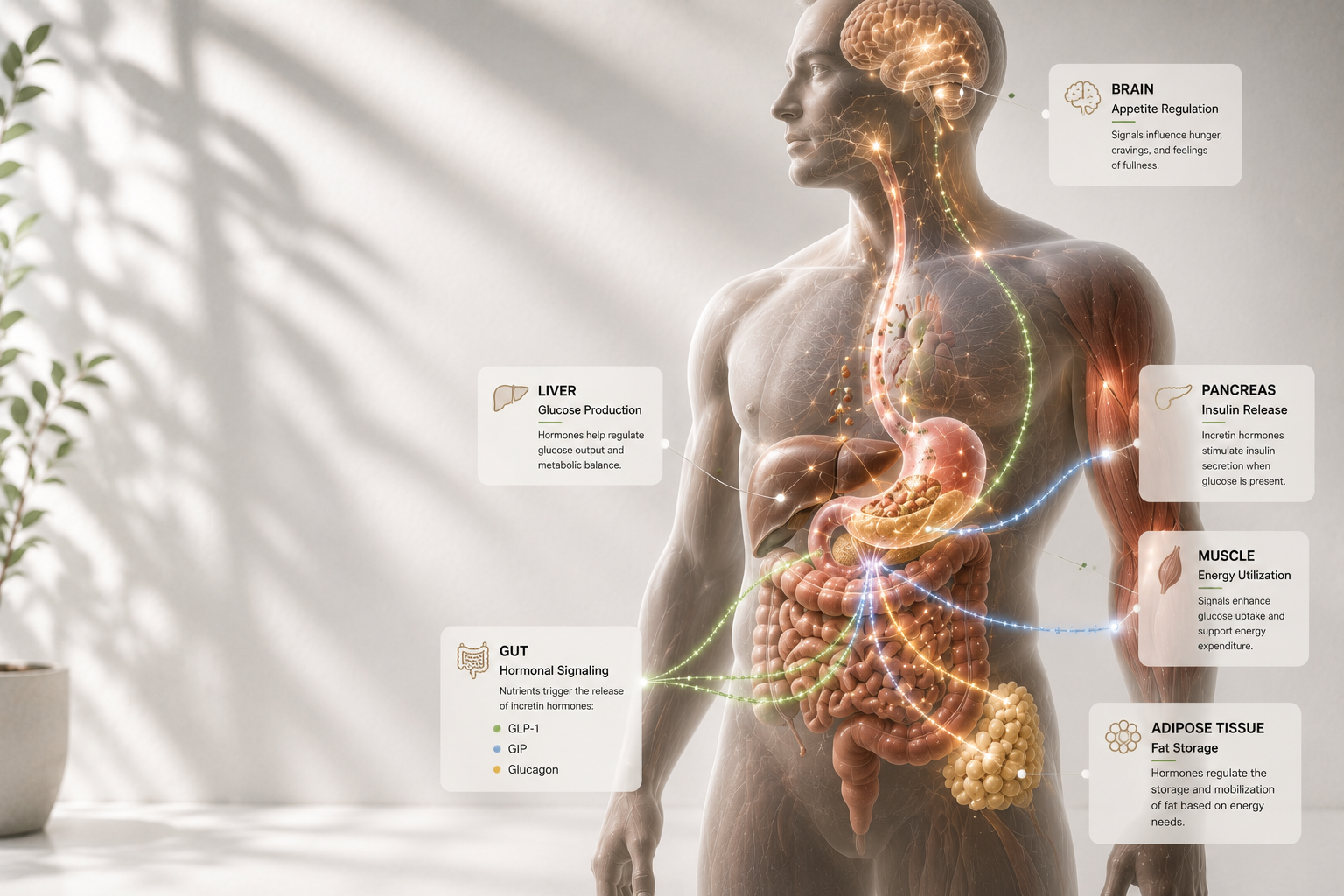
Within minutes, specialized cells lining the gastrointestinal tract detect the presence of nutrients and begin releasing hormones into the bloodstream. These hormones communicate with the pancreas, liver, brain, stomach, adipose tissue, kidneys, cardiovascular system, and skeletal muscle, coordinating hundreds of physiological responses that determine how nutrients are absorbed, stored, utilized, or burned for energy.
This network of gut-derived hormones is known as the incretin system, and it has become one of the most important discoveries in modern endocrinology and obesity medicine.
For decades, clinicians focused primarily on insulin as the central regulator of metabolism. While insulin remains critically important, researchers now recognize that insulin functions as only one component of a much larger hormonal communication network.
Among the most influential hormones within this system are:
Glucagon-like peptide-1 (GLP-1)
Glucose-dependent insulinotropic polypeptide (GIP)
Glucagon
Together, these hormones help regulate appetite, blood glucose, gastric emptying, nutrient utilization, fat storage, energy expenditure, and body weight.
Modern peptide therapies are largely designed to enhance or modify these naturally occurring biological signals rather than introducing entirely artificial pathways. Understanding how these hormones normally function provides the scientific foundation for understanding today's most effective metabolic medications.
What Is the Incretin Effect?
One of the earliest clues that the gastrointestinal tract plays an active role in metabolism came from an observation made over fifty years ago.
Researchers discovered that consuming glucose by mouth stimulated a much larger insulin response than receiving the exact same amount of glucose intravenously, even when blood glucose levels were identical.
This unexpected phenomenon became known as the incretin effect.
If insulin secretion depended solely on blood glucose concentration, both methods of glucose administration should have produced identical responses. Instead, oral glucose consistently generated significantly greater insulin release.
The explanation was that the digestive tract was releasing additional hormones in response to nutrient exposure—hormones that amplified insulin secretion before blood glucose rose dramatically.
Scientists eventually identified two primary incretin hormones responsible for much of this effect:
GLP-1
GIP
These hormones act as early messengers, informing the body that nutrients are arriving and preparing multiple organ systems for efficient nutrient handling.
The incretin effect accounts for approximately 50–70% of post-meal insulin secretion in healthy individuals, highlighting the enormous contribution of gut hormones to normal metabolic regulation.
The Gastrointestinal Tract Is an Endocrine Organ
Although often viewed simply as a digestive system, the gastrointestinal tract is also one of the body's largest endocrine organs.
Scattered throughout the stomach and intestines are millions of specialized enteroendocrine cells capable of sensing nutrients within the intestinal lumen and releasing highly specific hormones into the bloodstream.
Different cell populations respond to different nutritional signals.
Examples include:
L cells → GLP-1, Peptide YY
K cells → GIP
I cells → Cholecystokinin (CCK)
X/A cells → Ghrelin
Enterochromaffin cells → Serotonin
These hormones communicate not only through the bloodstream but also through direct neural pathways, particularly via the vagus nerve, creating rapid two-way communication between the gastrointestinal tract and the central nervous system.
This relationship is often referred to as the gut-brain axis, one of the most active areas of current metabolic research.
GLP-1: The Satiety Hormone
Glucagon-like peptide-1 (GLP-1) is produced primarily by intestinal L cells located within the distal ileum and colon.
Following nutrient ingestion—particularly meals containing carbohydrates, fats, and proteins—GLP-1 concentrations begin rising within minutes.
Although naturally occurring GLP-1 has an extremely short half-life of approximately 1–2 minutes due to rapid degradation by the enzyme dipeptidyl peptidase-4 (DPP-4), its physiological effects are remarkably broad.
GLP-1 receptors are distributed throughout multiple organ systems, allowing a single hormone to coordinate numerous metabolic responses simultaneously.
Effects of GLP-1 include:
Brain
Reduces hunger
Increases satiety
Reduces food reward
Decreases food cravings
Improves meal termination
Pancreas
Enhances glucose-dependent insulin secretion
Suppresses glucagon secretion during hyperglycemia
Improves beta-cell responsiveness
Stomach
Slows gastric emptying
Delays nutrient absorption
Prolongs fullness after meals
Liver
Indirectly improves glucose regulation by reducing glucagon-driven hepatic glucose production.
Cardiovascular System
GLP-1 receptors are expressed within the heart and vascular tissues, where activation appears to improve endothelial function and may contribute to reductions in major adverse cardiovascular events observed in clinical trials.
Kidneys
GLP-1 modestly increases sodium excretion and may contribute to improvements in blood pressure regulation.
Collectively, these actions make GLP-1 one of the body's most powerful regulators of post-meal metabolism.
GIP: More Than an Insulin Hormone
Glucose-dependent insulinotropic polypeptide (GIP) is secreted primarily from K cells located in the proximal small intestine.
Historically, GIP was viewed simply as an insulin-stimulating hormone.
Modern research has revealed a much broader physiological role.
Like GLP-1, GIP enhances glucose-dependent insulin secretion following meals. However, GIP receptors are also expressed within adipose tissue, skeletal muscle, bone, and the central nervous system.
Emerging evidence suggests that GIP signaling may influence:
Nutrient partitioning
Fat metabolism
Appetite regulation
Skeletal muscle metabolism
Bone remodeling
Cognitive function
Interestingly, obesity appears to reduce normal GIP responsiveness. This initially led researchers to question its therapeutic value. More recent studies, however, have demonstrated that pharmacologic GIP receptor activation—particularly when combined with GLP-1 receptor activation—produces substantially greater weight loss than GLP-1 therapy alone.
The exact mechanisms remain under active investigation but likely involve complementary effects on central appetite regulation, insulin sensitivity, and adipose tissue biology.
Glucagon: Beyond Blood Sugar
Glucagon is often described simply as insulin's opposite hormone.
While it is true that glucagon increases blood glucose during fasting by stimulating hepatic glucose production, this description only captures part of its physiological importance.
Glucagon also influences:
Lipolysis
Fat oxidation
Energy expenditure
Ketogenesis
Hepatic amino acid metabolism
Perhaps most importantly, glucagon appears to increase metabolic rate by promoting energy utilization rather than storage.
Historically, glucagon was considered unsuitable for obesity treatment because of its tendency to raise blood glucose.
However, when glucagon receptor activation is combined with simultaneous GLP-1 receptor activation—which strongly lowers blood glucose—the metabolic advantages of glucagon may be preserved while minimizing hyperglycemia.
This concept forms the biological foundation for triple agonist therapies such as retatrutide.
Why Modern Peptide Therapies Work So Well
Rather than targeting a single symptom, modern incretin-based therapies influence multiple regulatory systems simultaneously.
Instead of asking patients to consciously resist hunger despite overwhelming biological signals, these medications help restore or amplify the body's own physiological mechanisms governing appetite and metabolism.
Depending on the therapy used, potential effects include:
Reduced hunger
Earlier satiety
Reduced food reward
Slower gastric emptying
Improved insulin secretion
Reduced glucagon release
Enhanced insulin sensitivity
Increased fat oxidation
Improved glycemic control
Favorable changes in cardiovascular risk factors
Because obesity involves numerous dysregulated biological pathways, therapies capable of influencing several systems simultaneously often produce more meaningful and sustained clinical outcomes than interventions targeting only one mechanism.
Looking Ahead
The discovery of the incretin system transformed obesity treatment by revealing that appetite and metabolism are regulated through highly coordinated hormonal communication rather than conscious willpower alone.
Building upon this understanding, researchers developed medications capable of selectively activating these natural pathways.
The first major breakthrough was the development of GLP-1 receptor agonists, medications designed to enhance one of the body's most powerful satiety signals.
The next article examines these therapies in depth, beginning with the biology of GLP-1 receptor activation and progressing through the development of semaglutide, its pharmacology, landmark clinical trials, safety profile, and clinical applications.
Key References
Holst JJ. The Physiology of Glucagon-Like Peptide-1. Physiological Reviews. 2007.
Drucker DJ. Mechanisms of Action and Therapeutic Application of GLP-1. Cell Metabolism. 2018.
Nauck MA, Meier JJ. The Incretin Effect in Health and Disease. Diabetologia. 2018.
Müller TD, et al. Glucagon Biology and Therapeutic Applications. Nature Reviews Drug Discovery. 2017.
Campbell JE, Drucker DJ. Pharmacology, Physiology, and Mechanisms of Incretin Hormones. Cell Metabolism. 2020.
Coskun T, et al. Triple-Hormone Receptor Agonists in Obesity Therapy. Cell Metabolism. 2022.
Finan B, Müller TD, DiMarchi RD. Next-Generation Peptide Therapeutics for Obesity and Diabetes. Nature Reviews Drug Discovery. 2021.