
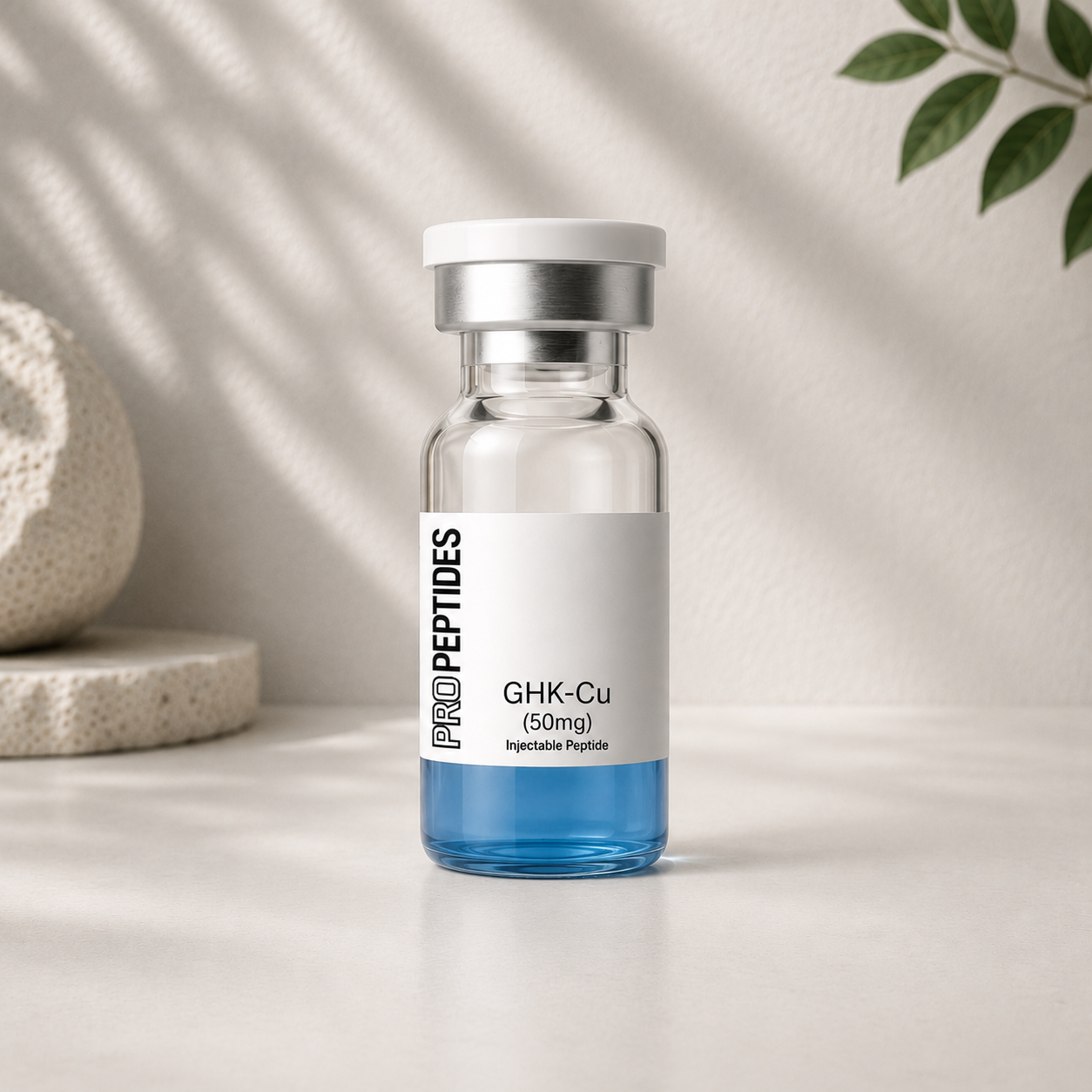
GHK-Cu
Understanding the Biology of Copper Peptides in Regeneration, Skin Health, and Healthy Aging
PROPeptides Foundations Program
Not all regenerative peptides were discovered while searching for new treatments for injury.
Some were discovered by observing the body's own natural healing processes.
One of the most fascinating examples is GHK-Cu, a naturally occurring copper-binding peptide that has attracted scientific interest for more than five decades. Originally identified in human plasma, GHK-Cu was later found throughout the body, including the skin, saliva, and urine, where it participates in tissue repair, immune regulation, extracellular matrix remodeling, and cellular maintenance.
Unlike many investigational peptides whose research remains largely confined to laboratory and animal models, GHK-Cu has been studied extensively in both experimental and human settings. Investigators have explored its effects on wound healing, collagen production, skin aging, hair follicle biology, inflammation, and even patterns of gene expression associated with aging and tissue repair.
One of the most intriguing observations is that naturally occurring GHK-Cu levels appear to decline with age. This has led researchers to investigate whether restoring GHK-Cu signaling could help support healthy tissue maintenance and improve the body's ability to repair itself.
Although many questions remain regarding therapeutic applications, GHK-Cu represents one of the most biologically interesting peptides in regenerative medicine because its influence extends far beyond a single tissue or organ system.
What Is GHK-Cu?
GHK-Cu is a naturally occurring tripeptide, meaning it consists of only three amino acids:
Glycine
Histidine
Lysine
When these amino acids bind with a copper ion (Cu²⁺), they form the biologically active complex known as GHK-Cu.
Despite its small size, this peptide participates in numerous physiological processes throughout the body.
Copper itself is an essential trace mineral involved in:
Collagen formation
Connective tissue integrity
Blood vessel development
Antioxidant defense
Cellular energy production
Enzyme function
GHK functions as one of the body's natural copper transport molecules, helping deliver copper where it is needed during tissue repair and normal cellular maintenance.
Rather than acting solely as a nutrient carrier, GHK-Cu also functions as a signaling molecule capable of influencing cellular behavior.
Discovery of GHK-Cu
GHK was first identified in 1973 by Dr. Loren Pickart during studies examining factors that influenced liver function and tissue regeneration.
Researchers observed that plasma obtained from younger individuals appeared to stimulate biological activity in older tissues. Further investigation led to the identification of a remarkably small peptide capable of reproducing many of these regenerative effects.
Subsequent studies demonstrated that GHK readily binds copper, creating the complex now known as GHK-Cu.
Over the following decades, research expanded into multiple fields including:
Dermatology
Cosmetic science
Wound healing
Hair restoration
Tissue engineering
Gene regulation
Regenerative medicine
Today, GHK-Cu remains one of the most extensively investigated naturally occurring regenerative peptides.
A Natural Decline With Aging
One of the most interesting observations regarding GHK-Cu is that its concentration decreases substantially with age.
Studies have demonstrated that circulating levels in older adults are significantly lower than those found in younger individuals.
Although aging is influenced by many factors, declining concentrations of endogenous signaling molecules may contribute to:
Slower wound healing
Reduced collagen production
Delayed tissue repair
Loss of skin elasticity
Progressive connective tissue degeneration
Researchers continue to investigate whether restoring youthful GHK-Cu signaling might help support healthier tissue maintenance throughout aging.
At present, this remains an active area of scientific investigation.
How Does GHK-Cu Work?
Unlike medications that target a single receptor, GHK-Cu appears to influence multiple interconnected biological systems.
Current research suggests that its actions involve several complementary mechanisms.
Gene Regulation
One of the most remarkable discoveries involving GHK-Cu is its apparent ability to influence gene expression.
Laboratory studies suggest that GHK-Cu may alter the activity of thousands of genes involved in:
Tissue repair
Inflammation
Antioxidant defense
Cellular growth
Extracellular matrix production
Stem cell activity
Rather than changing DNA itself, GHK-Cu appears to influence which genes are turned on or off in response to injury and aging.
This broad regulatory capacity has generated significant interest in regenerative medicine and longevity research.
Collagen Production
Collagen provides the structural framework for:
Skin
Tendons
Ligaments
Bone
Blood vessels
Connective tissue
Experimental and clinical studies suggest that GHK-Cu stimulates fibroblasts to produce:
Collagen
Elastin
Glycosaminoglycans
Proteoglycans
These components contribute to tissue strength, elasticity, and structural integrity.
Because collagen synthesis naturally declines with age, this mechanism has become one of the primary reasons GHK-Cu is studied in dermatology and aesthetic medicine.
Extracellular Matrix Remodeling
Healing requires more than producing collagen.
Damaged extracellular matrix must also be reorganized.
GHK-Cu appears to influence enzymes involved in extracellular matrix remodeling, helping coordinate the removal of damaged structural proteins while supporting new tissue formation.
Balanced remodeling is essential for minimizing fibrosis and promoting healthy tissue architecture.
Anti-Inflammatory Activity
Several studies suggest that GHK-Cu may help regulate inflammatory signaling.
Rather than completely suppressing inflammation, it appears to influence pathways that promote appropriate resolution following injury.
Experimental observations include reduced expression of certain pro-inflammatory cytokines and improved regulation of oxidative stress.
These findings continue to be investigated across multiple disease models.
Skin Regeneration
The skin represents one of the best-studied applications of GHK-Cu.
Human clinical studies have investigated its effects on:
Fine lines and wrinkles
Skin elasticity
Dermal thickness
Wound healing
Photodamage
Scar remodeling
Several topical formulations containing copper peptides have demonstrated improvements in measures of skin appearance and collagen remodeling, although results vary between studies.
These findings have contributed to widespread interest in copper peptides within dermatology and cosmetic science.
Hair Biology
Hair follicles undergo continuous cycles of growth, regression, and rest.
Researchers have investigated whether GHK-Cu influences this cycle by supporting the environment surrounding the hair follicle.
Experimental studies suggest potential effects involving:
Hair follicle size
Dermal papilla cell activity
Blood vessel formation
Growth factor signaling
Follicular regeneration
Although encouraging findings have been reported, additional high-quality clinical trials are needed to establish its effectiveness for various forms of hair loss.
Wound Healing
One of the earliest therapeutic interests in GHK-Cu involved wound repair.
Experimental studies have demonstrated potential improvements in:
Fibroblast activity
Collagen deposition
Angiogenesis
Re-epithelialization
Granulation tissue formation
Several human studies involving topical applications have also suggested benefits in certain wound-healing settings.
Because wound healing depends on many variables, continued investigation remains important.
Beyond Skin: Systemic Research
Although often associated with dermatology, GHK-Cu has been investigated in many additional areas.
These include:
Lung fibrosis
Liver injury
Bone repair
Nerve regeneration
Cardiovascular biology
Stem cell biology
Chronic inflammation
Many of these investigations remain at the laboratory or animal research stage, but they illustrate the broad biological interest surrounding this peptide.
Safety and Human Evidence
Compared with many regenerative peptides, GHK-Cu has accumulated a relatively substantial body of human research, particularly in topical dermatologic applications.
However, evidence varies depending on:
Route of administration
Tissue being studied
Clinical indication
Study design
While topical formulations have demonstrated favorable safety profiles in many studies, considerably less evidence exists regarding systemic therapeutic administration.
Additional clinical trials are needed to establish standardized dosing protocols, long-term safety, and efficacy across different medical conditions.
GHK-Cu Compared With Other Regenerative Peptides
Although regenerative peptides are often discussed together, their primary areas of investigation differ.
Peptide - Primary Research Focus
BPC-157 - Angiogenesis, tendon biology, gastrointestinal protection
Thymosin Beta-4 (TB500) - Cellular migration, cytoskeletal organization, tissue remodeling
GHK-Cu - Collagen synthesis, extracellular matrix remodeling, skin biology, gene regulation
These distinctions are simplified, and considerable overlap exists among their biological effects. Current evidence suggests that each peptide influences multiple pathways involved in tissue repair rather than acting through a single mechanism.
Bringing It All Together
GHK-Cu is one of the most extensively studied naturally occurring regenerative peptides.
Its influence extends beyond wound healing to include collagen production, extracellular matrix remodeling, inflammatory regulation, antioxidant defense, and cellular signaling associated with healthy aging.
Unlike many investigational compounds that focus primarily on one tissue, GHK-Cu appears to participate in the maintenance of connective tissues throughout the body.
Although much remains to be learned about therapeutic administration, decades of research continue to support its importance as a naturally occurring regulator of tissue biology.
Understanding GHK-Cu highlights an important principle of regenerative medicine: successful healing depends not only on repairing injury but also on maintaining the biological environment that allows tissues to remain healthy throughout life.
Looking Ahead
While GHK-Cu is primarily recognized for its role in collagen production, extracellular matrix remodeling, and connective tissue maintenance, another naturally occurring peptide has attracted significant attention for a very different reason—its ability to regulate inflammation at its source.
Unlike regenerative peptides that primarily stimulate tissue repair, KPV has been investigated for its unique capacity to influence inflammatory signaling while helping preserve normal tissue function. Researchers have explored its effects across gastrointestinal health, skin disorders, immune regulation, and chronic inflammatory conditions, making it one of the most intriguing anti-inflammatory peptides currently under investigation.
In the next article, we'll examine the biology of KPV, exploring how this small peptide interacts with the immune system, why it differs from traditional anti-inflammatory therapies, and where current research suggests it may fit within modern regenerative and precision medicine.
Key References
Pickart L, Margolina A. Regenerative and Protective Actions of the GHK-Cu Peptide in Human Tissues. BioMed Research International. 2018.
Pickart L. The Human Tripeptide GHK and Tissue Remodeling. Journal of Biomaterials Science.
Maquart FX, et al. Stimulation of Collagen Synthesis by the GHK-Copper Complex. FEBS Letters.
Campbell JD, et al. Gene Expression Modulation by GHK-Cu. Experimental Gerontology.
Finkley MB. Copper Peptides and Skin Regeneration. Clinics in Dermatology.
Clinical Perspective
Among regenerative peptides, GHK-Cu occupies a unique position because its biology spans musculoskeletal healing, dermatology, aesthetic medicine, and healthy aging. We most commonly discuss GHK-Cu in situations where connective tissue quality, collagen remodeling, skin integrity, or hair health are important considerations. While its broad biological effects make it an exciting area of research, treatment decisions should remain grounded in the quality of available evidence and the specific clinical problem being addressed. In our practice, GHK-Cu is viewed as one component of a comprehensive regenerative strategy that emphasizes accurate diagnosis, progressive rehabilitation, nutritional optimization, and therapies designed to support the body's natural capacity for repair and long-term tissue health.