
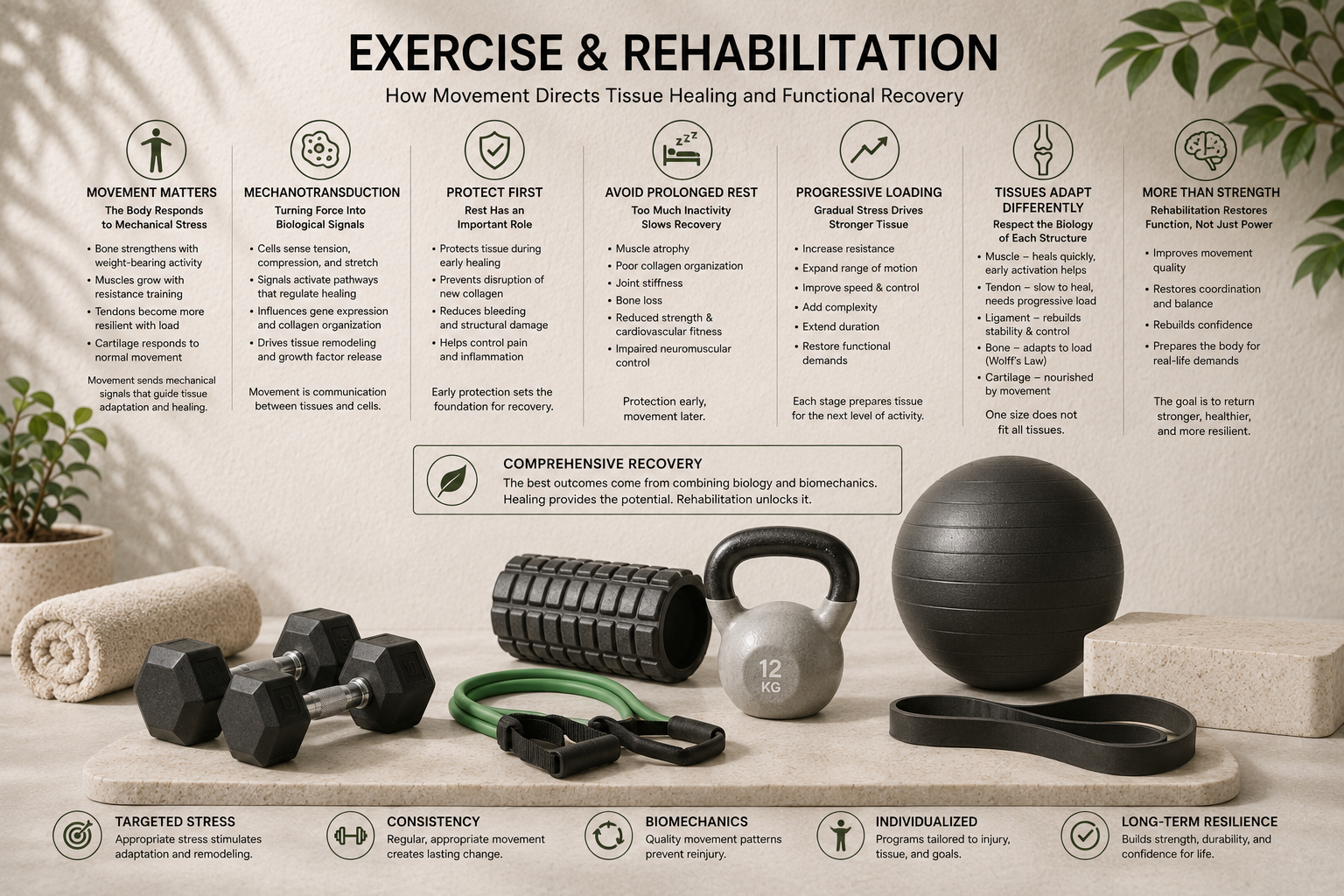
Exercise & Rehabilitation
How Movement Directs Tissue Healing and Functional Recovery
PROPeptides Foundations Program
Healing does not end when new tissue forms.
After an injury, the body begins rebuilding damaged structures by producing collagen, forming new blood vessels, reorganizing the extracellular matrix, and gradually restoring strength. However, newly formed tissue is initially immature and mechanically disorganized. Left alone, it rarely develops into tissue that is as strong, resilient, or functional as it was before injury.
Movement changes that.
Every step, every muscle contraction, and every controlled exercise sends mechanical signals into healing tissue. These signals influence how collagen fibers align, how muscles regain strength, how tendons adapt to load, and how the nervous system restores coordinated movement.
For this reason, rehabilitation is far more than "getting stronger."
It is an essential part of the biological healing process.
Modern sports medicine increasingly recognizes that successful recovery depends upon both biological healing and appropriate mechanical loading. Neither can fully replace the other.
The Body Responds to Mechanical Stress
The human body is remarkably adaptable.
Bone becomes stronger when exposed to weight-bearing activity.
Muscles enlarge in response to resistance training.
Tendons become stiffer and more resilient with progressive loading.
Even cartilage responds to the compressive forces generated during normal movement.
These adaptations occur because cells can detect mechanical forces and convert them into biological signals.
This process is known as mechanotransduction.
Rather than functioning as passive building materials, cells continuously sense tension, compression, and movement within their environment. These mechanical signals influence gene expression, protein synthesis, collagen organization, and tissue remodeling.
Healing is therefore influenced not only by chemistry but also by physics.
What Is Mechanotransduction?
Mechanotransduction describes the process by which cells convert mechanical forces into biochemical responses.
Specialized proteins on the surface of cells detect changes in:
Tension
Compression
Shear stress
Stretch
Pressure
These signals activate intracellular pathways that regulate:
Gene expression
Collagen synthesis
Cell proliferation
Cytoskeletal organization
Growth factor production
Extracellular matrix remodeling
In many ways, movement serves as another form of communication between tissues and cells.
The body is constantly asking:
"How much force is this tissue experiencing?"
The answer determines how that tissue adapts.
Rest Has an Important Role
Immediately following an injury, protecting damaged tissue is often necessary.
Excessive stress applied too early may:
Disrupt newly forming collagen
Increase bleeding
Delay healing
Worsen structural damage
Increase pain
For this reason, temporary protection, activity modification, bracing, or immobilization may be appropriate depending on the injury.
However, complete rest is rarely the long-term goal.
Healing tissues gradually become biologically prepared to tolerate increasing mechanical loads.
Determining when and how to introduce those loads is one of the primary objectives of rehabilitation.
The Problem With Prolonged Immobilization
Although immobilization protects tissue during the earliest stages of healing, excessive immobilization creates its own problems.
Research has shown that prolonged inactivity may contribute to:
Muscle atrophy
Reduced tendon stiffness
Poor collagen organization
Joint stiffness
Bone loss
Decreased cardiovascular fitness
Impaired neuromuscular control
Even relatively short periods of inactivity can produce measurable declines in muscle strength.
This illustrates an important principle:
Healing requires protection early, but adaptation requires movement later.
Successful rehabilitation balances both.
Progressive Loading
One of the central concepts in rehabilitation is progressive loading.
Rather than exposing healing tissue to maximum stress immediately, rehabilitation gradually increases the demands placed upon the recovering structure.
Progression may involve changes in:
Resistance
Range of motion
Speed
Complexity
Duration
Functional demands
Each stage prepares tissues for the next level of activity while minimizing the risk of reinjury.
Progressive loading reflects the body's natural biology.
As tissues become stronger, they become capable of adapting to greater forces.
Different Tissues Respond Differently
Not all tissues heal—or adapt—at the same rate.
Muscle
Muscle generally has an excellent blood supply and often heals relatively quickly.
Early controlled activation helps minimize muscle atrophy while restoring strength and coordination.
Tendons
Tendons heal more slowly because of their limited vascularity.
Progressive loading stimulates collagen organization and improves tendon stiffness over time.
Excessive loading too early may delay recovery, while insufficient loading may prevent normal adaptation.
Ligaments
Ligaments require gradual increases in stress to restore tensile strength and joint stability.
Rehabilitation frequently emphasizes neuromuscular control in addition to tissue healing.
Bone
Bone remodels according to mechanical demands.
Weight-bearing exercise stimulates osteoblast activity and improves bone density over time.
This principle is commonly referred to as Wolff's Law, which describes the tendency of bone to adapt to the loads placed upon it.
Cartilage
Although cartilage has limited regenerative capacity, appropriate joint loading helps maintain cartilage nutrition through the movement of synovial fluid.
Controlled movement often benefits joint health more than prolonged immobilization.
Strength Is Only Part of Recovery
Many patients believe rehabilitation ends when strength returns.
In reality, successful recovery also requires restoring:
Balance
Coordination
Mobility
Endurance
Movement efficiency
Joint stability
Sport-specific function
The nervous system must relearn efficient movement patterns following injury.
Without this retraining, abnormal movement mechanics may persist long after tissues have healed.
Pain Does Not Always Reflect Tissue Healing
One of the greatest challenges during rehabilitation is interpreting pain appropriately.
Pain serves as a valuable warning signal, but it does not always correspond directly to tissue damage.
Some individuals experience persistent pain despite adequate structural healing.
Others may have minimal pain despite significant tissue pathology.
For this reason, rehabilitation decisions should be guided by a combination of:
Clinical examination
Functional testing
Imaging when appropriate
Tissue healing timelines
Patient-specific goals
Symptom response over time
Recovery is best measured by improving function rather than pain alone.
Rehabilitation Is Individualized
No single rehabilitation program is appropriate for every patient.
Recovery depends upon numerous variables, including:
The injured tissue
Injury severity
Surgical versus non-surgical treatment
Age
Overall health
Previous injuries
Occupational demands
Athletic goals
Rate of healing
Two patients with similar MRI findings may require very different rehabilitation strategies based on their individual circumstances.
This is why rehabilitation should be viewed as a dynamic process rather than a standardized protocol.
Exercise Beyond Recovery
The benefits of exercise extend beyond healing injured tissue.
Regular physical activity supports:
Cardiovascular health
Metabolic function
Muscle maintenance
Bone density
Hormonal regulation
Immune function
Mental health
Long-term mobility
These systemic effects create a healthier biological environment that supports future healing while reducing the risk of subsequent injuries.
Recovery therefore represents an opportunity not only to restore previous function but also to improve overall health.
Bringing It All Together
Healing is a partnership between biology and movement.
Cells rebuild damaged tissue through carefully coordinated molecular signaling, while mechanical loading teaches that tissue how to function within the real world.
Without biological repair, movement cannot restore damaged structures.
Without appropriate movement, biological repair may produce tissue that is weaker, less organized, and less functional.
Modern rehabilitation integrates both principles.
Exercise is not simply a method of regaining strength—it is one of the body's most powerful biological signals for directing tissue remodeling, restoring movement, and returning patients to the activities that matter most.
Looking Ahead
Throughout this educational center, we have explored the biology of tissue repair, inflammation, regenerative peptides, combination therapy, nutrition, and rehabilitation.
In the final section, we'll answer many of the most common questions patients ask about regenerative medicine, including peptide safety, treatment expectations, recovery timelines, storage, travel, and how these therapies fit into comprehensive medical care.
Key References
Khan KM, Scott A. Mechanotherapy: How Physical Therapists' Prescription of Exercise Promotes Tissue Repair.British Journal of Sports Medicine.
Magnusson SP, et al. The Adaptation of Tendon to Mechanical Loading. Journal of Applied Physiology.
Baar K. Mechanisms of Skeletal Muscle Hypertrophy and Adaptation to Resistance Exercise. Sports Medicine.
Frost HM. Wolff's Law and Bone Remodeling. The Anatomical Record.
Griffin XL, Costa ML, Parsons N. Rehabilitation Following Musculoskeletal Injury. Bone & Joint Research.
Dye SF. The Pathophysiology of Patellofemoral Pain and Tissue Homeostasis. Clinical Orthopaedics and Related Research.
Clinical Perspective
One of the most common misconceptions in sports medicine is that healing and rehabilitation are separate processes. In reality, rehabilitation is an extension of healing itself. Once injured tissue is biologically capable of tolerating load, appropriately prescribed movement becomes one of the primary drivers of continued recovery. In our practice, rehabilitation programs are individualized based on the specific tissue involved, the stage of healing, functional goals, and objective findings from physical examination and musculoskeletal ultrasound. Whether a patient is recovering from a muscle strain, tendon injury, ligament sprain, fracture, or regenerative procedure, the objective remains the same: progressively restore strength, movement quality, confidence, and function while respecting the biology of tissue repair.