
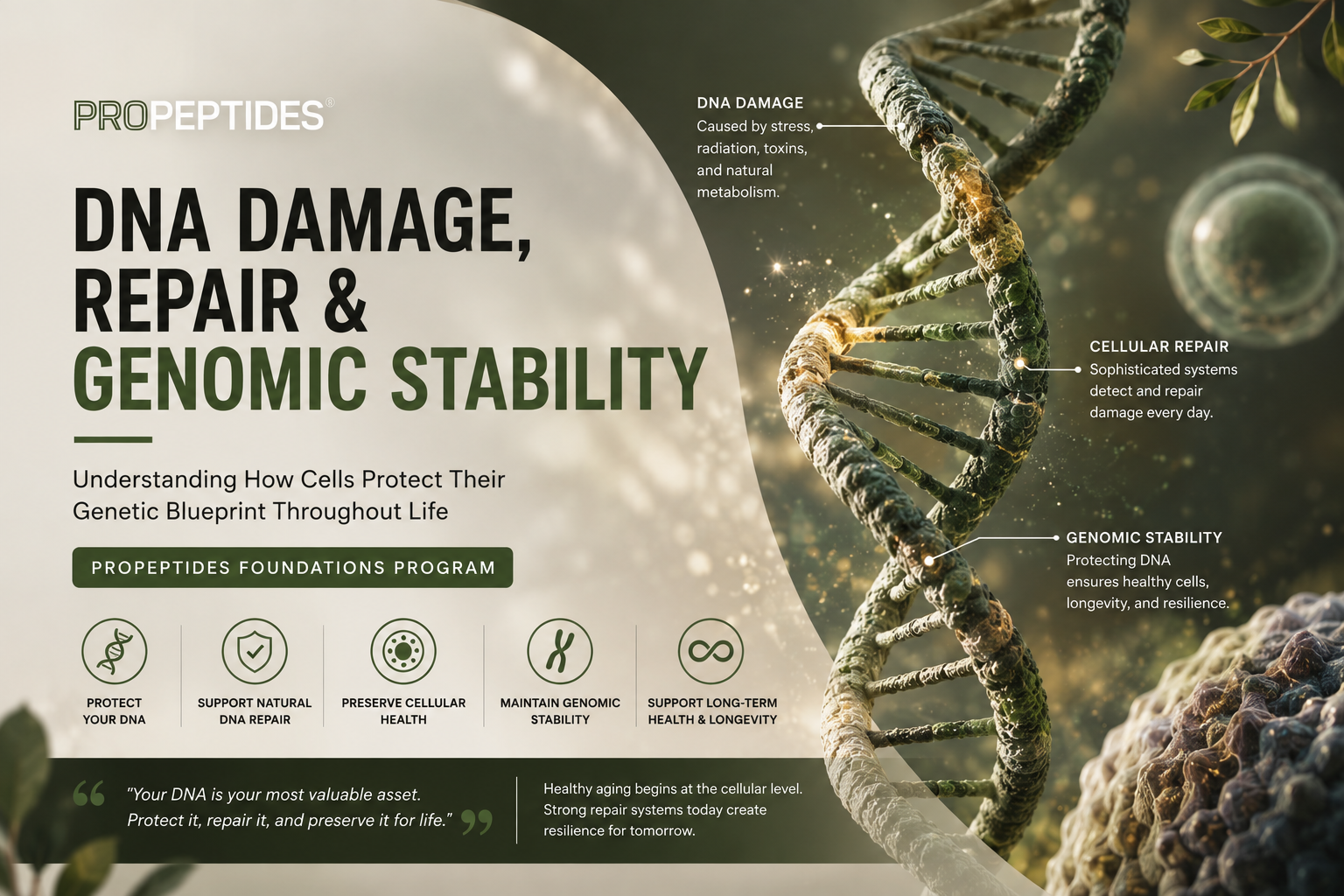
DNA Damage, Repair & Genomic Stability
Understanding How Cells Protect Their Genetic Blueprint Throughout Life
PROPeptides Foundations Program
Introduction
Every cell in the human body contains an extraordinary amount of genetic information.
If the DNA from a single human cell were stretched end to end, it would measure nearly two meters (approximately six feet) in length. This immense amount of genetic material must be precisely organized, protected, copied, and repaired throughout an individual's lifetime. Every cell division, every metabolic reaction, and every environmental exposure places this genetic blueprint under constant stress.
Remarkably, DNA is not a static molecule.
It is continuously damaged and continuously repaired.
Scientists estimate that every cell experiences tens of thousands of DNA lesions each day. These injuries arise from normal metabolism, reactive oxygen species, ultraviolet radiation, environmental toxins, replication errors, inflammation, and countless other sources.
Without sophisticated repair systems, life would not be possible.
Fortunately, cells possess an extensive network of DNA surveillance and repair mechanisms that identify damage, correct errors, and preserve genomic integrity before permanent mutations accumulate.
As we age, however, these repair systems gradually become less efficient.
Damage accumulates.
Repair slows.
Errors persist.
The gradual loss of genomic stability is now recognized as one of the foundational biological processes that contributes to aging and many chronic diseases.
DNA Is the Cell's Instruction Manual
DNA contains the genetic instructions necessary to build, maintain, and repair every cell in the body.
Within these sequences are the genes responsible for producing:
Structural proteins
Enzymes
Hormones
Cellular receptors
Growth factors
Immune proteins
Signaling molecules
Thousands of other functional proteins
Every time a cell divides, this genetic information must be copied with extraordinary accuracy.
Although the replication process is remarkably precise, it is not perfect.
Fortunately, cells continuously monitor newly synthesized DNA for mistakes.
DNA Is Constantly Under Attack
DNA damage occurs continuously throughout life.
Sources of damage include:
Internal sources
Reactive oxygen species
Normal cellular metabolism
DNA replication errors
Chronic inflammation
Spontaneous chemical reactions
External sources
Ultraviolet radiation
Ionizing radiation
Tobacco smoke
Air pollution
Environmental toxins
Certain medications
Viral infections
Many of these stressors are unavoidable.
Rather than preventing every injury, biology has evolved highly efficient systems for repairing damage before it becomes permanent.
Types of DNA Damage
DNA can be damaged in many different ways.
Examples include:
Base modifications
Individual DNA bases become chemically altered.
Single-strand breaks
One strand of the DNA double helix is disrupted.
Double-strand breaks
Both strands are broken simultaneously.
These represent some of the most serious forms of DNA damage.
Cross-linking
Chemical bonds form between DNA strands, interfering with replication.
Replication errors
Incorrect nucleotides become incorporated during cell division.
Each type of damage requires specialized repair machinery.
DNA Repair Systems
Rather than relying on one repair mechanism, cells possess multiple highly specialized repair pathways.
Major repair systems include:
Base Excision Repair (BER)
Repairs small chemical alterations caused by oxidation and metabolism.
Nucleotide Excision Repair (NER)
Removes bulky DNA damage such as ultraviolet-induced lesions.
Mismatch Repair (MMR)
Corrects mistakes introduced during DNA replication.
Homologous Recombination (HR)
Accurately repairs double-strand DNA breaks using an intact DNA template.
Non-Homologous End Joining (NHEJ)
Rapidly reconnects broken DNA strands when no template is available.
Together, these systems maintain remarkable genetic stability throughout life.
DNA Repair Requires Energy
DNA repair is not automatic.
Repair requires:
ATP
Enzymes
Cellular signaling
Protein synthesis
Chromatin remodeling
Nutrient availability
For this reason, DNA repair depends upon overall cellular health.
Cells experiencing mitochondrial dysfunction, chronic inflammation, or metabolic stress may become less efficient at maintaining genomic integrity.
This illustrates another example of how the hallmarks of aging interact rather than functioning independently.
What Is Genomic Instability?
Genomic instability refers to the gradual accumulation of DNA damage, mutations, and chromosomal abnormalities over time.
As repair mechanisms become less efficient:
Mutations accumulate.
Chromosomes become more unstable.
Cells lose functional precision.
Cellular communication becomes impaired.
Genomic instability increases the likelihood of:
Cellular senescence
Apoptosis
Malignant transformation
Tissue dysfunction
For this reason, genomic instability is considered one of the primary hallmarks of aging.
DNA Damage and Cancer
One of the most important consequences of impaired DNA repair is an increased risk of cancer.
Cancer develops when genetic mutations accumulate in genes regulating:
Cell growth
Cell division
DNA repair
Apoptosis
Tumor suppression
Healthy DNA repair systems eliminate many potentially dangerous mutations before they become clinically significant.
When these protective systems fail, abnormal cells may continue dividing, eventually forming tumors.
This relationship explains why cancer incidence generally increases with advancing age.
DNA Damage and Aging
DNA damage influences aging even when cancer does not develop.
Accumulated mutations can impair:
Protein production
Cellular metabolism
Stem cell function
Tissue regeneration
Immune responses
Cellular communication
Over decades, these small functional impairments gradually reduce tissue resilience.
Rather than causing immediate disease, genomic instability contributes to the progressive decline in physiological function associated with aging.
NAD+, PARPs, and DNA Repair
One of the most important molecules involved in DNA repair is nicotinamide adenine dinucleotide (NAD⁺).
Beyond its role in energy metabolism, NAD⁺ serves as an essential substrate for enzymes called poly(ADP-ribose) polymerases (PARPs).
PARPs rapidly detect DNA damage and coordinate repair by recruiting additional repair proteins to injured DNA.
When DNA damage is extensive, PARP activity increases dramatically.
This consumes substantial amounts of cellular NAD⁺.
As NAD⁺ levels decline with age, researchers have become increasingly interested in understanding how changes in NAD⁺ metabolism influence DNA repair and healthy aging.
This area remains an active field of investigation and will be explored in greater detail in the next article.
Lifestyle Supports Genomic Stability
Although DNA damage cannot be completely prevented, several lifestyle factors help support healthy repair systems.
These include:
Regular physical activity
Nutritious dietary patterns
Adequate sleep
Healthy metabolic function
Smoking avoidance
Sun protection
Maintaining a healthy body composition
These interventions reduce unnecessary DNA injury while supporting the energy production and cellular maintenance systems required for effective repair.
Again, healthy aging depends upon preserving the body's natural maintenance mechanisms rather than eliminating every source of stress.
Where Peptides Enter DNA Repair Research
Several investigational peptides are being studied because they may influence biological pathways involved in cellular maintenance and tissue resilience.
Some peptides may indirectly affect:
Mitochondrial function
Oxidative stress
Cellular metabolism
Inflammatory signaling
Tissue repair
However, no peptide has been approved specifically to enhance DNA repair or reverse genomic instability associated with normal aging.
Current longevity research focuses primarily on understanding how mitochondrial health, NAD⁺ metabolism, oxidative stress, and cellular signaling collectively influence genomic maintenance.
As our understanding of these interconnected systems grows, peptide-based therapies may eventually become part of broader strategies aimed at supporting cellular resilience.
Genomic Stability Connects Every Hallmark of Aging
DNA sits at the center of cellular biology.
Damage to the genome influences nearly every other hallmark of aging.
Genomic instability can contribute to:
Cellular senescence
Mitochondrial dysfunction
Stem cell exhaustion
Chronic inflammation
Impaired autophagy
Loss of proteostasis
Likewise, dysfunction within each of these systems can further increase DNA damage.
This interconnected network illustrates why aging is best understood as the gradual decline of multiple complementary maintenance systems rather than failure of a single biological pathway.
Bringing It All Together
Every day, the human genome is challenged by thousands of small injuries arising from normal metabolism, environmental exposures, and cellular activity. Sophisticated DNA repair systems continuously identify and correct these errors, preserving the integrity of the genetic information that governs cellular function. These repair mechanisms are essential for preventing mutations, maintaining tissue health, and reducing the risk of both cancer and age-related dysfunction.
As aging progresses, DNA repair gradually becomes less efficient. Accumulated damage contributes to genomic instability, impaired cellular communication, reduced regenerative capacity, and many of the biological changes associated with aging. Understanding genomic maintenance highlights an important principle of longevity science: preserving health depends not only on preventing injury but also on maintaining the cellular systems responsible for detecting and repairing damage throughout life.
Looking Ahead
DNA repair requires far more than specialized repair enzymes. It also depends on an adequate supply of cellular energy and signaling molecules that coordinate maintenance throughout the cell. One of the most important of these molecules is nicotinamide adenine dinucleotide (NAD⁺), a coenzyme that plays essential roles in energy metabolism, DNA repair, mitochondrial function, and cellular stress responses. Declining NAD⁺ levels have become one of the most actively investigated areas of longevity research.
In the next article, we'll explore NAD⁺, Sirtuins & Cellular Repair, examining how NAD⁺ supports healthy cellular function, why its levels change with age, and what current research suggests about strategies to maintain this critical metabolic cofactor.
Clinical Perspective
Genomic stability is fundamental to healthy aging because every aspect of cellular function depends upon the integrity of DNA. Throughout life, highly specialized repair systems continuously detect and correct thousands of DNA lesions generated by normal metabolism and environmental exposures. With advancing age, however, these repair mechanisms gradually lose efficiency, allowing mutations and chromosomal abnormalities to accumulate. This progressive genomic instability contributes not only to increased cancer risk but also to declining tissue function, impaired regeneration, and multiple hallmarks of aging. Current longevity research focuses on preserving DNA maintenance through support of mitochondrial health, metabolic function, NAD⁺ biology, and cellular stress responses rather than attempting to eliminate DNA damage entirely. Peptide research remains investigational in this area, with most therapeutic strategies aimed at indirectly supporting the broader physiological systems that maintain genomic integrity.