
Combination Performance Therapy
Integrating Multiple Physiological Pathways to Support Adaptation, Recovery, and Performance
PROPeptides Foundations Program
Human performance is the product of countless biological systems working together.
No single hormone builds muscle.
No single metabolic pathway determines endurance.
No individual peptide controls recovery.
Instead, adaptation emerges from the coordinated interaction of the nervous system, endocrine system, musculoskeletal system, cardiovascular system, immune system, and cellular energy metabolism. Every training session activates dozens of signaling pathways simultaneously, each contributing a small but important part of the adaptive response.
This systems-based view of physiology has influenced modern peptide research.
Rather than focusing on one isolated biological target, investigators have become increasingly interested in how multiple signaling pathways interact. The concept behind combination therapy is straightforward: if different peptides influence different aspects of physiology, carefully selected combinations may complement one another by supporting separate components of the adaptive process.
Importantly, this concept remains distinct from the idea that "more is better."
The goal of combination therapy is not to maximize biological stimulation. Rather, it is to improve coordination among physiological systems while respecting the body's normal regulatory mechanisms.
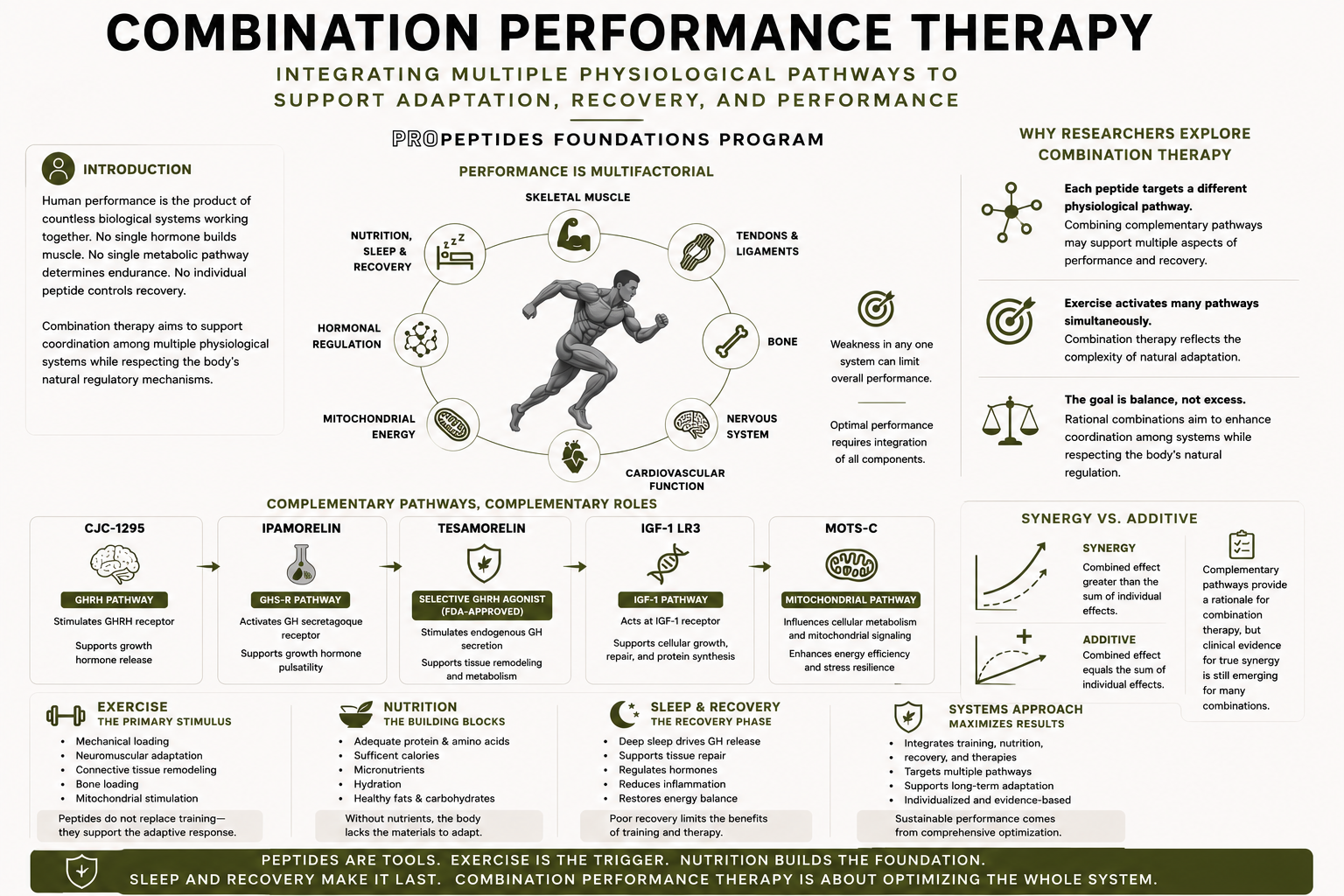
Performance Is Multifactorial
Athletic performance depends on much more than muscle size.
Successful adaptation requires the integration of numerous physiological systems, including:
Skeletal muscle
Tendons and ligaments
Bone
Nervous system
Cardiovascular function
Mitochondrial energy production
Hormonal regulation
Nutrition
Sleep
Recovery
Weakness in any one of these systems can limit overall performance.
For example, increasing muscle strength without adequate tendon adaptation may increase injury risk. Likewise, improving mitochondrial function without appropriate resistance training is unlikely to maximize strength.
This systems perspective explains why modern sports medicine increasingly emphasizes comprehensive performance optimization rather than isolated interventions.
Why Researchers Explore Combination Therapy
Each peptide discussed in this section influences a different aspect of physiology.
For example:
CJC-1295 stimulates the growth hormone-releasing hormone receptor.
Ipamorelin activates the growth hormone secretagogue receptor.
Tesamorelin selectively stimulates endogenous growth hormone secretion through an FDA-approved GHRH analog.
IGF-1 LR3 acts directly at the IGF-1 receptor.
MOTS-c influences cellular metabolism and mitochondrial signaling.
Because these pathways are biologically distinct, researchers have investigated whether targeting multiple systems simultaneously produces different physiological responses than targeting a single pathway alone.
The rationale is based on normal physiology.
Exercise itself never activates only one pathway.
Instead, training produces coordinated responses involving mechanical loading, endocrine signaling, inflammation, neural adaptation, energy metabolism, and tissue remodeling.
Combination therapy attempts to reflect this biological complexity.
Complementary Rather Than Redundant Mechanisms
An important principle in physiology is that different signaling pathways often perform complementary functions.
For example:
Growth hormone signaling primarily coordinates tissue remodeling and metabolism.
IGF-1 promotes many downstream cellular adaptations involved in repair and protein synthesis.
Mitochondrial signaling regulates energy availability.
Mechanical loading initiates mechanotransduction.
Nutrition provides amino acids and energy substrates.
Sleep coordinates endocrine recovery.
Each component contributes something different.
Combining therapies that target complementary biology is conceptually different from repeatedly stimulating the same pathway.
This distinction is central to rational combination therapy.
Synergy Versus Additive Effects
The term synergy is frequently used in discussions of peptide combinations, but it is often misunderstood.
In physiology, synergy refers to two or more biological processes interacting in a way that produces an effect greater than would be expected from either process alone.
This differs from an additive effect, where the combined response is simply the sum of the individual effects.
True biological synergy requires evidence demonstrating that interacting pathways amplify one another.
For many peptide combinations, this level of evidence remains limited.
While complementary mechanisms provide a plausible physiological rationale, robust clinical studies confirming synergistic benefits are still lacking for many proposed combinations.
Understanding this distinction helps separate theoretical mechanisms from demonstrated clinical outcomes.
The Central Role of Exercise
Perhaps the most important concept in performance medicine is that peptides do not replace exercise.
Resistance training provides:
Mechanical loading
Satellite cell activation
Neuromuscular adaptation
Connective tissue remodeling
Bone loading
Mitochondrial stimulation
Without these physiological signals, many of the pathways influenced by performance peptides are only minimally activated.
Exercise remains the primary stimulus.
Peptides, where appropriate and supported by evidence, are best viewed as potential modulators of the adaptive response rather than substitutes for training.
Nutrition Determines the Building Blocks
Adaptation requires raw materials.
Even if anabolic signaling pathways become activated, muscle cannot synthesize new proteins without adequate amino acids.
Likewise, mitochondrial adaptation depends on sufficient energy availability and micronutrients that support normal cellular metabolism.
Performance nutrition therefore remains foundational.
Key nutritional considerations include:
Total protein intake
Protein distribution throughout the day
Carbohydrate availability for training demands
Healthy dietary fats
Micronutrient sufficiency
Hydration
No peptide compensates for chronic nutritional deficiencies.
Sleep Is the Primary Recovery Intervention
Sleep coordinates many of the physiological processes discussed throughout this section.
During sleep:
Growth hormone pulses increase.
Protein synthesis continues.
Neural recovery occurs.
Memory consolidation improves.
Immune regulation is optimized.
Tissue repair progresses.
Poor sleep disrupts nearly every adaptive pathway involved in performance.
Consequently, optimizing sleep often produces greater improvements in recovery than attempting to manipulate individual biochemical pathways.
This is one reason lifestyle interventions remain the foundation of evidence-based performance medicine.
Individual Physiology Matters
No two athletes respond identically to the same intervention.
Training age, genetics, nutrition, sex, age, injury history, sleep quality, metabolic health, and hormonal status all influence physiological adaptation.
Because of this variability, modern sports medicine increasingly emphasizes individualized care rather than standardized protocols.
The same principle applies to peptide research.
Future precision medicine approaches may eventually allow clinicians to better identify which individuals are most likely to benefit from specific therapies.
At present, however, evidence remains insufficient to support broad generalizations across diverse populations.
Evidence-Based Combination Therapy
The popularity of peptide combinations has grown rapidly, particularly within athletic and wellness communities.
However, enthusiasm should not be confused with scientific certainty.
Many proposed combinations are based upon:
Physiological rationale
Animal studies
Mechanistic research
Small clinical investigations
Clinical experience
While these forms of evidence can generate important hypotheses, they do not replace large, randomized clinical trials evaluating long-term safety and clinically meaningful outcomes.
As a result, clinicians should carefully distinguish between:
Established medical indications
Early human research
Preclinical evidence
Theoretical physiological models
Maintaining this distinction allows new therapies to be evaluated objectively while protecting patients from unsupported claims.
A Systems-Based Framework for Performance
One of the recurring themes throughout this educational program is that physiology functions as an integrated network.
Performance emerges from the interaction of multiple biological systems rather than any single molecule.
A simplified framework illustrates this concept:
Physiological System - Primary Role in Performance
Mechanical loading - Initiates adaptation through mechanotransduction
Endocrine signaling - Coordinates tissue remodeling and metabolism
Mitochondrial function - Produces cellular energy
Nutrition - Supplies substrates for repair and growth
Nervous system - Develops coordination, strength, and motor learning
Sleep and recovery - Completes adaptation and restores homeostasis
Each system influences the others.
Successful performance optimization therefore requires strengthening the entire network rather than focusing exclusively on one pathway.
Bringing It All Together
Combination performance therapy reflects an evolving understanding of human physiology. Rather than viewing performance through the lens of a single hormone or signaling pathway, modern research increasingly recognizes that adaptation results from coordinated interactions among endocrine regulation, mechanical loading, mitochondrial function, nutrition, recovery, and neural adaptation.
This systems-based perspective provides a useful framework for interpreting peptide research. Different peptides target different aspects of physiology, and combining them is best understood as an attempt to influence complementary biological processes—not to override the body's natural regulation. While this rationale is scientifically plausible, the strength of evidence supporting specific combinations varies considerably and continues to evolve.
Ultimately, the most effective performance strategy remains rooted in the fundamentals of exercise science. Progressive training, sound nutrition, adequate sleep, and structured recovery create the biological environment in which any additional intervention must operate.
Looking Ahead
Exercise provides the stimulus for adaptation, but nutrition determines whether the body has the resources needed to respond. Adequate protein, energy intake, hydration, and micronutrient availability influence muscle protein synthesis, mitochondrial function, connective tissue remodeling, immune regulation, and recovery.
In the next article, we'll explore Nutrition for Performance, examining how dietary patterns, protein timing, energy availability, and nutrient quality influence human performance and how nutrition integrates with the physiological principles discussed throughout this section.
Key References
Hawley JA, Hargreaves M, Joyner MJ, Zierath JR. Integrative Biology of Exercise. Cell.
Booth FW, Roberts CK, Laye MJ. Lack of Exercise Is a Major Cause of Chronic Diseases. Comprehensive Physiology.
Phillips SM, Van Loon LJC. Dietary Protein for Athletes: From Requirements to Optimum Adaptation. Journal of Sports Sciences.
Kenney WL, Wilmore JH, Costill DL. Physiology of Sport and Exercise.
American College of Sports Medicine. ACSM Position Stand: Nutrition and Athletic Performance.
Clinical Perspective
Combination therapies are increasingly discussed in sports medicine and peptide research, but they should be interpreted within the broader context of systems physiology. Human performance depends on the coordinated function of multiple biological systems, and no single intervention can replace the foundational roles of exercise, nutrition, sleep, and recovery. When considering investigational peptide combinations, clinicians should evaluate not only the proposed mechanisms of action but also the quality of supporting evidence, potential interactions, patient-specific factors, and long-term safety. A physiology-first approach provides the most reliable framework for integrating emerging therapies into evidence-based performance medicine.