
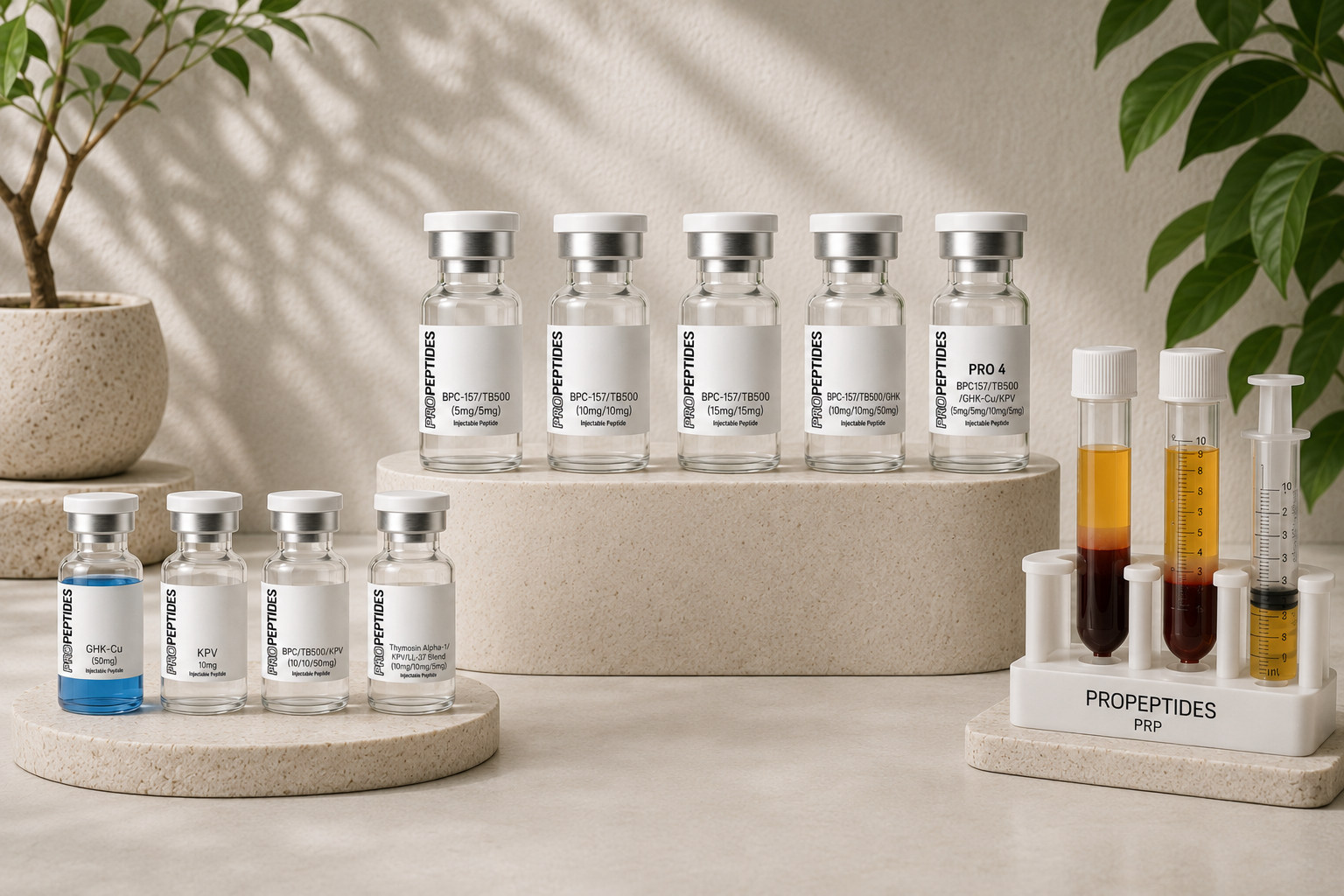
Combination Therapy
Why Researchers Study Multiple Regenerative Peptides Together
PROPeptides Foundations Program
Healing is rarely driven by a single biological signal.
When an injury occurs, thousands of molecules begin communicating simultaneously. Platelets release growth factors. Immune cells coordinate inflammation. Blood vessels expand and form new branches. Fibroblasts produce collagen. Stem and progenitor cells migrate into damaged tissue. The extracellular matrix is dismantled and rebuilt while mechanical forces gradually organize new tissue into functional structures.
No single molecule controls this entire process.
Instead, healing depends upon the coordinated interaction of numerous biological pathways that overlap, reinforce one another, and change over time.
This complexity explains why modern regenerative medicine increasingly investigates combination therapies rather than relying on a single intervention.
Rather than expecting one therapy to accomplish every aspect of healing, researchers are exploring whether different biologic treatments may complement one another by influencing separate phases of tissue repair.
The concept is similar to many other areas of medicine. Just as cardiovascular disease is often managed through a combination of nutrition, exercise, medications, and blood pressure control, tissue healing may benefit from a comprehensive strategy that addresses multiple aspects of the regenerative process.
Healing Is a Network, Not a Single Pathway
One of the greatest misconceptions in regenerative medicine is that healing follows a single biological pathway.
In reality, successful repair resembles an orchestra far more than a solo performance.
Every stage of healing depends on dozens of interconnected systems working together, including:
Hemostasis
Inflammation
Immune regulation
Angiogenesis
Cellular migration
Collagen synthesis
Extracellular matrix remodeling
Mechanical loading
Tissue maturation
These processes occur simultaneously and continuously influence one another.
If one component is disrupted, the entire healing response may become less efficient.
For this reason, investigators increasingly study therapies that influence different parts of the repair process rather than expecting one intervention to address every biological need.
Different Peptides, Different Biological Roles
Although considerable overlap exists, different regenerative peptides have been investigated for different areas of tissue biology.
For example:
BPC-157 has primarily been studied for its potential effects on angiogenesis, nitric oxide signaling, gastrointestinal protection, and tendon biology.
Thymosin Beta-4 (TB-500) has been investigated for cellular migration, actin regulation, wound healing, and tissue remodeling.
GHK-Cu has demonstrated effects involving collagen production, extracellular matrix organization, skin biology, and gene regulation.
Because these biological actions are not identical, researchers have explored whether combining peptides may influence multiple aspects of tissue repair simultaneously.
Importantly, this hypothesis remains an active area of investigation. While laboratory and animal studies provide biological rationale, robust human clinical trials evaluating specific peptide combinations remain limited.
Healing Changes Over Time
Another reason combination therapy has attracted interest is that the biological needs of healing tissues change throughout recovery.
Immediately after injury, the body prioritizes:
Bleeding control
Inflammatory signaling
Immune cell recruitment
Days later, priorities shift toward:
Angiogenesis
Fibroblast activation
Cellular proliferation
Weeks to months later, the emphasis becomes:
Collagen maturation
Extracellular matrix remodeling
Mechanical adaptation
Restoration of strength
Because healing is dynamic rather than static, researchers continue investigating whether different interventions may have greater biological relevance during different phases of recovery.
This concept is sometimes referred to as stage-specific regenerative support, although optimal clinical strategies have not yet been established.
Combination Therapy Beyond Peptides
One of the most important principles in regenerative medicine is that peptides represent only one potential component of treatment.
Successful recovery often depends upon integrating multiple evidence-based strategies.
These may include:
Physical therapy
Progressive resistance exercise
Nutritional optimization
Sleep optimization
Metabolic health management
Platelet-rich plasma (PRP)
Orthobiologic procedures
Appropriate mechanical loading
Activity modification
Patient education
Rather than replacing these interventions, investigational peptides are generally viewed as complementary to a comprehensive rehabilitation program.
This systems-based approach reflects the complexity of human healing.
Peptides and Platelet-Rich Plasma
Platelet-rich plasma (PRP) and therapeutic peptides are sometimes discussed together because both involve biological signaling rather than simply providing structural support.
However, they are fundamentally different.
PRP is produced by concentrating a patient's own platelets, which release numerous naturally occurring growth factors involved in the early stages of healing.
Investigational peptides, by contrast, are individual signaling molecules that may influence specific biological pathways depending on the peptide being studied.
Because these approaches operate through different mechanisms, researchers continue exploring whether they may complement one another in certain clinical settings.
At present, high-quality comparative studies evaluating these combinations remain limited.
The Importance of Rehabilitation
Even the most sophisticated biological therapy cannot replace appropriate rehabilitation.
Healing tissues require carefully controlled mechanical loading to develop normal structure and function.
Appropriately prescribed rehabilitation helps:
Align collagen fibers
Restore mobility
Improve neuromuscular control
Increase tissue strength
Prevent recurrent injury
Without progressive rehabilitation, repaired tissues may remain mechanically weak despite successful biological healing.
For this reason, exercise and physical therapy remain foundational components of nearly every evidence-based recovery program.
Nutrition Supports Every Stage of Healing
Every regenerative process requires raw materials.
Protein provides amino acids for new tissue formation.
Vitamin C contributes to collagen synthesis.
Copper supports enzymes involved in connective tissue formation.
Zinc participates in cellular proliferation.
Adequate calories provide the energy necessary for tissue repair.
Sleep supports hormone regulation and protein synthesis.
No peptide can compensate for severe nutritional deficiencies or inadequate recovery.
Biology functions best when the entire healing environment is optimized.
Individualized Care
No two injuries are biologically identical.
Healing may differ depending on:
Patient age
Tissue involved
Severity of injury
Blood supply
Metabolic health
Smoking status
Diabetes
Physical activity
Previous injuries
Surgical history
Because these variables influence recovery, regenerative medicine increasingly emphasizes individualized treatment plans rather than standardized protocols.
The optimal approach for one patient may not be appropriate for another, even when imaging findings appear similar.
Current Evidence and Future Directions
Interest in combination regenerative therapies continues to grow.
Laboratory investigations have demonstrated numerous biological interactions among growth factors, extracellular matrix proteins, immune cells, and signaling peptides.
However, translating these findings into clinical practice requires carefully designed human research.
Important questions remain regarding:
Which combinations are most effective
Appropriate timing
Optimal dosing
Patient selection
Long-term safety
Comparative effectiveness
As regenerative medicine evolves, future studies will likely focus increasingly on integrated treatment strategies rather than isolated therapies.
Bringing It All Together
Healing is one of the most biologically complex processes in human physiology.
Rather than relying on a single molecule, successful tissue repair depends upon the coordinated interaction of inflammation, angiogenesis, cellular migration, collagen synthesis, extracellular matrix remodeling, rehabilitation, nutrition, and time.
This complexity explains why regenerative medicine increasingly adopts a systems-based perspective.
Investigational peptides, platelet-rich plasma, rehabilitation, exercise, nutrition, and other biologic therapies should not be viewed as competing approaches.
Instead, they represent different tools that may influence separate aspects of tissue repair.
The future of regenerative medicine will likely depend less on discovering one "perfect" therapy and more on understanding how multiple biological systems can be optimized together to support the body's remarkable capacity for healing.
Looking Ahead
While biologic therapies may help create a favorable environment for tissue repair, they cannot replace the nutritional building blocks required to construct new tissue.
Every tendon fiber, collagen molecule, blood vessel, and muscle cell depends on adequate protein, vitamins, minerals, and energy availability.
In the next article, we'll explore Nutrition During Tissue Healing, examining how diet influences collagen synthesis, immune function, inflammation, and the body's ability to recover from injury.
Key References
Foster TE, Puskas BL, Mandelbaum BR, Gerhardt MB, Rodeo SA. Platelet-Rich Plasma: From Basic Science to Clinical Applications. American Journal of Sports Medicine.
Andia I, Maffulli N. Biological Therapies in Regenerative Sports Medicine. Sports Medicine.
Murray IR, Geeslin AG, et al. Orthobiologics and Regenerative Medicine: Current Evidence and Future Directions.Journal of Bone and Joint Surgery.
Griffin XL, et al. Principles of Tissue Repair and Regenerative Medicine. Bone & Joint Research.
Eming SA, Martin P, Tomic-Canic M. Wound Repair and Regeneration: Mechanisms, Signaling, and Translation.Science Translational Medicine.
Clinical Perspective
One of the most important lessons we've learned in regenerative medicine is that successful outcomes rarely depend on a single intervention. Patients often ask whether one peptide is "better" than another or whether PRP alone is enough to heal an injury. In reality, healing is influenced by many interacting variables, including tissue biology, mechanical loading, rehabilitation, nutrition, metabolic health, sleep, and patient-specific factors. Rather than searching for a single solution, our approach focuses on identifying the biological and mechanical limitations preventing recovery and addressing them through a comprehensive treatment strategy. This systems-based philosophy reflects both the complexity of human physiology and the direction in which regenerative medicine continues to evolve.