
CJC-1295
Understanding Growth Hormone-Releasing Hormone and the Physiology of Endogenous Growth Hormone Stimulation
PROPeptides Foundations Program
Growth hormone secretion is one of the body's most tightly regulated physiological processes.
Rather than being released continuously, growth hormone is secreted in carefully timed pulses under the coordinated influence of the hypothalamus, pituitary gland, sleep, exercise, nutrition, and multiple hormonal feedback systems. This pulsatile pattern allows growth hormone to support tissue remodeling, metabolism, recovery, and body composition while avoiding the physiological consequences of chronically elevated hormone concentrations.
Because of the important role growth hormone plays in human physiology, researchers have long been interested in developing therapies that work with the body's natural regulatory systems rather than replacing them entirely.
One approach has been to stimulate the pituitary gland through the growth hormone-releasing hormone (GHRH) receptor, allowing the body to produce its own growth hormone in response to physiologic signals.
CJC-1295 was developed as part of this effort.
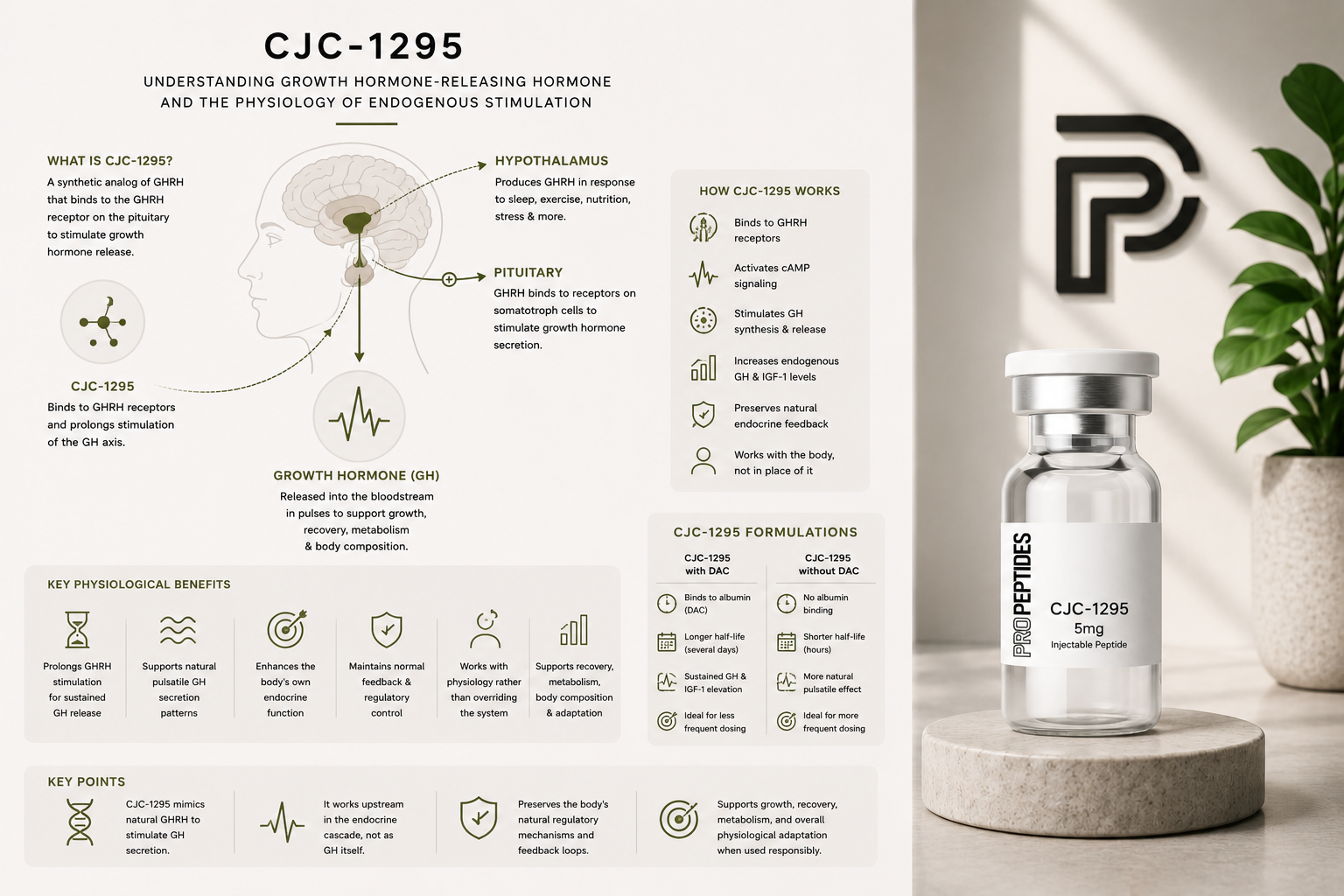
Rather than acting as growth hormone itself, CJC-1295 is an investigational synthetic analog of GHRH designed to prolong stimulation of the normal growth hormone axis. Depending on the formulation, it may extend the activity of endogenous GHRH while preserving many aspects of normal pituitary regulation.
Understanding how CJC-1295 functions first requires understanding the physiology it is designed to mimic.
What Is CJC-1295?
CJC-1295 is a synthetic peptide derived from the structure of naturally occurring growth hormone-releasing hormone (GHRH).
Native GHRH is produced within the hypothalamus and released into the portal circulation connecting the hypothalamus and anterior pituitary gland.
Once it reaches the pituitary, GHRH binds to receptors on somatotroph cells, stimulating the synthesis and release of growth hormone.
The limitation of native GHRH is that it is rapidly degraded in the circulation, with a plasma half-life measured in only a few minutes.
To overcome this limitation, researchers developed modified GHRH analogs with greater stability.
CJC-1295 is one such analog.
Its structural modifications allow it to remain biologically active substantially longer than native GHRH, thereby prolonging stimulation of the growth hormone axis.
Why Was CJC-1295 Developed?
The goal of CJC-1295 was not simply to increase growth hormone concentrations.
Rather, researchers sought to develop a molecule capable of supporting the body's existing endocrine physiology.
Unlike administering recombinant human growth hormone directly, stimulating the GHRH receptor allows the pituitary gland to remain an active participant in hormone regulation.
This distinction is important.
The pituitary continues to respond to:
Somatostatin
Ghrelin
Negative feedback from IGF-1
Sleep
Exercise
Nutritional status
Because these regulatory mechanisms remain functional, therapies that stimulate endogenous growth hormone release may preserve more of the body's normal endocrine control than exogenous growth hormone administration.
This physiological concept has made GHRH analogs an important area of endocrine research.
How CJC-1295 Works
CJC-1295 binds to the growth hormone-releasing hormone receptor (GHRH-R) located on somatotroph cells within the anterior pituitary.
Activation of this receptor initiates intracellular signaling through cyclic AMP (cAMP) and protein kinase A (PKA), ultimately stimulating:
Growth hormone synthesis
Growth hormone release
Somatotroph activity
The released growth hormone then circulates throughout the body, where it exerts direct metabolic effects and stimulates the production of insulin-like growth factor-1 (IGF-1), primarily in the liver and in peripheral tissues.
Importantly, CJC-1295 does not function as growth hormone itself.
Instead, it amplifies one of the body's upstream signaling pathways.
CJC-1295 With DAC vs Without DAC
One of the most common sources of confusion surrounding CJC-1295 is that two different formulations are often discussed under the same name.
CJC-1295 with Drug Affinity Complex (DAC)
The original CJC-1295 was engineered with a Drug Affinity Complex (DAC) that allows the peptide to bind reversibly to circulating albumin.
Albumin is the most abundant protein in human plasma and has a relatively long circulating half-life. By attaching to albumin, CJC-1295 with DAC remains in circulation significantly longer than native GHRH.
This prolonged half-life can sustain elevated growth hormone and IGF-1 concentrations for several days following administration in clinical studies.
Modified GRF (1-29) / CJC-1295 Without DAC
A second peptide, commonly referred to as Modified GRF (1-29) or CJC-1295 without DAC, incorporates amino acid substitutions that improve stability but does not include the albumin-binding Drug Affinity Complex.
As a result, its duration of action is much shorter, more closely resembling the natural pulsatile physiology of endogenous GHRH.
Although these peptides are often grouped together, they possess distinct pharmacokinetic profiles and should not be considered interchangeable.
Physiological Versus Pharmacological Stimulation
One of the major theoretical advantages of GHRH analogs is that they stimulate the body's existing endocrine system rather than bypassing it.
When functioning normally, the pituitary continues responding to:
Negative feedback from IGF-1
Somatostatin inhibition
Ghrelin signaling
Sleep-associated hormone rhythms
This differs fundamentally from administering recombinant growth hormone, which delivers hormone directly into the circulation regardless of the body's current physiological needs.
Whether this distinction translates into clinically meaningful differences depends on the therapeutic context and continues to be investigated.
Exercise, Sleep, and Growth Hormone
Growth hormone secretion is influenced by several powerful physiological stimuli.
Among the most important are:
Deep Sleep
The largest endogenous growth hormone pulses typically occur during slow-wave sleep shortly after sleep onset.
Poor sleep quality may reduce the magnitude of these normal pulses.
Resistance Exercise
High-intensity resistance exercise stimulates transient increases in growth hormone secretion, particularly when large muscle groups are involved and rest periods are relatively short.
These acute increases are believed to contribute to the broader adaptive response to training, although long-term improvements in muscle mass are influenced by many additional factors.
Nutritional Status
Fasting, blood glucose concentrations, and energy availability all influence growth hormone physiology through interactions involving ghrelin, insulin, and hypothalamic signaling.
Because these natural stimuli remain active during GHRH receptor stimulation, they continue contributing to overall endocrine regulation.
Clinical Research
Most clinical studies involving CJC-1295 have focused on endocrine physiology rather than athletic performance.
Published investigations have demonstrated that CJC-1295 can increase circulating growth hormone and IGF-1 concentrations for varying durations depending on the specific formulation studied.
Researchers have explored potential applications involving:
Adult growth hormone deficiency
Age-related changes in growth hormone secretion
Body composition
Metabolic health
Healthy aging
However, relatively few large, long-term clinical trials have evaluated meaningful functional outcomes such as strength, athletic performance, or long-term quality of life.
Consequently, many questions remain regarding optimal patient selection, duration of therapy, long-term safety, and comparative effectiveness.
Safety and Current Evidence
Most published human studies have reported that CJC-1295 was generally well tolerated within the conditions studied.
Reported adverse events have included:
Injection-site reactions
Headache
Flushing
Mild gastrointestinal symptoms
As with any therapy that influences the growth hormone–IGF-1 axis, theoretical considerations include alterations in glucose metabolism, fluid balance, and endocrine regulation.
Long-term safety data remain limited, particularly in healthy individuals using CJC-1295 for performance optimization rather than recognized medical indications.
For this reason, CJC-1295 should be considered an investigational peptide whose potential benefits and risks continue to be studied.
CJC-1295 Compared With Recombinant Growth Hormone
Although both approaches influence the GH–IGF-1 axis, they do so through fundamentally different mechanisms.
Feature
CJC-1295 / Recombinant Growth Hormone
Primary target / GHRH receptor in the pituitary
Growth hormone receptors throughout the body / Hormone source
Stimulates endogenous GH secretion / Provides exogenous GH directly
Physiological feedback / Preserved to a greater extent
Bypasses pituitary regulation / GH secretion
Influences endogenous release / Continuous pharmacologic exposure after administration
Current status -
Investigational / FDA-approved for specific medical indications
These differences explain why the two therapies should not be considered biologically equivalent.
Bringing It All Together
CJC-1295 was developed to enhance one of the body's own regulatory pathways rather than replacing growth hormone directly. By acting as a synthetic analog of growth hormone-releasing hormone, it stimulates the pituitary gland to release endogenous growth hormone while maintaining many of the physiological feedback mechanisms that normally regulate the GH–IGF-1 axis.
This approach distinguishes CJC-1295 from recombinant growth hormone and has made it an important subject of endocrine research. Although studies have demonstrated predictable effects on growth hormone and IGF-1 concentrations, the extent to which these hormonal changes translate into meaningful improvements in body composition, recovery, or athletic performance remains an active area of investigation.
Understanding CJC-1295 also reinforces a broader principle introduced throughout this section: effective performance medicine begins with understanding normal physiology. Therapeutic peptides are best viewed as tools designed to influence existing biological systems—not to replace them.
Looking Ahead
Growth hormone secretion is regulated by more than one signaling pathway. While CJC-1295 acts through the growth hormone-releasing hormone receptor, another important physiological regulator is ghrelin, often referred to as the body's hunger hormone. Ghrelin stimulates growth hormone release through a completely different receptor, providing an additional mechanism for influencing endogenous hormone secretion.
In the next article, we'll explore Ipamorelin, examining how selective ghrelin receptor activation differs from GHRH stimulation and why researchers have investigated combining these complementary physiological pathways.
→ Continue to: Ipamorelin
Key References
Teichman SL, Neale A, Lawrence B, et al. Prolonged Stimulation of Growth Hormone and IGF-1 Following Administration of CJC-1295 in Healthy Adults. Journal of Clinical Endocrinology & Metabolism.
Veldhuis JD, Iranmanesh A. Physiology of Growth Hormone Secretion. Endocrine Reviews.
Alba M, et al. Pharmacokinetics and Pharmacodynamics of CJC-1295. Clinical Endocrinology.
Melmed S, et al. Williams Textbook of Endocrinology.
Giustina A, Veldhuis JD. Neuroregulation of Growth Hormone Secretion. Endocrine Reviews.
Clinical Perspective
CJC-1295 illustrates an important concept in endocrine physiology: there is a meaningful difference between stimulating a normal biological pathway and replacing the hormone that pathway produces. By targeting the GHRH receptor, CJC-1295 is designed to work upstream within the growth hormone axis, allowing the pituitary gland and its natural feedback mechanisms to remain central to hormone regulation. While this mechanism is physiologically appealing, the clinical significance of this approach continues to be evaluated, particularly in healthy individuals seeking improvements in performance or recovery. As with all investigational peptide therapies, decisions regarding their use should be grounded in current evidence, individualized medical assessment, and a clear understanding of both their potential benefits and limitations.