
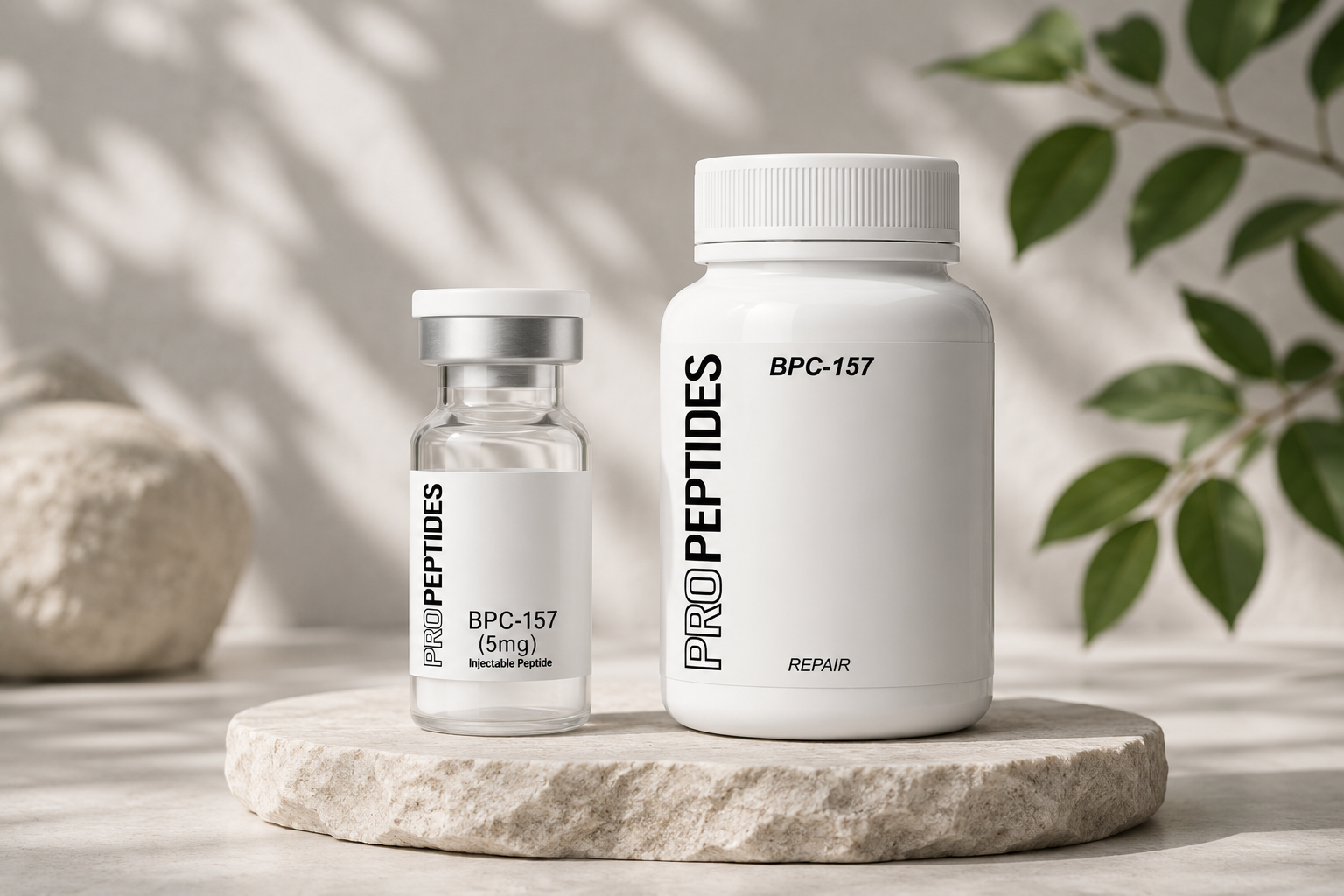
BPC-157
Understanding One of the Most Studied Experimental Peptides in Regenerative Medicine
PROPeptides Foundations Program
Among the many peptides investigated for their potential roles in tissue repair, BPC-157 has generated considerable scientific interest.
Over the past several decades, laboratory and animal studies have suggested that BPC-157 may influence multiple biological pathways involved in healing, including angiogenesis, cellular migration, collagen organization, tendon repair, nerve regeneration, and gastrointestinal protection. These findings have led researchers to investigate its potential applications across a wide range of tissues.
At the same time, BPC-157 remains an investigational compound.
Although hundreds of preclinical studies have been published, well-designed human clinical trials remain limited. Much of what is currently understood about BPC-157 comes from experimental animal models, and it is important not to assume that findings observed in these models will necessarily translate to humans.
This distinction is critical.
Scientific curiosity and promising laboratory research do not automatically establish clinical effectiveness.
The purpose of this article is to examine what BPC-157 is, where it comes from, how it is believed to function biologically, what current research suggests, and where important questions remain unanswered.
What Is BPC-157?
BPC-157 stands for Body Protection Compound-157.
It is a synthetic peptide consisting of 15 amino acids and was originally derived from a naturally occurring protective protein identified in human gastric juice. Researchers became interested in this peptide after observing that certain gastric proteins appeared to play important roles in protecting the gastrointestinal lining from injury.
Scientists subsequently isolated a stable peptide fragment that retained many of these protective properties in experimental models.
Unlike many peptide hormones that function by binding to a single well-defined receptor, BPC-157 appears to influence multiple biological signaling pathways simultaneously. For this reason, researchers often describe it as a pleiotropic peptide, meaning that it may produce a variety of biological effects across different tissues.
Rather than replacing damaged tissue directly, BPC-157 is thought to influence the environment in which healing occurs by affecting cellular communication, blood vessel formation, inflammatory signaling, and tissue remodeling.
Discovery and Early Research
Initial investigations of BPC-157 focused primarily on the gastrointestinal tract.
Researchers observed that experimental administration of the peptide appeared to protect gastric tissue against a variety of injuries, including chemically induced ulcers and other forms of mucosal damage.
As additional studies were performed, investigators reported potential effects extending beyond the digestive system.
Animal research began exploring possible roles in:
Tendon healing
Ligament repair
Skeletal muscle injury
Bone healing
Peripheral nerve regeneration
Skin wounds
Blood vessel growth
Intestinal injury
These findings expanded scientific interest considerably and established BPC-157 as one of the most frequently studied experimental peptides within regenerative medicine research.
How Is BPC-157 Thought to Work?
Unlike medications that target a single enzyme or receptor, BPC-157 appears to influence multiple interconnected biological pathways involved in tissue repair.
Although many mechanisms remain incompletely understood, several recurring themes have emerged from experimental research.
Cellular Communication
Healing depends on continuous communication between injured tissues and surrounding cells.
Laboratory studies suggest that BPC-157 may influence signaling pathways involved in:
Cell migration
Fibroblast activity
Endothelial cell function
Extracellular matrix organization
Growth factor interactions
Rather than initiating healing independently, BPC-157 may help coordinate the communication necessary for normal tissue repair.
Angiogenesis
One of the most consistently reported findings involves angiogenesis, the formation of new blood vessels.
Healing tissues require oxygen and nutrients to rebuild effectively.
Experimental models suggest that BPC-157 may support angiogenesis by influencing pathways involving vascular endothelial growth factor (VEGF) and nitric oxide signaling.
Improved vascularity could theoretically enhance nutrient delivery, waste removal, and cellular activity within injured tissue.
Whether these findings produce meaningful clinical benefits in humans remains under investigation.
Nitric Oxide Signaling
Nitric oxide is an important signaling molecule involved in:
Blood vessel dilation
Blood flow regulation
Cellular communication
Angiogenesis
Inflammatory responses
Several laboratory studies suggest that BPC-157 may interact with nitric oxide pathways, potentially helping regulate vascular responses following injury.
These interactions remain an active area of investigation and are not yet fully understood.
Collagen Organization
Collagen provides the structural framework for tendons, ligaments, skin, and many connective tissues.
Animal studies suggest that BPC-157 may influence fibroblast activity and collagen organization during tissue remodeling.
Importantly, collagen quantity alone does not determine tissue strength.
Successful healing also depends upon collagen alignment, maturation, and appropriate mechanical loading during rehabilitation.
This reinforces the concept that peptide therapy, if beneficial, should be viewed as one component of a comprehensive recovery program rather than a replacement for rehabilitation.
Potential Areas of Research
Although the quality of evidence varies substantially, BPC-157 has been investigated across numerous biological systems.
Tendons and Ligaments
Much of the interest surrounding BPC-157 comes from tendon research.
Animal studies have reported improvements in:
Collagen organization
Tendon strength
Fibroblast activity
Healing after tendon transection
Ligament recovery
Because tendons and ligaments typically heal slowly due to limited blood supply, therapies that influence angiogenesis and extracellular matrix remodeling have attracted considerable attention.
High-quality human studies remain limited.
Skeletal Muscle
Experimental studies have also investigated muscle injury.
Reported findings include:
Reduced fibrosis
Improved muscle regeneration
Enhanced cellular organization
Accelerated functional recovery in animal models
Whether these findings translate into improved recovery following athletic injury or surgery in humans remains unknown.
Bone
Several animal studies suggest possible effects on fracture healing and bone remodeling.
Potential mechanisms include interactions with angiogenesis and osteoblast activity.
Human clinical evidence remains insufficient to draw definitive conclusions.
Peripheral Nerves
Nerve injuries present unique challenges because neural tissue regenerates slowly.
Experimental studies have reported possible improvements in:
Axonal regeneration
Functional recovery
Nerve healing after injury
These findings remain largely confined to preclinical research.
Gastrointestinal Tissue
The gastrointestinal tract remains one of the earliest and most extensively studied areas of BPC-157 research.
Animal models have suggested protective effects involving:
Gastric ulcers
Intestinal injury
Inflammatory bowel disease models
Anastomotic healing
Mucosal integrity
Additional human research is needed before clinical conclusions can be established.
Safety and Human Evidence
One of the greatest limitations of current BPC-157 research is the relative lack of robust human clinical trials.
Although numerous animal studies have demonstrated encouraging findings, translation from laboratory models to clinical practice requires carefully designed human investigations evaluating:
Safety
Appropriate dosing
Pharmacokinetics
Long-term effects
Clinical effectiveness
Comparative outcomes
At present, these data remain limited.
For this reason, major medical organizations have not established standardized clinical guidelines regarding the therapeutic use of BPC-157.
As with many investigational compounds, enthusiasm generated by preclinical findings should be balanced with recognition of the current evidence gaps.
Current Research Limitations
When evaluating BPC-157, it is important to recognize several limitations of the available literature.
These include:
Heavy reliance on animal studies
Limited randomized human trials
Variable dosing protocols
Different administration routes across studies
Inconsistent outcome measures
Limited long-term safety data
These limitations do not necessarily indicate that BPC-157 is ineffective.
Rather, they highlight the need for additional high-quality clinical research before definitive conclusions can be made.
Bringing It All Together
BPC-157 is one of the most extensively investigated experimental peptides in regenerative medicine.
Laboratory and animal studies suggest that it may influence multiple biological pathways involved in tissue repair, including angiogenesis, collagen organization, cellular migration, nitric oxide signaling, and extracellular matrix remodeling.
These findings have generated considerable scientific interest across orthopedics, sports medicine, gastroenterology, and regenerative medicine.
However, enthusiasm should be balanced with scientific rigor.
While preclinical research is promising, high-quality human clinical evidence remains limited. Continued investigation will determine whether the biological mechanisms observed in experimental models translate into meaningful clinical benefits for patients.
Understanding both the potential and the limitations of the current evidence allows patients and clinicians to make more informed decisions as research continues to evolve.
Looking Ahead
While BPC-157 has attracted attention for its potential influence on tissue repair and angiogenesis, another naturally occurring peptide has been investigated for its role in cellular migration, actin regulation, and tissue remodeling.
In the next article, we'll explore Thymosin Beta-4 (TB-500)—a peptide involved in wound healing, cytoskeletal organization, and regenerative biology that has become another major focus of experimental musculoskeletal research.
Key References
Sikiric P, et al. Stable Gastric Pentadecapeptide BPC-157: Review of Experimental Evidence. Journal of Physiology and Pharmacology.
Seiwerth S, et al. BPC-157 and Tissue Healing in Experimental Models. Current Pharmaceutical Design.
Vukojević J, et al. Experimental Evidence Supporting the Biological Activity of BPC-157. Frontiers in Pharmacology.
Chang CH, et al. Experimental Tendon Healing Models and Biological Augmentation. Journal of Orthopaedic Research.
International Olympic Committee Consensus Statements and reviews on regenerative therapies in sports medicine (for broader context regarding evidence evaluation).
Clinical Perspective
BPC-157 is one of the peptides most frequently discussed by patients interested in regenerative medicine. Its popularity is driven largely by a substantial body of laboratory and animal research demonstrating effects on multiple aspects of tissue healing biology. In clinical practice, however, decisions should not be based solely on promising preclinical data. The nature of the injury, the quality of the available evidence, the patient's goals, and the overall rehabilitation plan are equally important considerations. At Arizona Sports Medicine, we view investigational peptides as one potential component of a comprehensive regenerative strategy that may also include diagnostic imaging, progressive rehabilitation, nutritional optimization, and established biologic therapies such as platelet-rich plasma when appropriate.