
The Biology of Obesity
Understanding How the Human Body Regulates Weight
PROPeptides Foundations Program
Introduction
For much of modern history, obesity was viewed primarily as the result of personal choices. Individuals who gained excess weight were often told they simply needed to eat less, exercise more, and demonstrate greater self-discipline. While nutrition and physical activity remain essential components of overall health, decades of research have demonstrated that body weight is regulated by far more than conscious decision making alone.
Today, obesity is recognized by numerous professional medical organizations—including the American Medical Association, The Obesity Society, and the World Health Organization—as a chronic, multifactorial disease involving complex interactions between genetics, neurobiology, endocrinology, metabolism, behavior, environmental influences, and cellular physiology.
Rather than functioning as a passive storage compartment, adipose tissue serves as a highly active endocrine organ that communicates continuously with the brain, pancreas, liver, skeletal muscle, gastrointestinal tract, and immune system. Likewise, the brain does not merely respond to hunger; it actively regulates food intake, energy expenditure, body fat stores, and metabolic efficiency through an elaborate network of hormonal feedback loops.
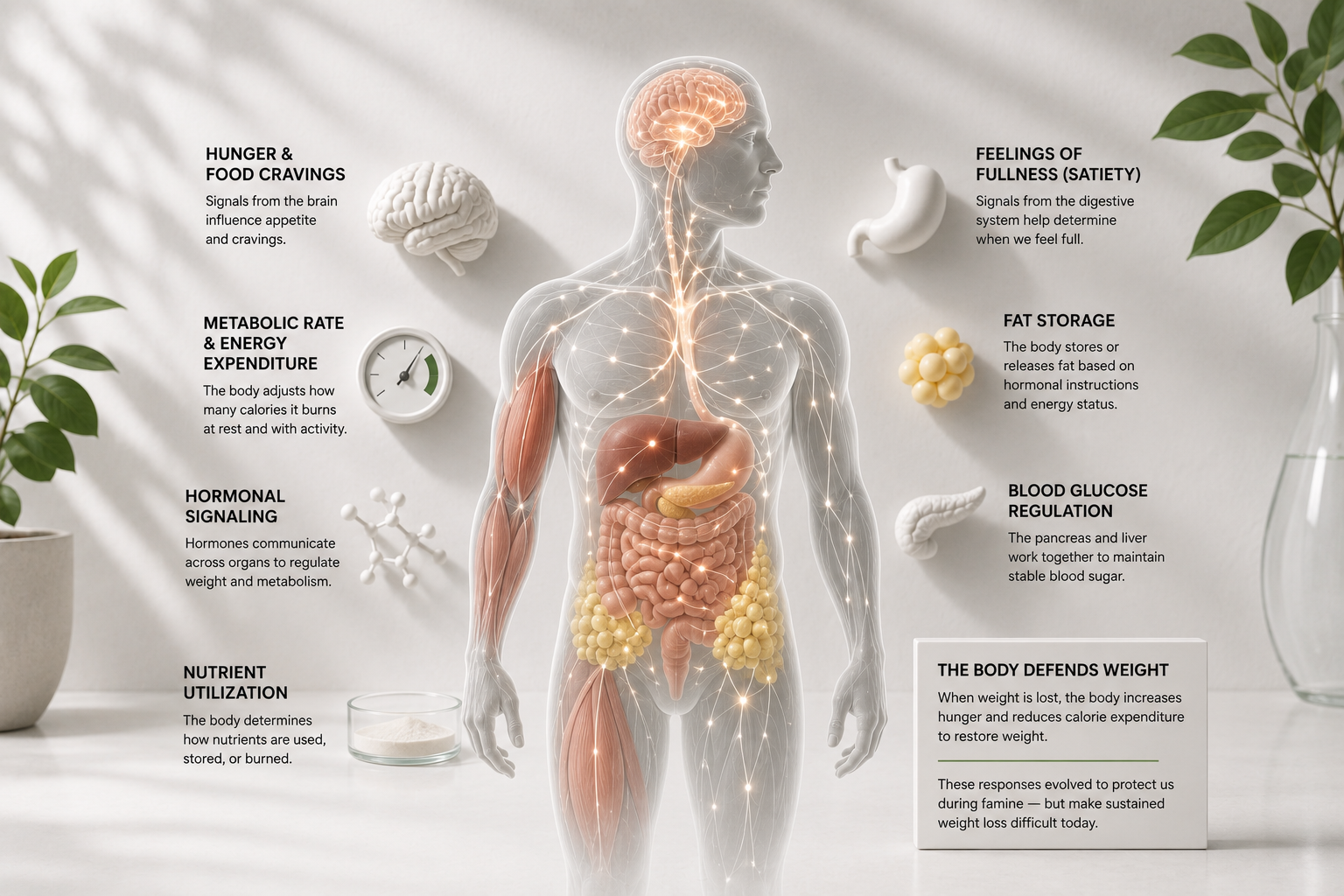
These biological systems evolved over hundreds of thousands of years to protect humans from starvation. In today's environment of readily available, calorie-dense foods and increasingly sedentary lifestyles, however, these same survival mechanisms often make sustained weight loss extraordinarily difficult.
Understanding these regulatory systems is the foundation of modern metabolic medicine. Before exploring how peptide therapies work, it is important to understand how the body normally controls body weight—and why that regulation can become disrupted.
Body Weight Is Actively Regulated
Many people imagine that body weight is simply the result of calories consumed minus calories burned. While energy balance certainly influences weight over time, this simplified equation overlooks the remarkable biological systems that continuously adjust both sides of that equation.
Every day, your body measures and integrates information from dozens of physiological signals, including:
Blood glucose concentrations
Nutrient availability
Gastrointestinal fullness
Hormonal signals from adipose tissue
Sleep quality
Physical activity
Stress hormones
Body temperature
Energy reserves
Circadian rhythms
This information is processed primarily within specialized regions of the hypothalamus, which functions as the body's central energy regulation center.
Rather than allowing body weight to fluctuate freely, the hypothalamus attempts to maintain energy balance within a relatively narrow range. When energy stores decline, multiple adaptive mechanisms are activated to restore body weight. When energy stores increase, opposing signals attempt to limit further weight gain.
These feedback systems are remarkably sophisticated and largely operate outside of conscious awareness.
The Hypothalamus: The Body's Metabolic Control Center
Deep within the brain lies a small structure called the hypothalamus. Although only a few cubic centimeters in size, it coordinates many of the body's most essential homeostatic processes, including temperature regulation, thirst, reproduction, hormone secretion, circadian rhythms, stress responses, and energy balance.
Within the hypothalamus are specialized neuronal populations that continuously receive information from throughout the body.
Some neurons stimulate hunger and food-seeking behavior.
Others promote satiety and reduce appetite.
These neurons respond to dozens of circulating hormones and nutrients, including:
Leptin
Ghrelin
GLP-1
GIP
Peptide YY (PYY)
Cholecystokinin (CCK)
Insulin
Glucose
Free fatty acids
Amino acids
Rather than relying on a single hormone, the hypothalamus integrates these signals simultaneously, allowing the brain to make continuous adjustments to energy intake and expenditure.
This dynamic communication network explains why appetite can change dramatically depending upon sleep, stress, illness, exercise, dietary composition, medications, and hormonal status.
Adipose Tissue Is an Endocrine Organ
One of the most significant discoveries in metabolic research has been the realization that body fat is biologically active.
For many years, adipose tissue was viewed simply as a storage depot for excess calories. We now know that fat cells produce dozens of signaling molecules known collectively as adipokines.
These include:
Leptin
Adiponectin
Resistin
TNF-α
IL-6
MCP-1
Numerous other inflammatory mediators
These signaling molecules communicate continuously with nearly every major organ system.
Healthy adipose tissue serves important physiological functions:
Long-term energy storage
Mechanical protection
Thermal insulation
Hormone production
Immune regulation
Nutrient buffering
As adipose tissue expands beyond its normal physiological capacity, however, its biological behavior begins to change.
Enlarged fat cells become increasingly inflamed, less responsive to insulin, and more likely to recruit immune cells such as macrophages. This chronic low-grade inflammatory state contributes to insulin resistance, endothelial dysfunction, altered lipid metabolism, and progressive metabolic disease.
Not all body fat behaves identically. Visceral adipose tissue, located deep within the abdominal cavity surrounding internal organs, is substantially more metabolically active than subcutaneous fat located beneath the skin. Excess visceral fat has been strongly associated with increased risks of cardiovascular disease, type 2 diabetes, fatty liver disease, hypertension, and systemic inflammation.
Understanding these differences helps explain why improvements in body composition—not simply reductions in body weight—are often a primary goal of metabolic therapy.
Hunger Is Controlled by Hormones
Feelings of hunger and fullness do not originate solely from the stomach. Instead, they arise from a complex interaction between the gastrointestinal tract, endocrine system, adipose tissue, and brain.
Several hormones play especially important roles in appetite regulation:
Ghrelin
Often referred to as the "hunger hormone," ghrelin is produced primarily within the stomach. Ghrelin concentrations typically rise before meals and fall after eating, stimulating appetite and encouraging food intake.
Sleep deprivation, caloric restriction, and prolonged dieting frequently increase circulating ghrelin concentrations, contributing to increased hunger during weight loss.
Leptin
Leptin is produced by adipose tissue and serves as a long-term indicator of stored energy reserves.
Under normal physiological conditions, increasing fat stores result in higher leptin concentrations, signaling the hypothalamus that sufficient energy is available and reducing appetite.
In many individuals with obesity, however, chronically elevated leptin concentrations are accompanied by reduced hypothalamic sensitivity—a phenomenon commonly referred to as leptin resistance.
Although leptin levels remain high, the brain behaves as though energy stores are inadequate, contributing to persistent hunger despite abundant fat reserves.
GLP-1
Glucagon-like peptide-1 (GLP-1) is released from specialized intestinal L cells following nutrient ingestion.
Unlike leptin, which reflects long-term energy storage, GLP-1 primarily provides meal-related information. It slows gastric emptying, enhances insulin secretion, suppresses glucagon release, and communicates with appetite centers within the brain to promote satiety.
Modern GLP-1 receptor agonists are designed to amplify these natural physiological signals and will be explored in detail in the following sections of this educational series.
More Than Willpower
Perhaps the most important lesson from modern obesity research is that successful weight management involves biology as much as behavior.
When individuals lose significant amounts of weight, the body does not simply accept its new size. Instead, it activates numerous compensatory mechanisms designed to restore previous energy stores. Hunger increases, resting metabolic rate often declines, and hormonal changes promote weight regain.
These responses are not signs of failure. They represent normal physiological adaptations that once improved survival during periods of famine.
Recognizing obesity as a disease of biological regulation has fundamentally changed modern treatment approaches. Rather than relying solely on calorie restriction, contemporary therapies increasingly focus on restoring normal hormonal communication between the brain, gastrointestinal tract, pancreas, adipose tissue, and peripheral organs.
This understanding provides the scientific foundation for peptide-based therapies such as GLP-1 receptor agonists, dual incretin agonists, and emerging multi-receptor metabolic treatments discussed throughout the remainder of this educational library.
Continue Your Learning
Now that you've explored how the body regulates weight, the next step is understanding one of the most important biological signaling systems involved in metabolism: the incretin system.
In the next article, we'll examine how GLP-1, GIP, and glucagon coordinate communication between the digestive tract, pancreas, liver, brain, and adipose tissue—and why these naturally occurring hormones have become the foundation of modern metabolic medicine.
→ Continue to: GLP-1 & Incretin Physiology
References
Bray GA, Kim KK, Wilding JPH. Obesity: A chronic relapsing progressive disease process. Obesity Reviews. 2017.
Blüher M. Obesity: global epidemiology, pathogenesis, and management. Nature Reviews Endocrinology. 2019.
Friedman JM. Leptin and the endocrine control of energy balance. Nature Metabolism. 2019.
Morton GJ, Meek TH, Schwartz MW. Neurobiology of food intake in health and disease. Nature Reviews Neuroscience. 2014.
Rosen ED, Spiegelman BM. What we talk about when we talk about fat. Cell. 2014.
Hall KD, Kahan S. Maintenance of lost weight and long-term management of obesity. Medical Clinics of North America. 2018.
Astrup A, et al. The role of leptin in human obesity and weight regulation. Nature Reviews Endocrinology. 2021.